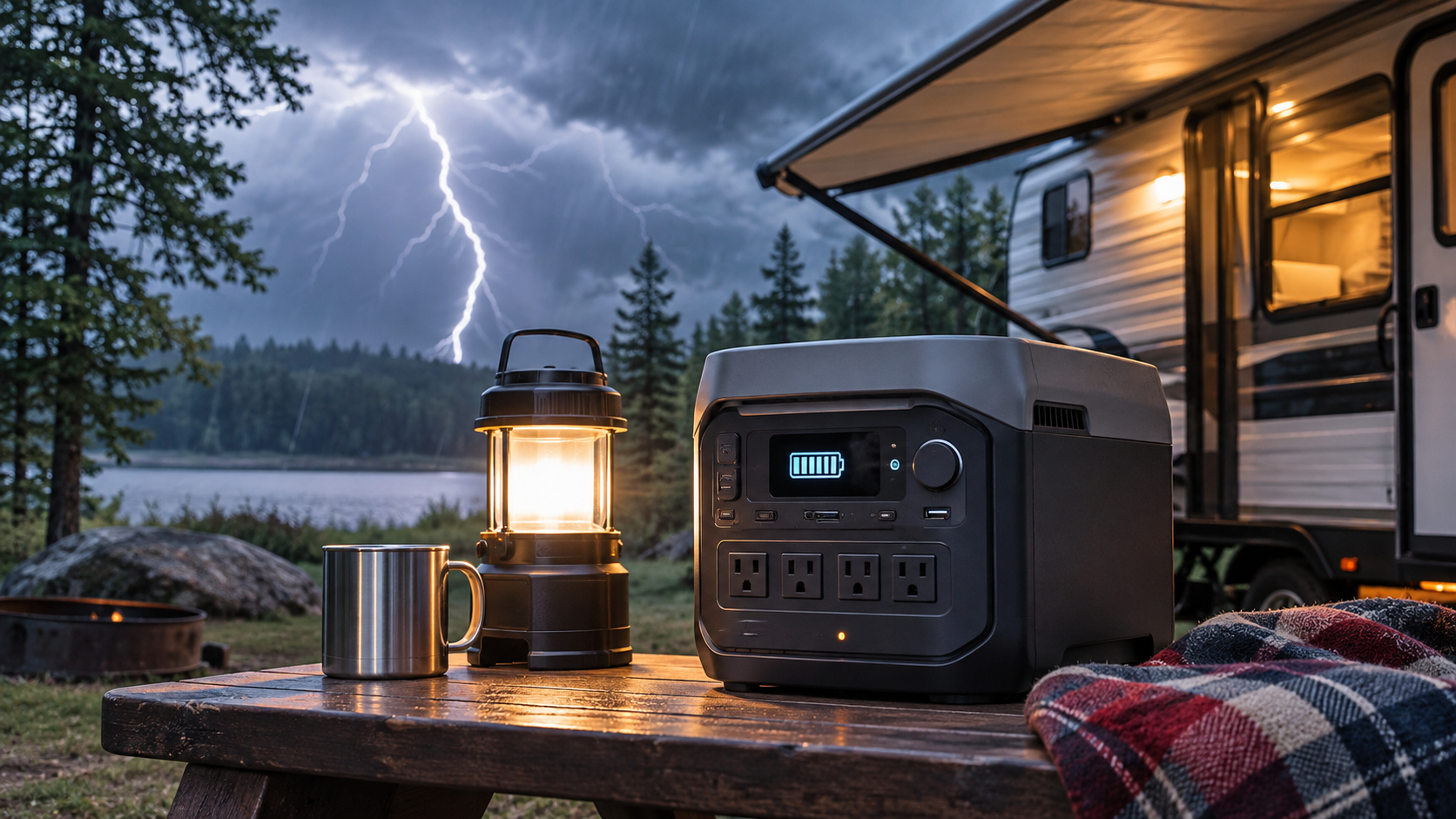


A storm can knock out campground hookups and shore power just when an RV or camper needs it most for refrigeration, lights, fans, and charging phones. Portable power keeps those essentials running without a grid connection, whether you’re parked at a campsite or riding out severe weather at home in your rig. The best option depends on what you need: an RV-ready outlet, a light and fast-charging power station, a fuel-powered backup for long outages, or solar to refill batteries once the clouds clear.
PowerOutage.us tracks more than 950 utilities serving over 200 million customers, about 95 percent of the country, and we consider outage patterns alongside our storm prep guidance to rank portable power stations for outages. An extended outage means days without hookups, and RV and camper owners need power that can be recharged on the road, at a campsite, or after a storm. The right setup pairs enough stored energy with more than one way to refill it.
How we ranked this portable power
These rankings draw on manufacturer specs, lab and owner reviews, and PowerOutage.us outage data.
The criteria below run from the factor we weighted heaviest to the one we weighted least.
- Capacity and output: First, because a unit has to store enough energy and deliver enough watts for the RV’s essentials.
- Recharge options: Second, because wall, solar, vehicle, and fuel charging decide how long power lasts when the outage drags on.
- RV compatibility: Third, because a 30-amp outlet, expandable capacity, or an RV-ready plug make setup simpler.
- Safety and durability: Fourth, because battery chemistry, carbon monoxide shutdown, and weather protection matter in storm conditions.
- Portability and value: Last, measured against the cost of a full outage kit.
Be aware that watt-hours measure how much energy a unit stores, while watts measure how much it can deliver at once. A big number on one doesn’t make up for a small number on the other, so check both against the largest appliance you plan to run.
5 Best portable power options for RVs and campers during storms
The five best options run from a 2,048 Wh RV-ready power station to a fuel-powered backup and a foldable solar panel.
1. Bluetti AC200L
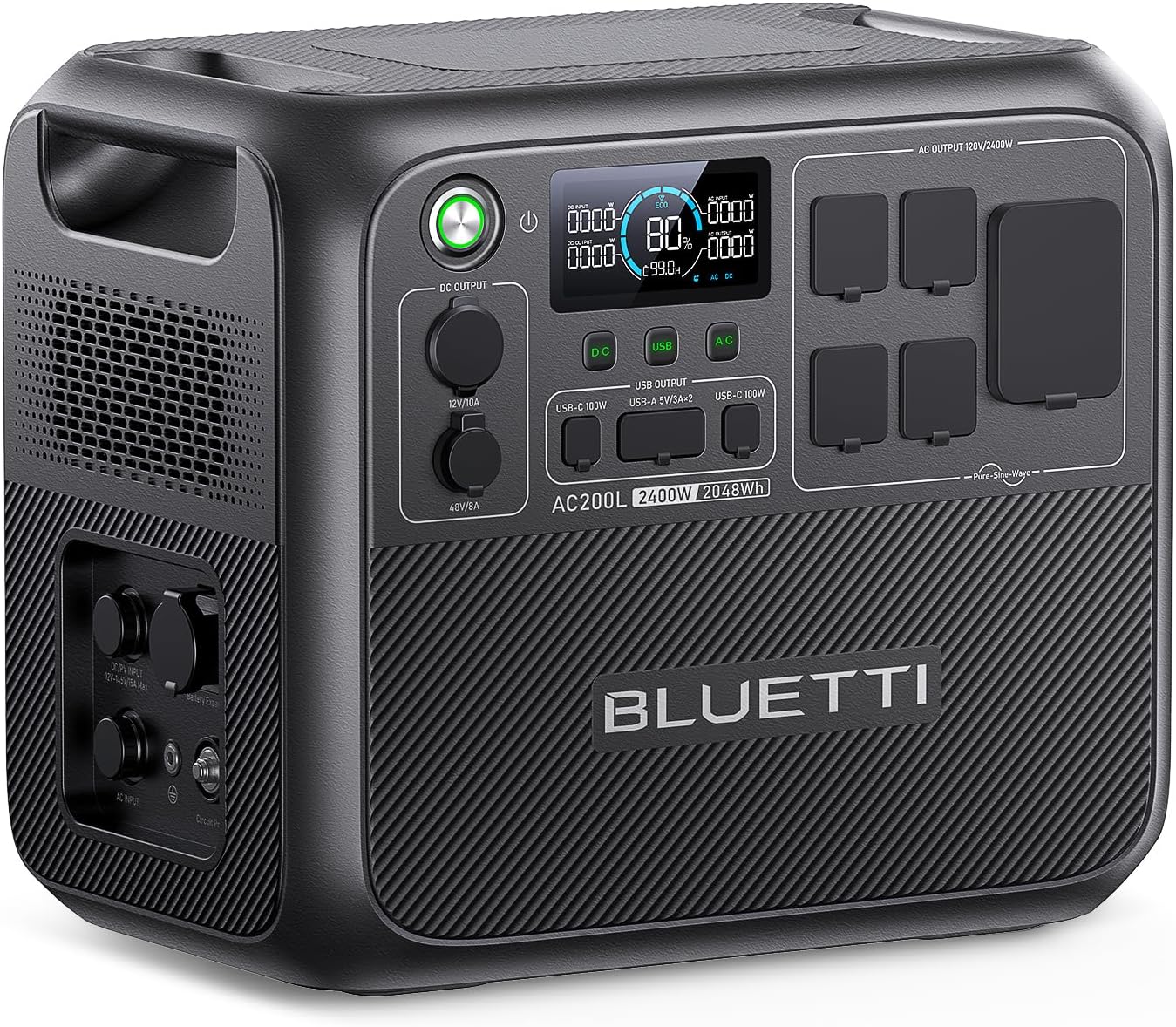
A 30-amp RV outlet, 2,048 Wh of LiFePO4 capacity, and 2,400 watts of output make the Bluetti AC200L the portable power station that plugs straight into most RVs.
Reach for the AC200L when the campground loses hookups or you’re riding out a storm in a travel trailer. The TT-30 outlet accepts a standard 30-amp RV cord, and expansion batteries raise capacity to as much as 8,192 Wh for a multi-day outage.
- Capacity: 2,048 Wh LiFePO4, expandable up to 8,192 Wh with B300 batteries
- Output: 2,400 W continuous, 3,600 W surge, in a pure sine wave
- Outlets: Four 120V/20A outlets and one 120V/30A NEMA TT-30
- Recharge: Up to 2,400 W from the wall, 1,200 W from solar, plus car charging
- Build: 61.6 lb, rated for 3,000+ cycles to 80% capacity
What are the Pros and Cons of the Bluetti AC200L?
Buy the Bluetti AC200L to power an RV through a storm via its 30-amp outlet. Skip it if you need something light enough to carry with one hand.
Pros
- Plugs into an RV through a 30-amp outlet.
- Expands to 8,192 Wh for multi-day outages.
- Recharges from the wall in about 90 minutes.
- Runs larger appliances at 2,400 watts.
Cons
- Weighs 61.6 pounds.
- Costs more than the smaller stations here.
- Limits a 50-amp RV to selected circuits.
2. Jackery Explorer 1000
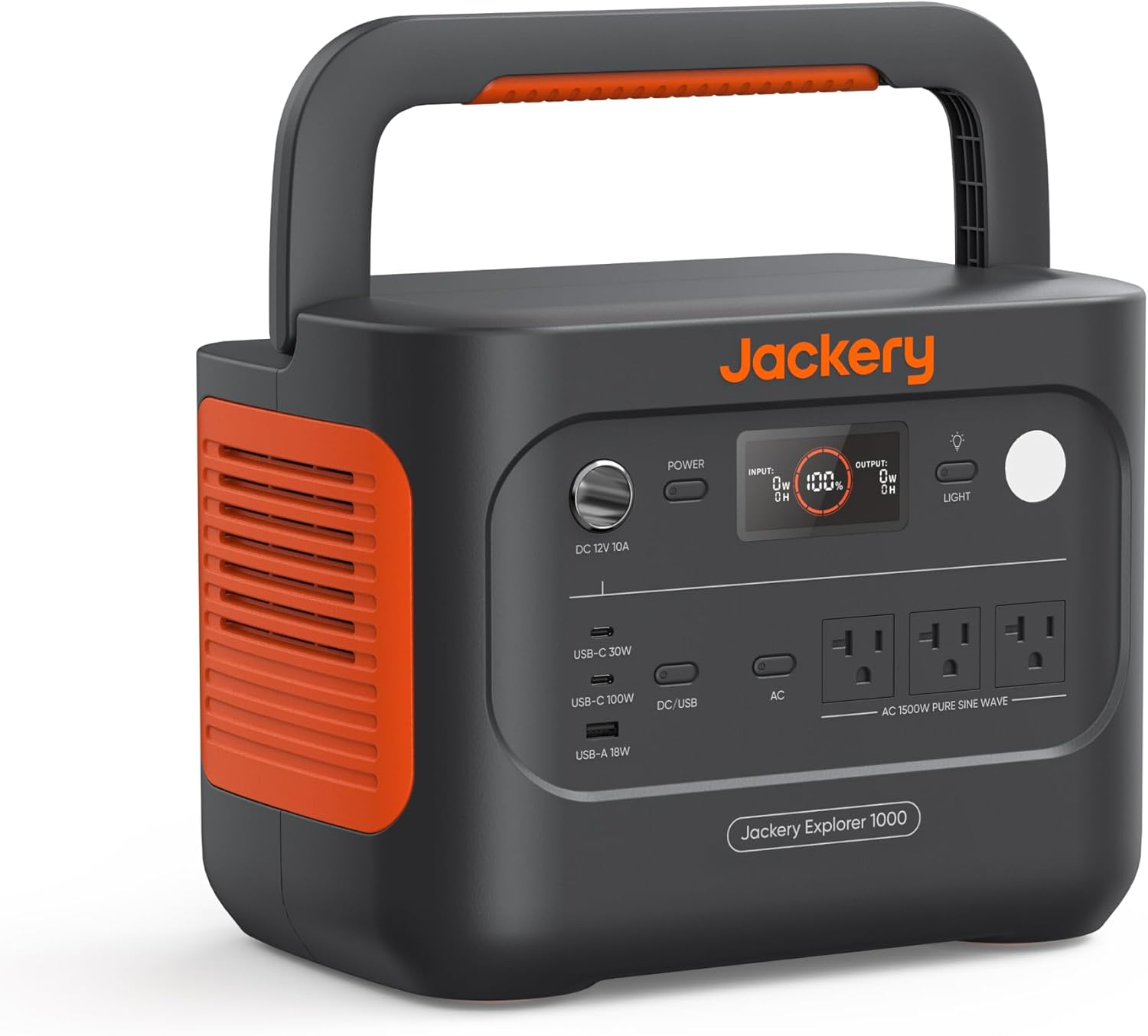
At 23.8 pounds with 1,070 Wh and 1,500 watts, the Jackery Explorer 1000 v2 is the power station that fits a camper, van, or small travel trailer.
Choose the Explorer 1000 v2 to keep a fridge, lights, a fan, a CPAP, and phones running through a storm night. It’s light enough to carry inside when the rain starts, and it recharges from the wall in under two hours.
- Capacity: 1,070 Wh LiFePO4
- Output: 1,500 W rated, 3,000 W surge, with three AC outlets
- Recharge: About 1.6 hours from the wall, up to 400 W from solar
- Ports: Dual USB-C (one at 100 W), USB-A, and a 12V car port
- Build: 23.8 lb, rated for 4,000 cycles to 70% capacity
What are the Pros and Cons of the Jackery Explorer 1000 v2?
Buy the Jackery Explorer 1000 v2 to keep a camper’s essentials running with a power station you can carry. Skip it if you want to run an RV air conditioner or need a 30-amp outlet.
Pros
- Weighs just 23.8 pounds.
- Recharges from the wall in about 1.6 hours.
- Lasts 4,000 cycles.
- Accepts up to 400 watts of solar.
Cons
- Can’t run a large air conditioner.
- Has no 30-amp RV outlet.
- Needs to stay dry, since it isn’t weatherproofed.
3. EcoFlow DELTA 3
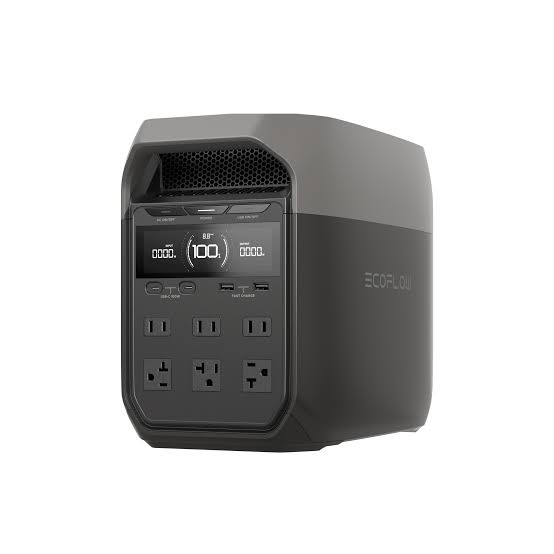
A 0 to 80 percent recharge in 45 minutes, 1,800 watts of output, and expandable capacity make the EcoFlow DELTA 3 a strong choice when you only get a short window of power between storm bands.
Choose the DELTA 3 if your power comes and goes, or if you'll refill from a generator or campground outlet for an hour at a time. It recharges quickly, accepts up to 500 watts of solar, and can expand from 1,024Wh to 5,000Wh with additional batteries.
- Capacity: 1,024 Wh LiFePO4, expandable to 5,000 Wh with extra batteries
- Output: 1,800 W rated, 3,600 W surge, with X-Boost for loads up to 2,200 W
- Recharge: 0 to 80% in 45 minutes and a full charge in approximately 56 minutes from the wall
- Solar: Up to 500 W input
- Build: Approximately 27.6 lb, rated for 4,000 cycles to 80% capacity
What are the Pros and Cons of the EcoFlow DELTA 3?
Buy the EcoFlow DELTA 3 if you want fast recharging, expandable capacity, and enough output to handle most essential household electronics and appliances during an outage. Skip it if you need a 30-amp RV outlet or a larger built-in battery.
Pros
- Recharges from 0 to 80% in approximately 45 minutes.
- Expandable up to 5,000Wh with additional batteries.
- Accepts up to 500 watts of solar input.
- Handles loads up to 2,200 watts with X-Boost.
Cons
- Weighs approximately 27.6 pounds, making it less portable than smaller power stations.
- Holds only 1,024Wh on its own.
- Offers standard AC outlets but no 30-amp RV port.
4. Honda EU2200i Companion

A 30-amp RV plug, up to 8.1 hours per tank, and CO-MINDER carbon monoxide shutdown make the Honda EU2200i Companion the backup for storms that outlast your batteries.
A 30-amp RV plug, up to 8.1 hours per tank, and CO-MINDER carbon monoxide shutdown make the Honda EU2200i Companion the backup for storms that outlast your batteries.
Choose the Companion when the outage runs longer than a battery can cover and you have a safe place to store fuel. Honda says it can pair with a standard EU2200i to run an RV air conditioner of up to 15,000 BTU.
- Output: 2,200 W max, 1,800 W rated
- Receptacles: One 20A 120V outlet and one 30A 125V locking RV plug
- Runtime: 3.2 hours at rated load, 8.1 hours at one-quarter load on 0.95 gallons
- Noise: 48 to 57 dB(A)
- Build: 47.4 lb, CO-MINDER shutdown, Bluetooth app
What are the Pros and Cons of the Honda EU2200i Companion?
Buy the Honda EU2200i Companion to keep an RV running for days on gasoline. Skip it if you can’t store fuel safely or want silent power you can use indoors.
Pros
- Keeps running as long as you have fuel.
- Connects to an RV through a 30-amp plug.
- Runs quietly for a generator.
- Shuts off automatically if carbon monoxide builds up.
Cons
- Burns gasoline you have to store and refill.
- Must run outdoors, well away from the RV.
- Must run outdoors, well away from the RV.
5. Jackery SolarSaga 200W
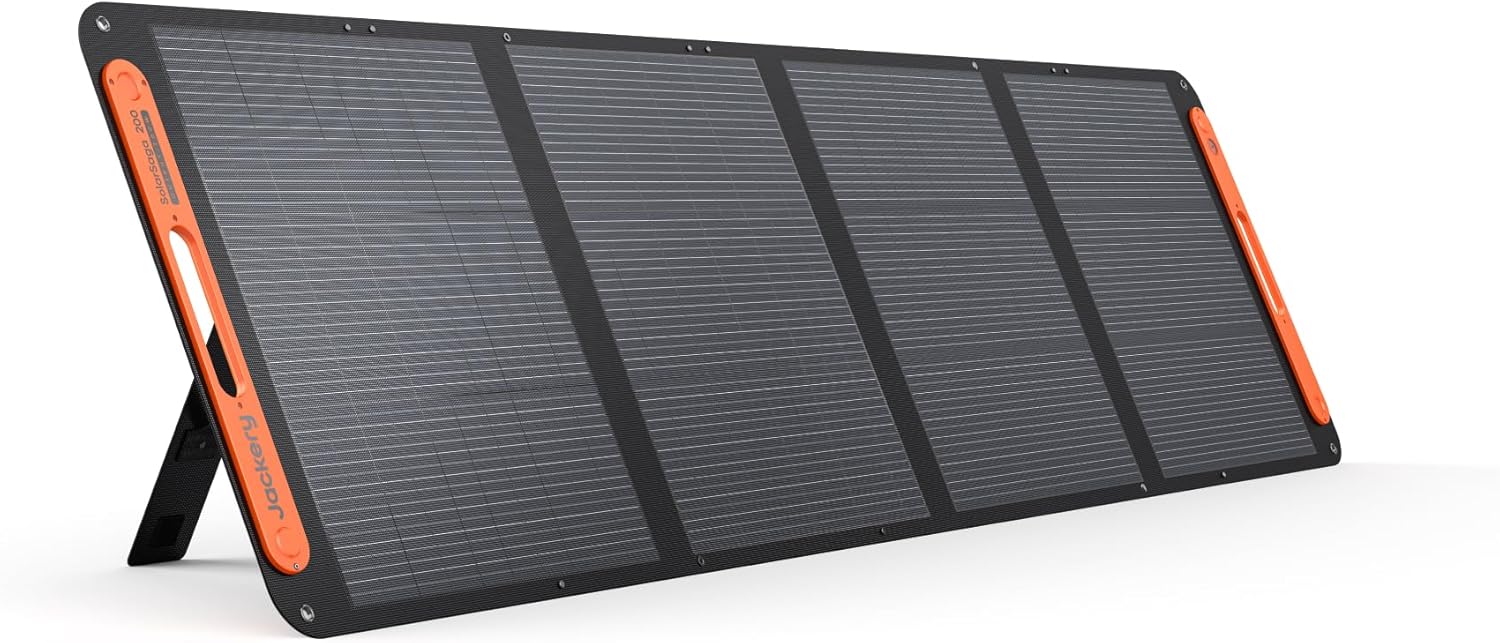
A 200-watt bifacial panel that folds flat and carries an IP68 waterproof rating makes the Jackery SolarSaga 200W the way to refill a power station once the storm passes.
Choose the SolarSaga 200W to recharge a power station when skies clear, at a campsite or beside the RV. Two panels can recharge the Explorer 1000 v2 in about 3.8 hours of ideal sun.
- Power: 200 W peak, with efficiency up to about 25%
- Design: Foldable and bifacial, with adjustable stands
- Build: IP68 waterproof with an ETFE-laminated surface, about 14.3 lb
- Cable: 3-meter cable with a DC8020 adapter
- Pairs with: Jackery Explorer stations, with adapters needed for other brands
What are the Pros and Cons of the Jackery SolarSaga 200W?
Buy the Jackery SolarSaga 200W to recharge a Jackery power station when the sky clears. Skip it if you plan to rely on a generator and don’t want to set up panels.
Pros
- Resists rain and dust with an IP68 rating.
- Folds flat for storage.
- Captures reflected light with bifacial cells.
- Includes a 3-meter cable.
Cons
- Produces far less under storm clouds.
- Recharges slowly on its own.
- Needs adapters for non-Jackery stations.
Power outages and why backup power matters for RV owners
In 2024, Hurricane Helene knocked out power for 4.79 million customers, and parts of western North Carolina sat dark for 14 days. Campground hookups and nearby services can go dark for as long, which makes stored energy and a way to recharge it essential.
In January 2026, Winter Storm Fern left over 1 million customers across the South dark for up to six days. Short winter days leave solar panels with less to collect, so a station with fast wall charging, or a generator as a backup, is what carries a rig through a stretch like that.
How to choose portable power for an RV or camper
Choosing the right option involves comparing capacity, output, and recharge methods.
- Size capacity in watt-hours to what you’ll run, and size output in watts to your largest appliance.
- Check the plug type. A 30-amp TT-30 outlet connects to an RV cord, while a 50-amp rig usually needs adapters and can power only selected circuits from a station.
- Plan more than one way to recharge: the wall, a vehicle, solar, or a generator. Our solar power bank guide covers smaller solar options.
- Look for LiFePO4 batteries, which offer thousands of charge cycles.
- Keep power stations dry and indoors during storms, and keep generators outdoors, at least 20 feet from the RV, with carbon monoxide alarms inside.
- Charge everything to full before the storm, and keep a portable power station topped off year-round.
Quick Recap
The Bluetti AC200L is the best overall portable power for RVs during storms, with the Jackery Explorer 1000 v2 offering a lighter option for campers and vans. The EcoFlow DELTA 2 recharges the fastest when power comes and goes, while the Honda EU2200i Companion provides fuel-powered backup for long outages and the Jackery SolarSaga 200W refills a Jackery station once the clouds clear. Consider combining a power station, a generator, and solar panels so you’re prepared for storms of any length.