

Our rankings sit on PowerOutage.us data. We track more than 950 utilities that serve over 200 million customers, roughly 95 percent of the country, and we pair that record with our storm prep guidance. During a multi-day outage, your phone becomes the alert system, the phone book, and the map, so the device that charges it matters.
Start with one fact that the marketing skips. Cranking recharges a phone at a crawl. The handle keeps a radio talking and a light burning, and it buys a single emergency call, but a full phone charge comes from a solar panel under real sun or a power bank you charged before the lights went out.
How we ranked these emergency chargers
These rankings come from manufacturer specs, owner and published reviews, and PowerOutage.us outage data. The criteria below run from the factor we weighted heaviest to the one we weighted least.
- Real phone-charging ability: First, because a crank only trickles, a solar panel does the actual charging, and a power bank holds the charge you banked.
- Reliability and build: Second, because a charger that cracks in a storm protects nobody.
- NOAA weather alerts: Third, because that radio band may deliver the only warning you get, and an automatic alert beats one you have to tune.
- Emergency extras: Fourth, because a flashlight, an SOS beacon, and a siren each earn their place when the power quits.
- Value: Last, measured against the cost of a full outage kit (which often includes a hand crank and charging device) rather than the sticker alone.
5 best hand-crank and solar phone chargers for emergencies
The five picks below stretch from an all-in-one crank radio to a bare folding panel built only to charge fast.
1. Midland ER310
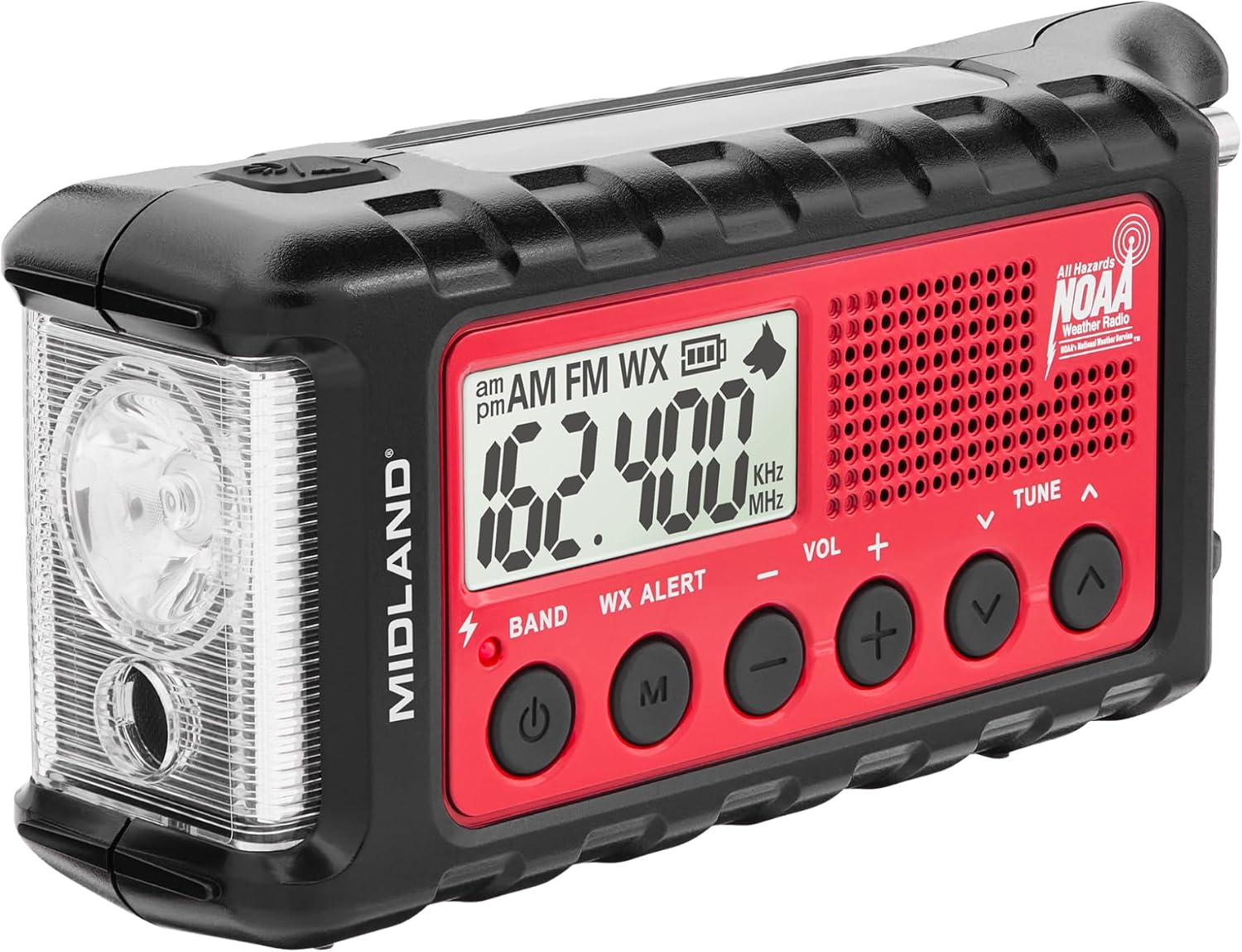
Four charging inputs, an automatic NOAA alert, a 2,600 mAh cell, and a 130-lumen beam make the Midland ER310 the most complete emergency charger here.
Reach for the ER310 when one device has to cover alerts, light, and a phone in a pinch. The weather alert arms itself, no tuning required, and the CREE flashlight doubles as an SOS beacon. The 2,600 mAh cell holds enough to power a call, though it stops short of a full recharge.
- Battery: 2,600 mAh cell, charged by crank, solar, USB, or 6 AA
- Weather radio: Automatic NOAA alert, no manual tuning
- Light: 130-lumen CREE flashlight with SOS beacon
- Phone charging: USB-A output
- Crank yield: One minute of cranking powers roughly 26 minutes of radio
Pros
- Arms NOAA alerts automatically.
- Charges from crank, solar, USB, and AA cells.
- Throws a 130-lumen beam and an SOS signal.
- Takes a beating and keeps working.
Cons
- Recharges a phone at a trickle off the crank.
- Holds a mid-size cell, short of a full charge.
- Prices above plain crank radios.
What buyers report
Verified owners on Amazon single it out as the do-everything pick and credit the self-arming alert and the flashlight. They repeat one caution: the handle barely moves a phone, so charge from solar or USB to fill one.
Should you buy it?
Choose the ER310 to run alerts, lights, and backup power from a single unit. Skip it if you only care about charging a phone quickly, where a portable solar panel or power bank pulls ahead.
2. RunningSnail MD-090P
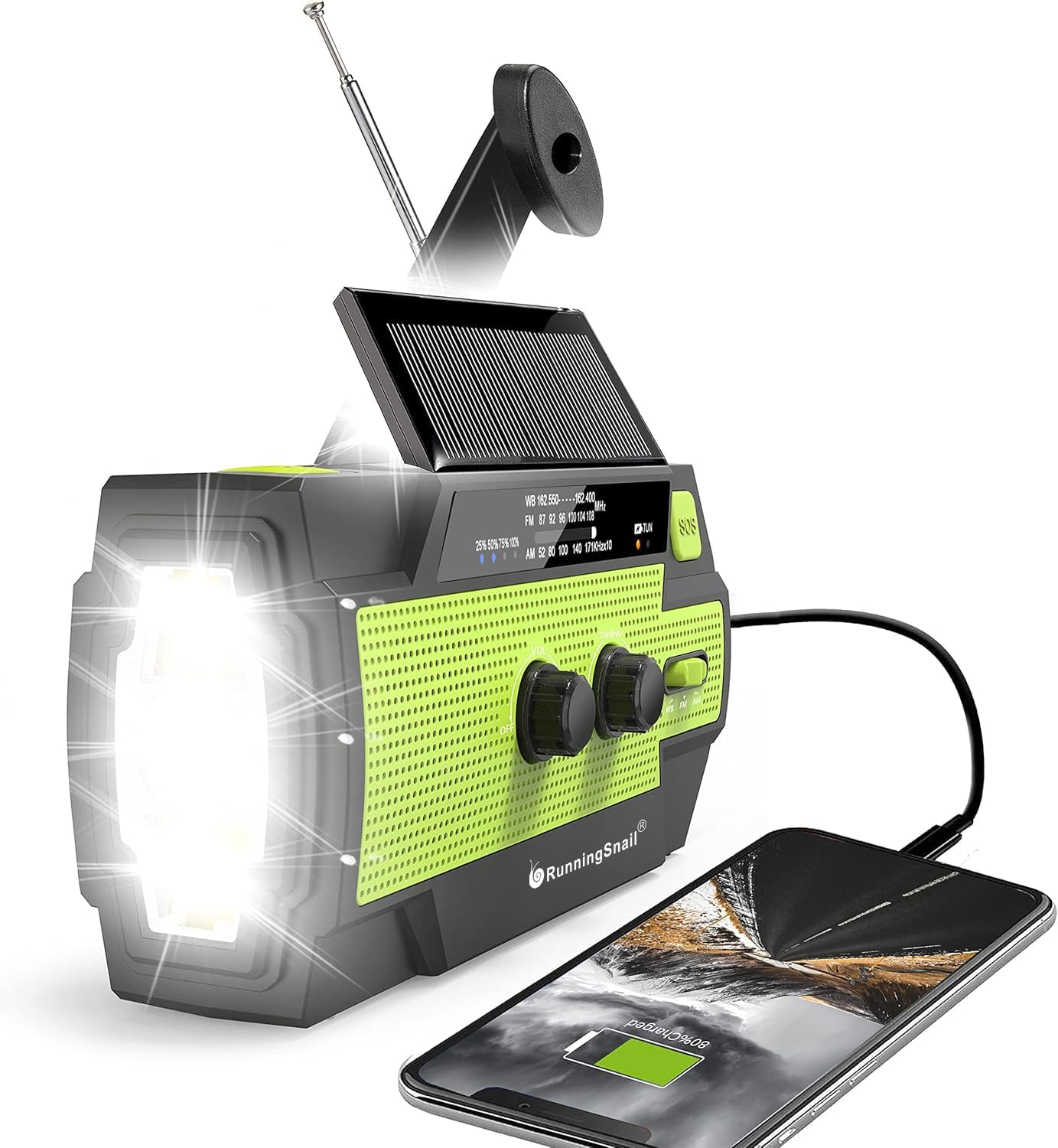
A 4,000 mAh cell, crank-and-solar input, and a low price make the RunningSnail MD-090P the bargain that still recharges a phone once.
Buy the MD-090P to bank the most milliamp-hours per dollar. One full charge recharges a phone about once; the NOAA band brings in the forecast, and the three-mode flashlight pairs with a reading lamp for camp light.
- Battery: 4,000 mAh cell, the largest in its price class
- Charging: Crank, solar, and USB
- Weather radio: NOAA band, tuned by hand
- Light: Three-mode flashlight plus reading lamp
- Phone charging: Recharges a phone roughly once
Pros
- Packs a large cell for the money.
- Recharges a phone about once per charge.
- Charges from crank, solar, and USB.
- Lights both a flashlight and a lamp.
Cons
- Weather band tunes manually.
- Builds to a budget standard.
- Cranks at a trickle like the rest.
What buyers report
Reviewers point to the price and the oversized cell and call it brand-name capacity for less. Their gripes stay minor: a plain build and a dial you work by hand.
Should you buy it?
Pick the MD-090P for the cheapest crank radio that still recharges a phone. Pass if you want a self-arming alert or a tougher shell.
3. BLAVOR Solar Power Bank
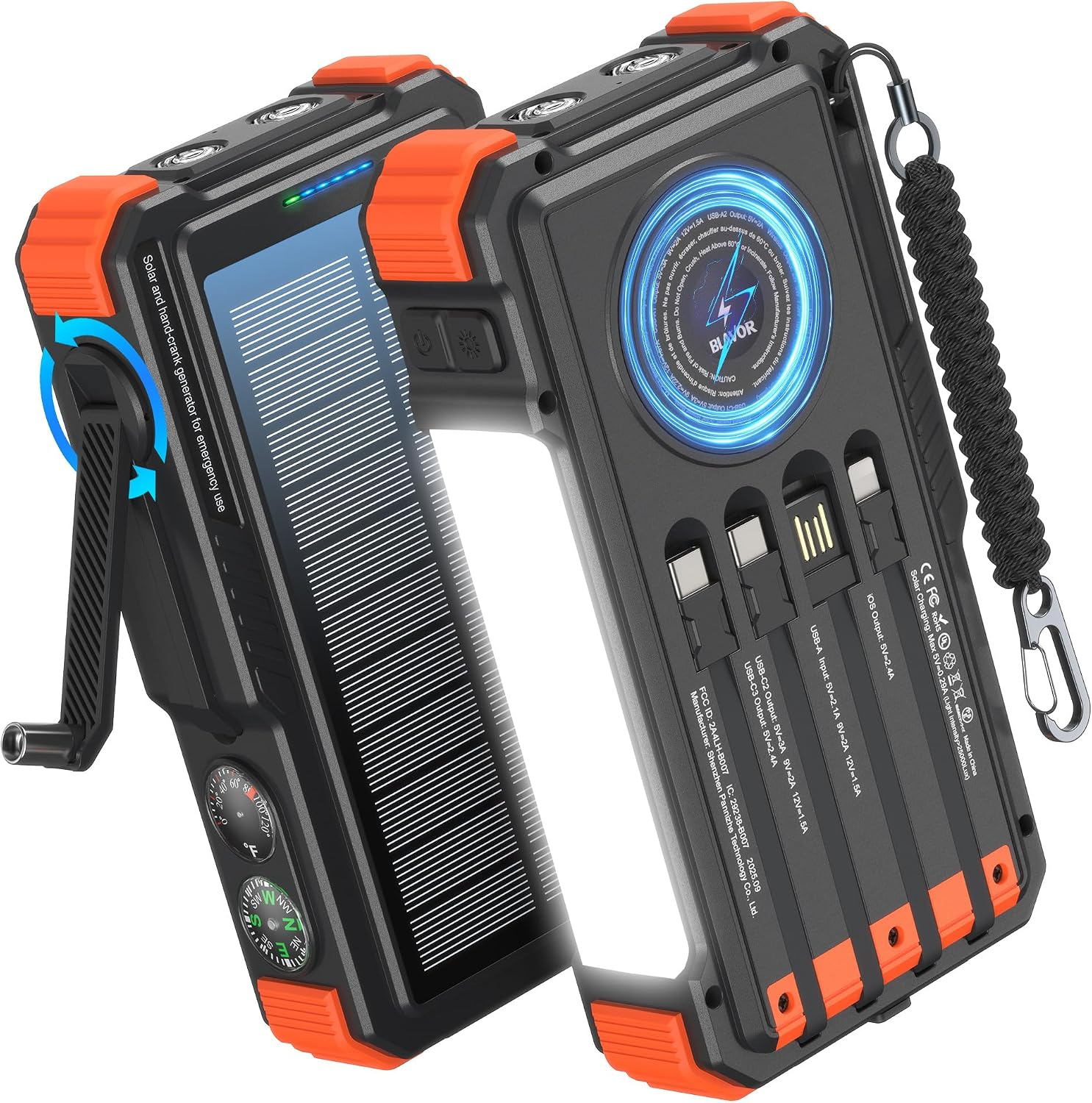
A 20,000 mAh cell, 20-watt USB-C, wireless charging, and a backup crank let the BLAVOR Solar Power Bank recharge a phone about four times.
Treat the BLAVOR as a charger first and a radio not at all. Top it off at the wall before a storm, and it powers four-plus phone recharges, with the crank and solar panel standing by once the grid quits and the wall outlet dies.
- Battery: 20,000 mAh cell
- Charging: Crank, solar, 20-watt USB-C PD, and wireless pad
- Cables: Four built-in cables, power up to seven devices
- Light: Built-in camping light
- Phone charging: Recharges a phone about four times
Pros
- Offers the most phone recharges in this lineup.
- Charges a phone fast over a 20-watt USB-C.
- Carries its own cables and a wireless pad.
- Falls back to crank and solar for backup.
Cons
- Recharges its own cell slowly from cranking or the sun.
- Needs a wall charge before the storm.
- Carries no weather radio.
What buyers report
Buyers rate it as the capacity pick that recharges phones again and again, with crank and solar as insurance. One note recurs: a cell this large fills slowly from the panel or handle, so charge it at the wall first.
Should you buy it?
Get the BLAVOR to keep phones and small devices running for days. Skip it if you need a weather radio or expect to recharge it entirely from sunlight. Our solar power bank guide covers the category in depth.
4. BigBlue 28W Solar Charger
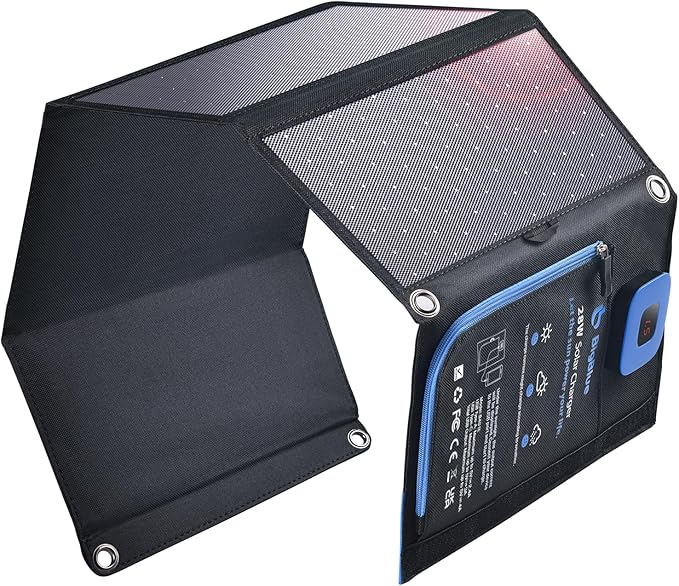
A 28-watt folding panel rated at 25.4 percent efficiency lets the BigBlue charge a phone at near wall speed whenever the sun is out.
Choose the BigBlue 28W for a sunny outage that runs past a single day. It stores nothing on its own, so combine it with a power bank, but unfolded under direct light, it pushes current into a phone as fast as a wall charger.
- Panel: 28-watt folding panel, 25.4 percent efficiency
- Outputs: USB-A and USB-C
- Meter: Built-in ammeter reads live output
- Build: Water-resistant, folds flat
- Phone charging: Near wall charging speed in direct sun
Pros
- Charges a phone fast in direct light.
- Reports live current on the ammeter.
- Drives two USB outputs together.
- Sheds water and folds flat to pack.
Cons
- Stores no charge of its own.
- Spreads wide when unfolded.
- Stalls without direct sun.
What buyers report
Reviewers praise the honest output and the ammeter that proves it, naming it the panel that actually recharges a phone outdoors. The standing caveat: it holds no battery, so carry a power bank alongside it.
Should you buy it?
Buy the BigBlue 28W to charge a phone off-grid through a long, sunny stretch. Skip it if you need power after dark or want one unit with a battery inside.
5. Sangean MMR-88
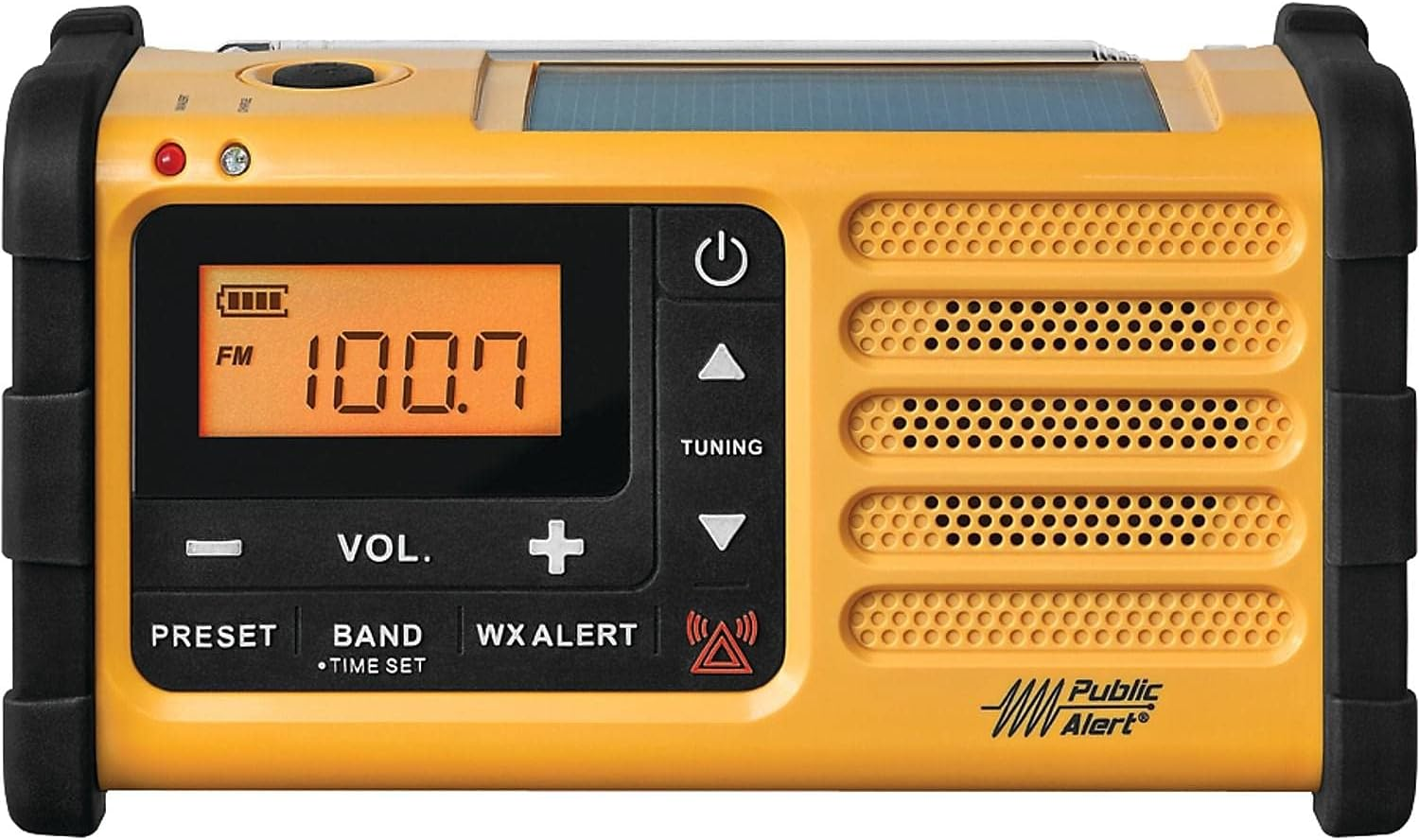
A rugged shell, the strongest reception here, and an 850 mAh LFP cell make the Sangean MMR-88 the radio you trust on weak signals.
Carry the MMR-88 when the radio has to take a drop and still pull a station from a faint broadcast. The 850 mAh cell stays small on purpose, so run it as a radio that tops off a phone rather than a charger that fills one.
- Battery: 850 mAh LFP cell
- Charging: Crank, solar, and USB
- Weather radio: NOAA alert with the best reception here
- Build: Rugged shell, LED light, and siren
- Crank yield: One minute of cranking powers about five minutes of radio
Pros
- Shrugs off drops and rough handling.
- Locks onto weak and distant signals.
- Holds a durable LFP cell.
- Adds an LED light and a siren.
Cons
- Has the smallest cell in this group.
- Works as a radio first, a charger second.
- Costs above budget crank radios.
What buyers report
Owners rank it the toughest unit with the clearest reception, a radio that lasts. Their one limit: the small cell tops a phone off rather than fills it.
Should you buy it?
Pick the MMR-88 for the most rugged, best-receiving radio with a phone top-off on the side. Pass if you need real charging capacity in your hand.
Power outages and why a charged phone matters
In 2024, Hurricane Helene knocked out power for 4.79 million customers, and pockets of western North Carolina stayed dark for 14 days straight. Across those two weeks, a phone was often the one line to alerts, family, and rescue.
And that October, Hurricane Milton tore into Florida and cut power for 3.4 million customers. An outage measured in days is exactly where a crank falls short and where solar paired with a charged power bank keeps a phone alive.
How to choose a hand-crank and solar phone charger
Choose a hand crank charger by deciding what type of features you want, looking at capacity, and considering NOAA alerts.
- Decide what you want. To charge a phone, build around solar and a power bank. For alerts and light, a crank radio is enough.
- Assemble a kit, not a hero device. A crank radio handles alerts, a folding panel charges by day, and a power bank covers the rest, per our outage kit advice.
- Favor automatic NOAA alerts so the radio warns you without a dial.
- Size the capacity to the need. Higher mAh means more phone recharges.
- Confirm the build and water resistance for your conditions, and fold in a medical device plan if anyone depends on one.