

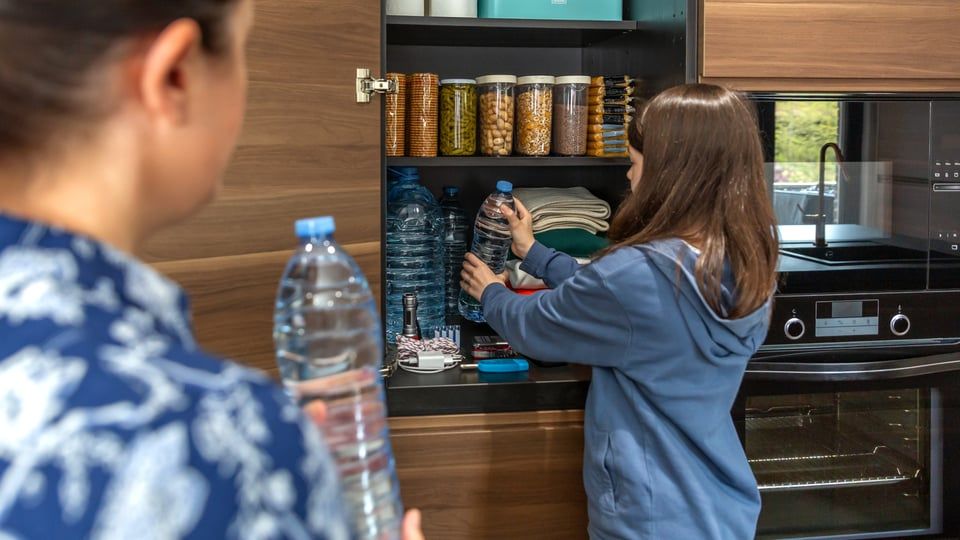


PowerOutage.us tracks more than 950 utilities serving over 200 million customers, about 95 percent of the country. That outage data shapes how we rank water filters and emergency food kits, so you buy the right gear before tap water fails, not after.
How we ranked these emergency water filters
We ranked these water filters on manufacturer specs, along with aggregated owner and published reviews. We also consider our own PowerOutage.us outage data for duration and conditions when reviewing filter functionality.
Here's what we weighted, heaviest first:
- Pathogen removal: We weighted pathogen class heaviest because a filter that stops bacteria but passes viruses can fail you after a flood.
- Filter lifespan: We favored filters that treat thousands of liters, because a multi-day outage rewards capacity you don't have to ration.
- Output and format: We matched each pick to a household job, from a countertop system to a straw in a go-bag.
- Owner-reported reliability: We read owner reviews for leaks, clogs, and failures, because an emergency is the wrong time to find them.
- Value: We compared price against lifespan, including what replacement cartridges cost.
How these emergency water filters compare
Compare our water filter picks.
| Water filter | Pathogen removal | Filter lifespan | Output format | Approx price |
|---|---|---|---|---|
| LifeStraw Personal | Bacteria, parasites | 4,000 L | Straw, drink directly | $15 |
| Sawyer Squeeze | Bacteria, protozoa | 100,000 gal | Up to 1.7 L per minute squeeze | $40 |
| Grayl GeoPress | Bacteria, protozoa, viruses | 250 L per cartridge | 24 oz in 8 seconds | $100 |
| Big Berkey | Bacteria, protozoa, virus reduction historically claimed | 3,000 gal per element pair | 2 to 3 gallons per hour countertop | $330 |
Prices are approximate since they often change.
The best emergency water filters and purifiers
These four picks cover the whole range, from a $15 straw for a glovebox up to a countertop system that treats gallons at a time.
1. LifeStraw Personal
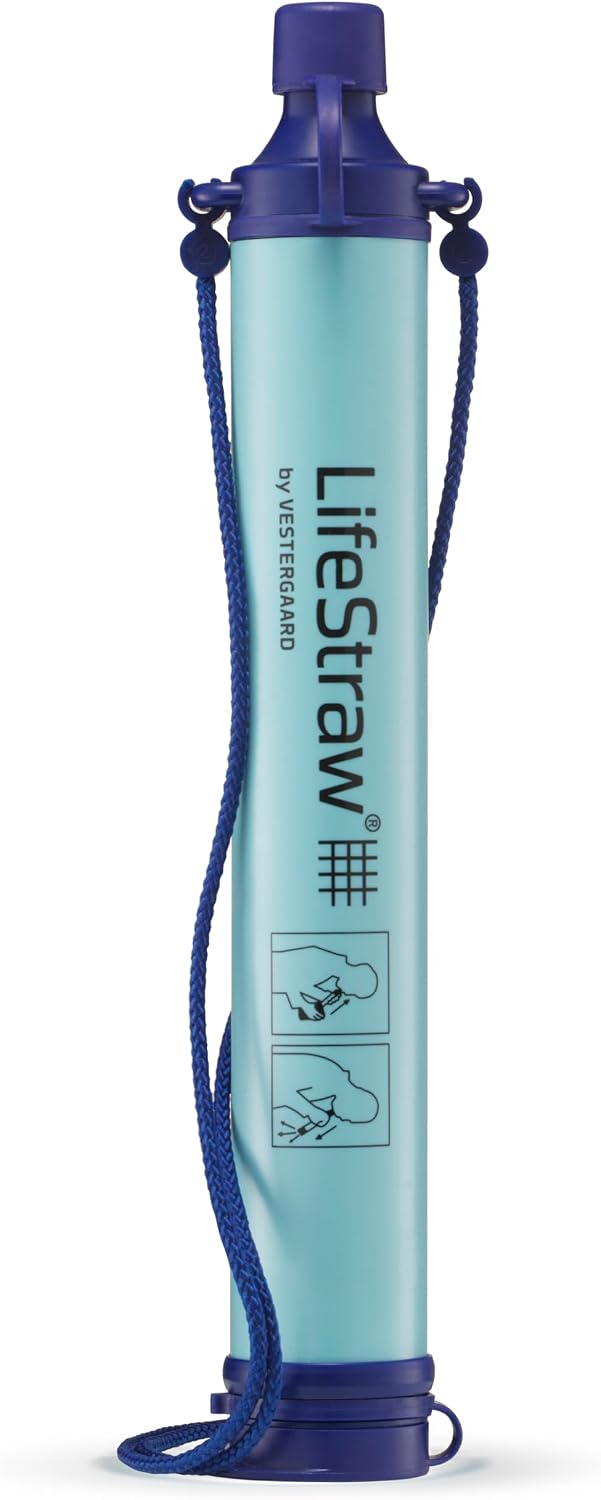
The LifeStraw Personal filters 4,000 L of water through a 0.2 micron membrane for about $15, and it weighs under 2 oz.
Anyone building an emergency kit gets the most from this pick. You should choose the LifeStraw Personal if you want one cheap, reliable filter in every glovebox, desk drawer, and go-bag, with no setup and nothing to charge.
- Removes 99.999999% of bacteria, 99.999% of parasites, and 99.999% of microplastics
- 0.2 micron membrane, does not remove viruses
- 4,000 L filter lifespan, about 1,000 gallons
- Straw format, drink straight from the source
- Under 2 oz, fits a glovebox, desk drawer, or coat pocket
Pros
- Costs about $15.
- Weighs under 2 oz.
- Needs no setup, spares, or maintenance.
- Stores for years.
Cons
- No virus removal.
- Sipping takes real effort.
- Stores no water, so you drink at the source.
LifeStraw Personal reviews
Owners rate the LifeStraw Personal 4.8 stars across more than 124,000 ratings, one of the most-reviewed filters on Amazon. Buyers like the size and price for emergency kits. Complaints center on the hard sipping effort.
Should you buy the LifeStraw Personal?
You should buy the LifeStraw Personal if you want the cheapest, most versatile backup layer for kits, vehicles, and everyday carry. You should pass on it if you need water for a full household at once, where a gravity system or bottle purifier treats more water per session.
2. Sawyer Squeeze
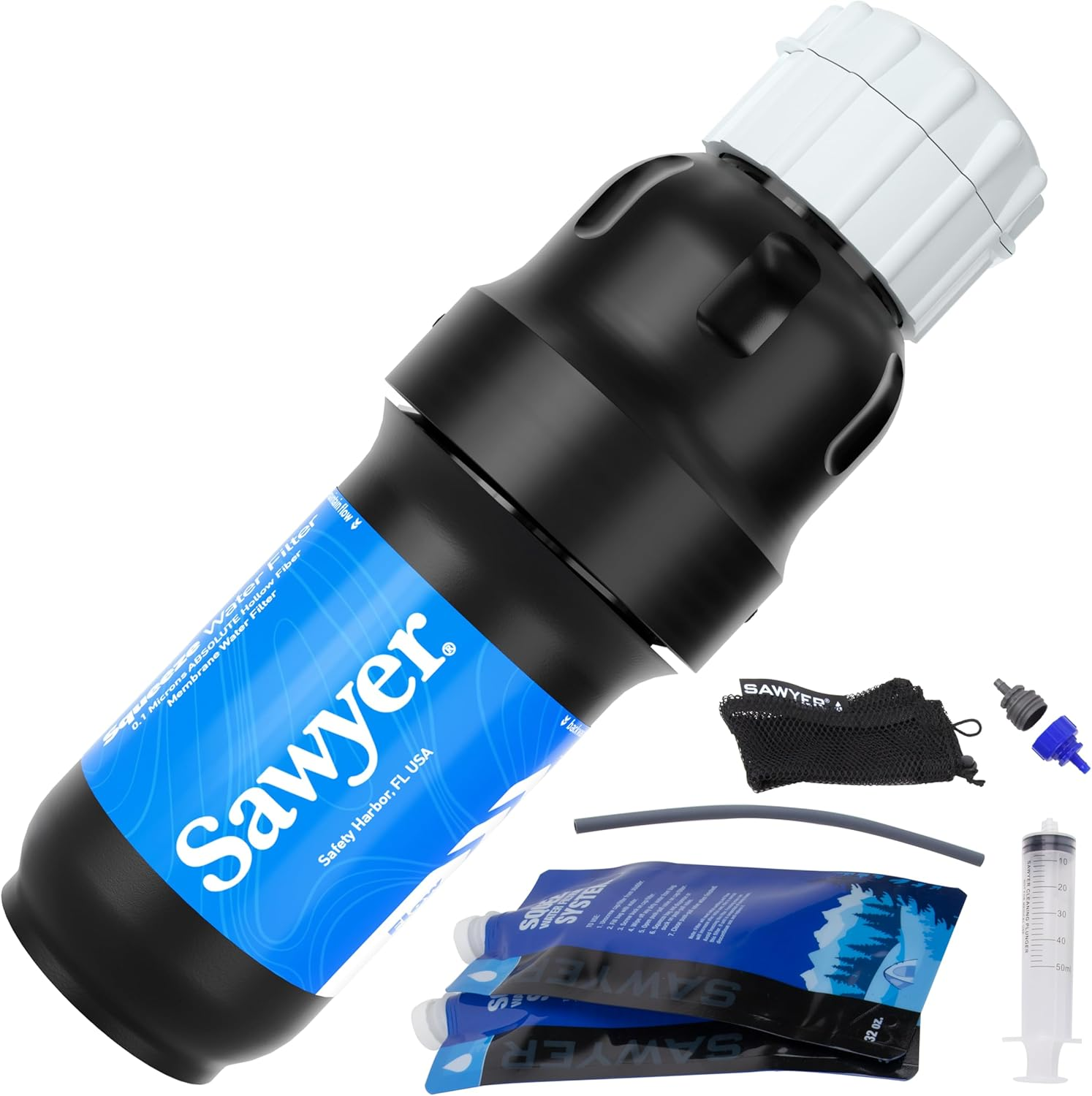
The Sawyer Squeeze filters up to 100,000 gallons through a 0.1 micron membrane for about $40, the best lifespan per dollar here.
Budget-first buyers and hikers already know this filter. You should consider the Sawyer Squeeze if you want one cheap, proven filter that outlives every other pick on this list.
- Removes 99.99999% of bacteria and 99.9999% of protozoa
- 0.1 micron absolute hollow-fiber membrane
- Rated up to 100,000 gallons
- Up to 1.7 L per minute when squeezing
- 3 oz total, with one 16 oz and two 32 oz pouches
Pros
- Rated for 100,000 gallons.
- Costs about $40.
- Weighs 3 oz.
- Proven on thousands of hiking trails.
Cons
- No virus removal.
- The included pouches wear out long before the filter does.
Sawyer Squeeze reviews
Owners on Amazon rate the Sawyer Squeeze 4.7 stars across more than 10,400 ratings. Reviewers like its value, weight, and track record on long trails. The common gripes are pouch attachment confusion the first time out and pouches that split with heavy squeezing.
Should you buy the Sawyer Squeeze?
You should buy the Sawyer Squeeze if you want the most filtered water per dollar and your water risk is bacteria and protozoa, not viruses. You should pass on it if sewage or floodwater could reach your supply, because it doesn't stop viruses.
3. Grayl GeoPress
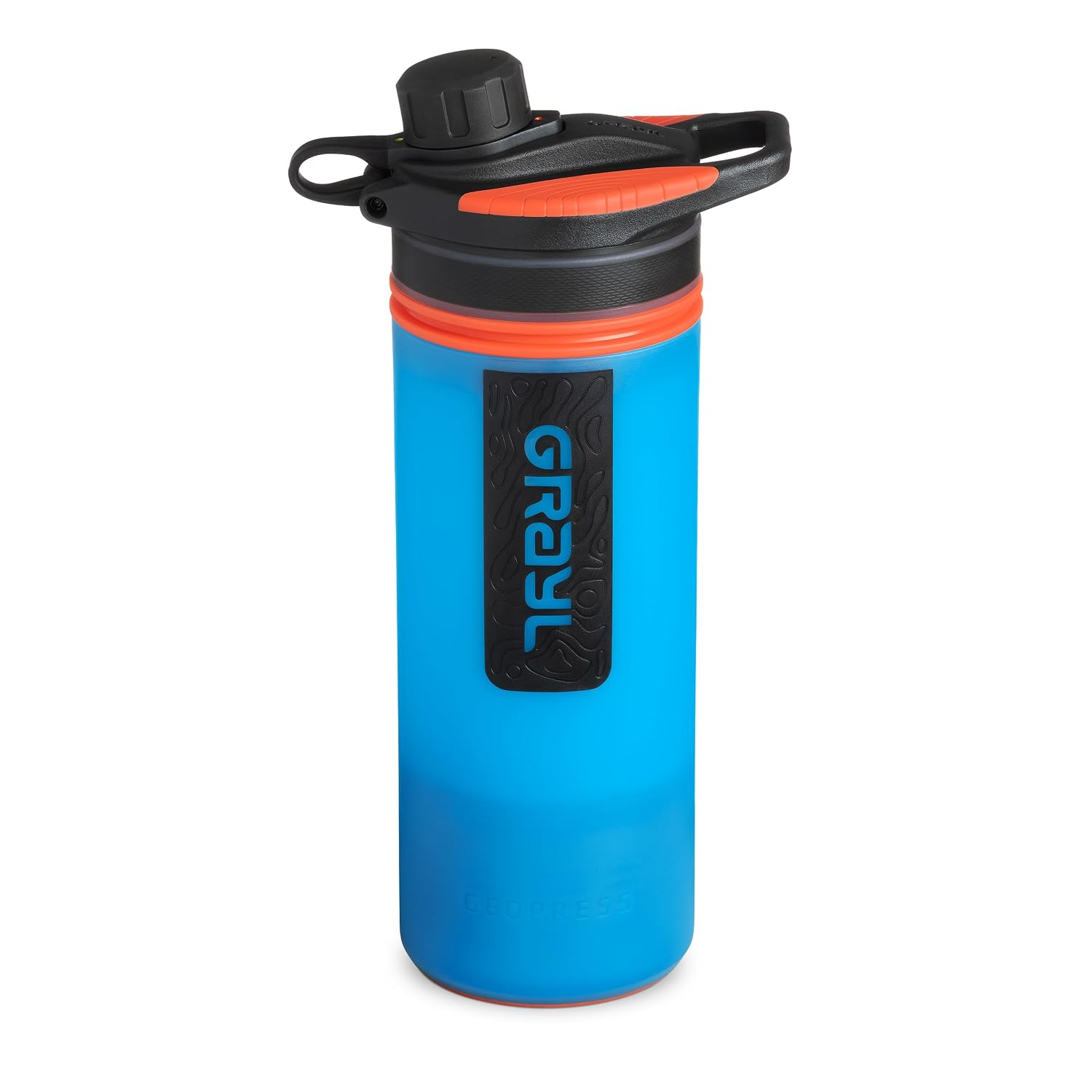
The Grayl GeoPress purifies 24 oz in about 8 seconds per press, and it removes viruses, bacteria, and protozoa in one step.
Flood-zone households and evacuating families should look here first. Floodwater carries sewage and viruses, and after a flood power outage, the GeoPress turns that risk into drinkable water in seconds.
- Removes 99.99% of viruses, 99.9999% of bacteria, 99.9% of protozoa
- Purifies 24 oz in about 8 seconds per press
- Electroadsorptive cartridge, about 250 L per cartridge
- Replacement cartridges run about $25 to $30
- 15.9 oz bottle with 24 oz capacity
Pros
- Full virus protection in one press.
- Fastest safe water here, about 8 seconds.
- One self-contained bottle, nothing to assemble.
- Built for evacuation and travel.
Cons
- Cartridges last about 250 L and cost $25 to $30 each.
- Costs the most per liter over its life.
Grayl GeoPress reviews
Owners rate the GeoPress about 4.6 stars across nearly 5,200 ratings. Travelers and preppers on sites like Reddit like how it makes questionable water drinkable in seconds, viruses included. The repeated complaint is cartridge cost, which runs far above a Sawyer per liter.
Should you buy the Grayl GeoPress?
You should buy the Grayl GeoPress if flooding, sewage, or evacuation could put viruses between you and safe water. You should pass on it if you need high-volume household water, where a gravity system treats far more per dollar.
4. Big Berkey
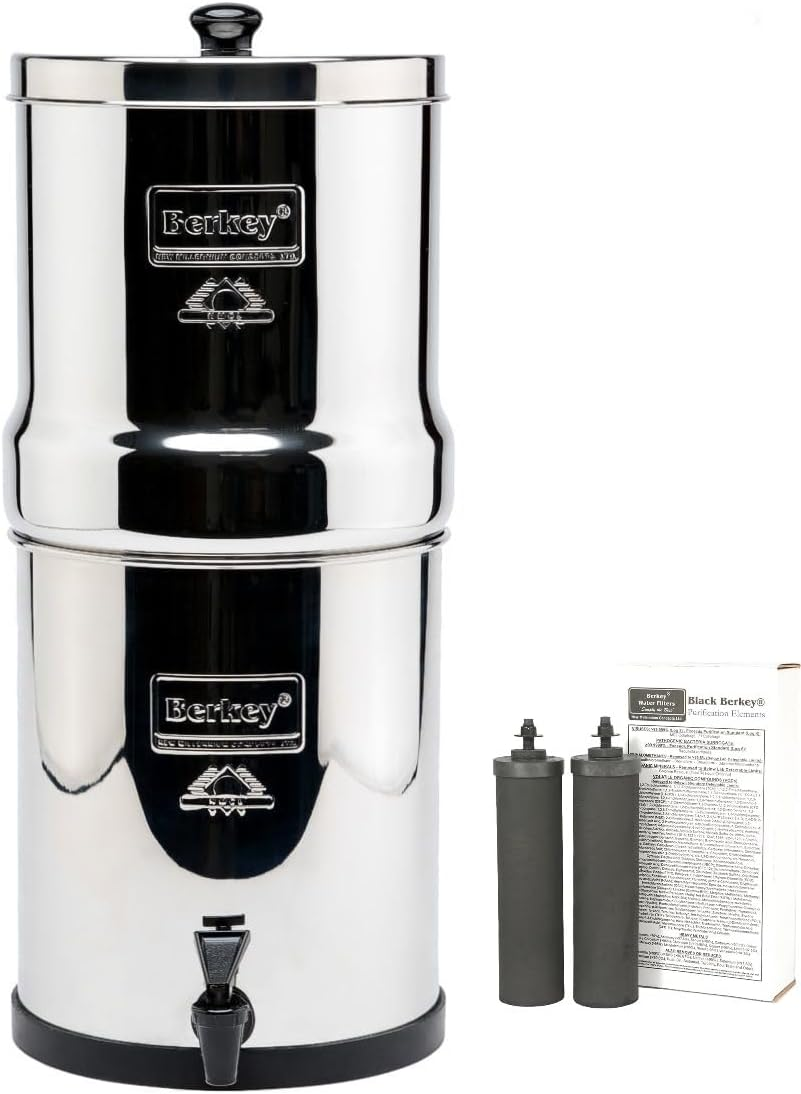
The Big Berkey holds 2.25 gallons in stainless steel chambers, and it treats 2 to 3 gallons per hour with no power or plumbing.
Households that want treated water sitting ready every day get the most here. You should consider the Big Berkey if you want one system covering daily drinking water and outage backup together in one.
- The manufacturer claims a reduction of certain PFAS compounds and a reduction of more than 200 contaminants overall
- 3,000 gallons per pair of Black Berkey elements
- Treats about 2 to 3 gallons per hour by gravity
- 2.25-gallon stainless steel chambers, dimensions vary slightly by production run
- Elements store for years unopened
Note that the manufacturer historically claimed virus reduction, though replacement-element availability makes those claims difficult to verify today.
Pros
- Gallons of treated water on tap daily.
- 3,000-gallon element lifespan.
- Stainless steel build lasts decades.
- Doubles as everyday drinking water.
Cons
- Filtration runs slowly, and priming elements is finicky.
- Costs about $330 up front.
Big Berkey reviews
Owners rate the Big Berkey 4.6 stars across about 4,100 ratings. Reviewers at ThePrepared and on Amazon report years of reliable daily use and outage peace of mind because gravity does the work. Complaints name slow filtration, finicky priming, and replacement elements that have been hard to find.
Should you buy the Big Berkey?
You should buy the Big Berkey if you want high-capacity treated water on the counter every day, outage or not. You should pass on it if the element supply pause worries you; third-party compatible replacement elements are available, but factor that uncertainty in before spending $330.
How power outages take down water systems
Winter Storm Uri knocked out power to 4.4 million Texas customers in February 2021, and the failures cascaded into water systems, forcing 322 boil-water notices statewide. With stoves down too, many homes had no way to boil, and a portable filter or purifier was the practical way to make water safe.
Similarly, Hurricane Helene cut power to 4.79 million customers in September 2024, and parts of western North Carolina stayed dark for 14 days while water systems were rebuilt. That's two weeks where a hurricane power outage means treating your own drinking water.
How to choose an emergency water filter for an outage
Choose an emergency water filter by considering the type of purification you need, along with your household size and expected filter lifespan.
- Filter or purifier: You should decide the virus question first. Floods and sewage backups call for a purifier like the GeoPress, but clean-source risk only needs a filter like the Sawyer Squeeze or LifeStraw Personal.
- Household size: A family sheltering at home needs high output like a gravity bag or countertop system, not a straw.
- Lifespan per dollar: The Sawyer Squeeze treats the most water per dollar, and the GeoPress costs the most per liter but handles the worst water.
- Storage pairing: A filter treats water; it doesn't hold it. You should store water ahead of storm season as part of your storm prep, especially before a winter storm power outage, when water systems freeze and fail.
- Buy before the storm: Filters sell out with the forecast, just like generators and plywood.