




When the power goes out during a storm, your refrigerator pretty much starts a 4-hour clock. An emergency food kit with freeze-dried meals provides food without needing a working stove or cold storage. In this guide, we’ll cover the best options, ranked specifically for power outage use.
At PowerOutage.us, we monitor 950 utilities covering 96% of U.S. electricity customers and track outages in real time across every major storm event. That data shapes how we think about power outage preparedness, including how many days your food supply actually needs to last.
5 Best emergency food kits for power outages
The products below were evaluated specifically for power outage use. That means no electric stove, limited water access, and potentially a multi-day duration. We filtered for just-add-water prep wherever we could, since stovetop kits need a camp stove or portable power station to function when the grid's down. We also weighted shelf life, daily calorie density, and how well each kit fits in a go-bag.
1. Mountain House “Just in Case” 3-Day Meal Kit
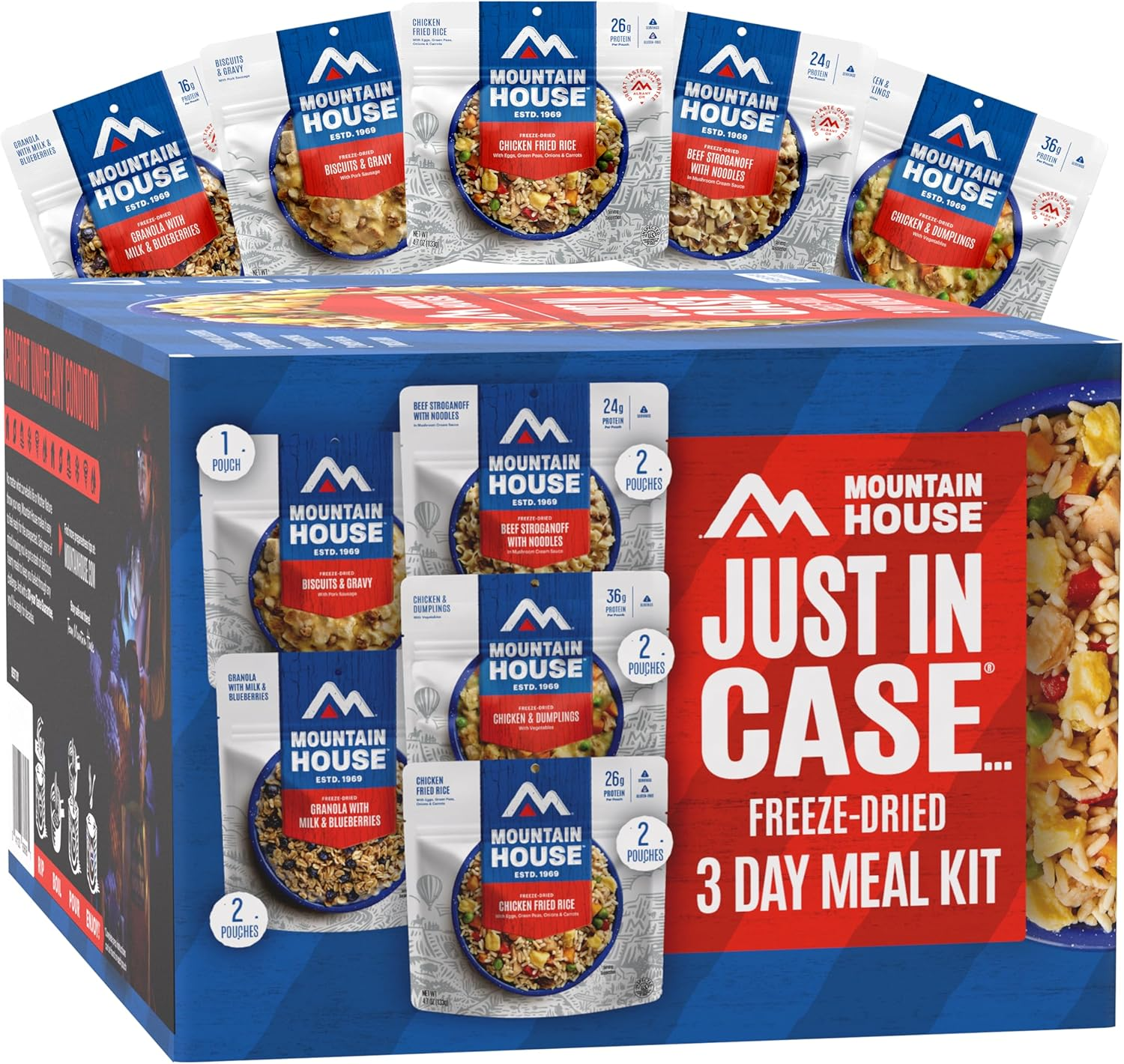
The Mountain House Just in Case 3-Day Meal Kit is our top pick. It's got a 30-year shelf life and just-add-water prep that works without electricity or a stove. It’s great for anyone building a core emergency food supply for power outages, whether you're sheltering in place or evacuating.
What emergency food do you get?
Mountain House is a freeze-dried brand that goes back to 1974, when its parent company, Oregon Freeze Dry, was supplying military rations for U.S. soldiers. The Just in Case kit comes with nine individual meal pouches covering three days for one person.
- Prep method: Just-add-water (boiling or room temperature); rehydrates in 9 minutes in the pouch
- Shelf life: 30 years (taste-guaranteed; lab-tested by outside universities)
- Servings: 18 servings across 9 pouches
- Average calories per day: 1,706
- Average protein per day: 75 g
- Meal variety: Chicken fried rice, beef stroganoff, biscuits and gravy, chicken and dumplings, granola with milk and blueberries
- Packaging: Flat cardboard box; individual pouches are resealable
- Cost per meal: Around $7.78
- Price: Around $69
Mountain House emergency food pros and cons
The Just in Case kit is the most practical pick for power outages because it works without a stove and doesn't leave you with leftovers that need refrigeration.
Pros
- Works without electricity; room-temperature water activates the meals when you can't boil water (though hot water makes it taste better)
- 30-year shelf life means you're not rotating stock for decades
- Flat, lightweight pouches pack easily into a go-bag or onto a closet shelf
- 75 g of daily protein is solid for a short-duration emergency
Cons
- Flavor and texture are middle-of-the-road according to reviewers; not the worst out there, but not the best either.
- Cardboard box packaging isn't rodent or moisture-resistant; transfer the pouches to a sealed plastic container for long-term storage
- At around $7.78 per meal, the per-serving cost is higher than stovetop competitors
Should you buy it?
The Mountain House Just in Case 3-Day Meal Kit is the right buy for most households because it feeds one person for three days without a stove and stores for 30 years. If you're starting an emergency food supply from zero, this is the kit to start with.
Buy it if:
- You're building your first emergency food supply and want one purchase that covers the basics
- You want food you can buy once and forget about, since the 30-year shelf life outlasts every other kit here
- You need pouches that pack flat into a go-bag or fit on a closet shelf
- You don't own a camp stove and don't plan to buy one
Skip it if:
- You're feeding a family of three or more, where ReadyWise covers more servings per dollar
- Taste is your top priority and you'll accept a shorter shelf life, where Peak Refuel wins
- You already own a camp stove and propane and want the cheapest meals, where Augason Farms costs about half as much per meal
2. Augason Farms 72-Hour Emergency Food Supply Kit
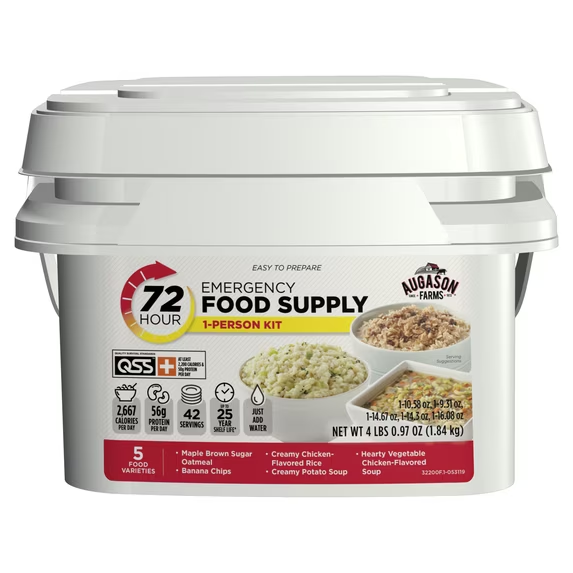
The Augason Farms 72-Hour 1-Person Emergency Food Supply Kit scored the highest taste marks of any kit here in published taste tests, and it's the cheapest option here. Homeowners who have a camp stove and a propane supply and want the most flavor for the least money.
What food do you get?
Augason Farms has been around since 1972. It targets the shelter-in-place market with bulk pouch meals that lean hard into comfort foods over portability.
- Prep method: Stovetop simmering (10 to 20 minutes) for most meals; the chocolate protein shake needs no heat
- Shelf life: 25 years
- Servings: Multiple servings per pouch across 5 meal types
- Average calories per day: 1,580
- Average protein per day: 58 g
- Meal variety: Creamy potato soup, lasagna-style pasta marinara, chicken-flavored rice, brown sugar oatmeal, chocolate protein shake
- Packaging: Compact pouch; 25-year shelf life (chocolate shake rated at 20 years)
- Cost per meal: Around $3.78
- Price: Around $34
Augason pros and cons
Augason Farms ranked first in published blind taste tests. The comfort-food flavors tend to land really well during a stressful event. The tradeoff is a cooking method that doesn't work without heat.
Pros
- Ranked first in published taste tests; familiar, comforting flavors that feel like canned soups from childhood
- Lowest price per meal at around $3.78, so it's the most affordable option to stock in bulk for a family
- 25-year shelf life matches most competitors in this list
Cons
- Most meals need stovetop simmering, so you need a camp stove, propane, and a pot during a grid-down scenario
- Pouches don't reseal after opening, so partial cooking leads to food waste unless you have refrigeration
- 1,580 calories per day is on the lower end for active adults under physical stress
Should you buy it?
The Augason Farms 72-Hour Kit makes sense only if you already own a camp stove and propane, because most of its meals need 10 to 20 minutes of simmering. With that heat source covered, it's the cheapest kit here at around $3.78 per meal and the best-tasting of the bunch in blind taste tests.
Buy it if:
- You have a camp stove, propane, and a pot ready to go during an outage
- You're stocking food for a family on a budget, since it costs around $34 per person for three days
- Comfort food matters to you during a stressful event, and these flavors ranked first in taste tests
Skip it if:
- You have no way to simmer a pot when the grid's down, since only the chocolate protein shake works without heat
- You want grab-and-go food with zero prep, where Life Gear or Mountain House fits better
3. Peak Refuel Basecamp 3.0 Bucket
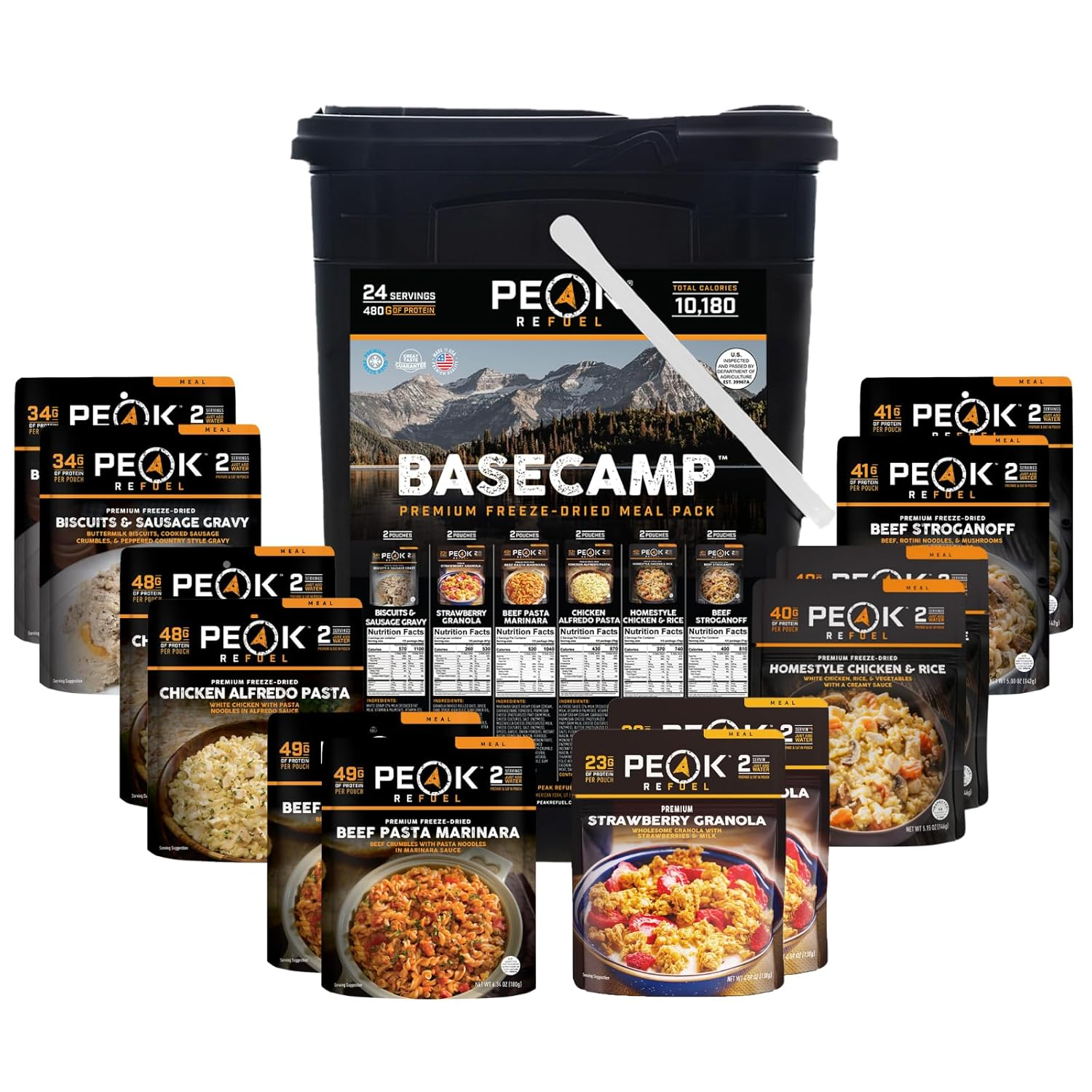
The Peak Refuel Basecamp 3.0 Bucket tastes noticeably better, according to reviewers, than any other freeze-dried kit here. But its 10-year shelf life and high cost per serving make it a weaker choice for long-term storage.
What emergency food do you get?
Peak Refuel targets hikers and backpackers, which pushes its calorie density and flavor profile higher than kits built purely for disaster scenarios.
- Prep method: Just-add-water; rehydrates directly in the pouch
- Shelf life: 10 years
- Days of food: 4 days per bucket
- Average calories per day: 2,545
- Average protein per day: 120 g
- Meal variety: Beef pasta marinara, biscuits and sausage gravy, chicken alfredo pasta, homestyle chicken and rice, beef stroganoff, strawberry granola
- Packaging: Heavy-duty plastic bucket; more resistant to pests and moisture than cardboard
- Cost per serving: Around $13.83
- Price: Around $133 to $166
Peak Refuel pros and cons
Peak Refuel's 2,545 calories and 120 g of daily protein are the highest in this list. That is important if you're dealing with physically demanding outage conditions like storm cleanup or an on-foot evacuation.
Pros
- Best-tasting freeze-dried kit here according to reviewers, who describe the meals as creamy, well-seasoned, and actually enjoyable.
- 2,545 calories per day is the highest here, which works well for active adults under stress
- Sturdy plastic bucket resists moisture and pests better than cardboard alternatives
- Just-add-water prep works without electricity or a stove
Cons
- 10-year shelf life is the shortest of the freeze-dried options; you'll need to replace it more often than Mountain House
- At around $13.83 per serving, the cost adds up fast for families buying multiple kits
- Shorter shelf life and higher price make it a poor fit for pure set-and-forget storage
Should you buy it?
The Peak Refuel Basecamp 3.0 Bucket is worth the extra money if you expect hard physical work during an outage, because it delivers 2,545 calories and 120 g of protein per day. That's the most of any kit here, and it covers storm cleanup or an on-foot evacuation better than anything else on this list.
Buy it if:
- You live in a storm-prone region where outages mean hauling supplies, clearing debris, or evacuating
- You want meals you'll actually enjoy eating, since reviewers rate it the best-tasting freeze-dried kit here
- You want a bucket that resists pests and moisture better than cardboard packaging
Skip it if:
- You want set-and-forget storage, because the 10-year shelf life means replacing it two or three times before a Mountain House kit expires
- You're buying for a family, where around $13.83 per serving adds up fast
- Your outages tend to be short and you'd rather spend less on a basic 3-day kit
4. ReadyWise Emergency Food Supply Bucket
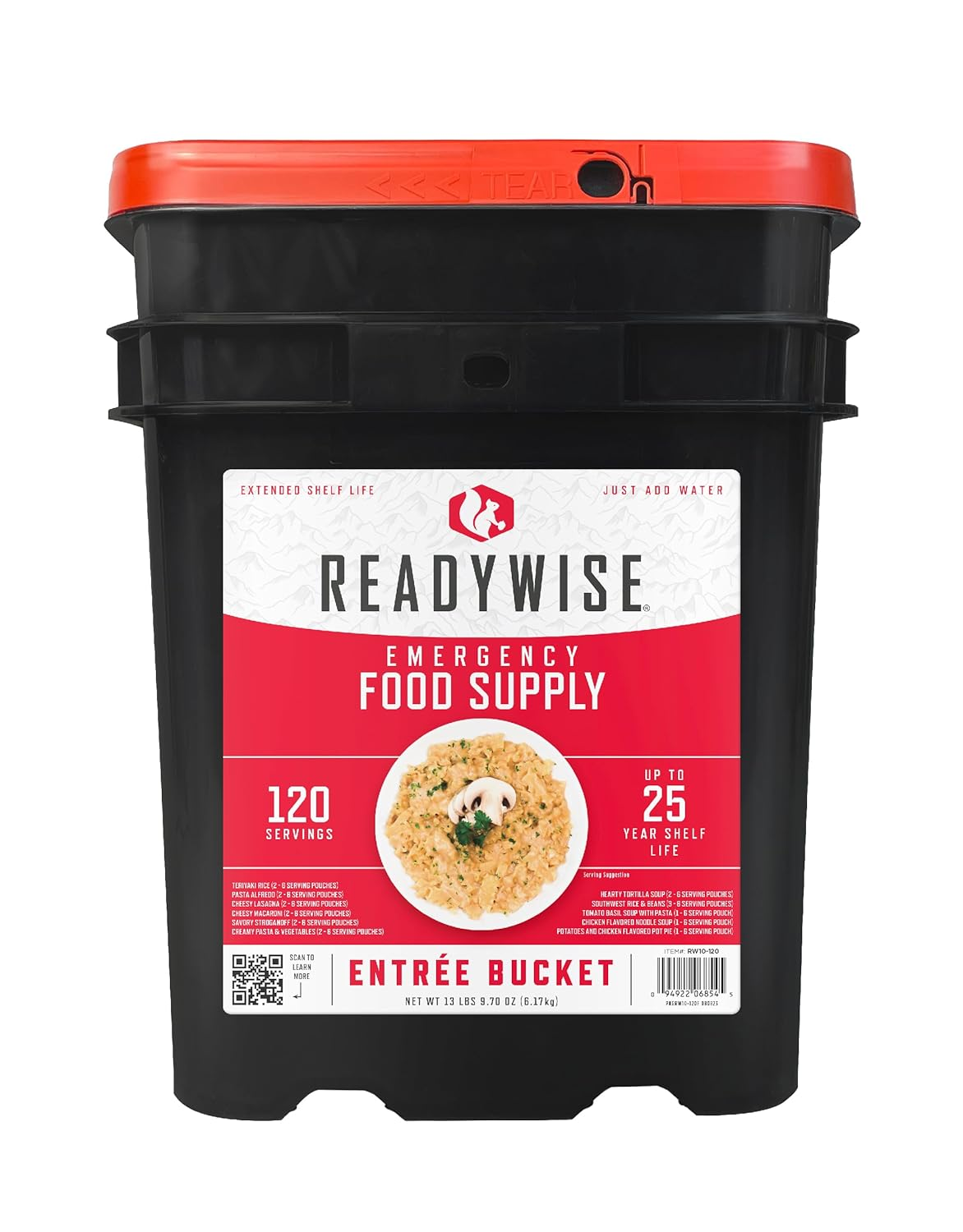
The ReadyWise Emergency Food Supply Bucket gives you 120 servings across 13 different meals. It's the most cost-effective option here for households stocking up for multiple people or a longer-duration outage.
What emergency food do you get?
ReadyWise is one of the most widely distributed emergency food brands, and it's available at major retailers. The flagship bucket balances variety, shelf life, and cost at the family scale.
- Prep method: Just-add-water (hot or cold); rehydrates directly in the pouch
- Shelf life: 25 years
- Servings: 120 servings; 13 different meal varieties
- Total calories: Approximately 24,000+ calories, depending on bucket configuration, averaging roughly 1,800 to 1,900 calories per day for one person over nearly two weeks.
- Packaging: Sealed plastic bucket with handle, around 20 lbs; sealed with ultra-high-barrier film
- Price: Around $85
ReadyWise pros and cons
The volume per dollar makes ReadyWise the practical choice when you're stocking up for multiple people. The tradeoff is that pouches don't reseal once you open them.
Pros
- 120 servings cover one person for 13 days, or a family of four for about 3 days per person
- 13 meal varieties, including stroganoff, tomato basil soup, and teriyaki rice, help reduce flavor fatigue over a longer outage
- The sturdy plastic bucket with a handle is easy to move during an evacuation
- 25-year shelf life matches the best long-term options in this list
Cons
- Pouches aren't resealable; once you open one, leftovers need to go into a separate container
- Pouches can be tough to open without scissors, which is extra friction during a stressful event
- Calorie density per day is moderate at around 1,874; active adults during storm cleanup will probably want to supplement
Should you buy it?
The ReadyWise Emergency Food Supply Bucket is the best buy for families because its 120 servings cover a household of four for about three days per person at around $85. No other kit here comes close on servings per dollar.
Buy it if:
- You're stocking food for two to four people and want one purchase instead of a pile of separate kits
- You want a 13-day supply for one person, which doubles as coverage for the extended rural outages that follow major hurricanes
- You want meal variety, since 13 different meals reduce flavor fatigue over a longer outage
Skip it if:
- You need a kit for a go-bag, because the 20 lb bucket stays home during an evacuation on foot
- You're buying for one person and short outages, where Mountain House packs smaller and easier
- Resealable pouches matter to you, since open ReadyWise pouches need a separate container for leftovers
5. Life Gear Emergency 3-Day Food, Water, and Thermal Blanket Supply
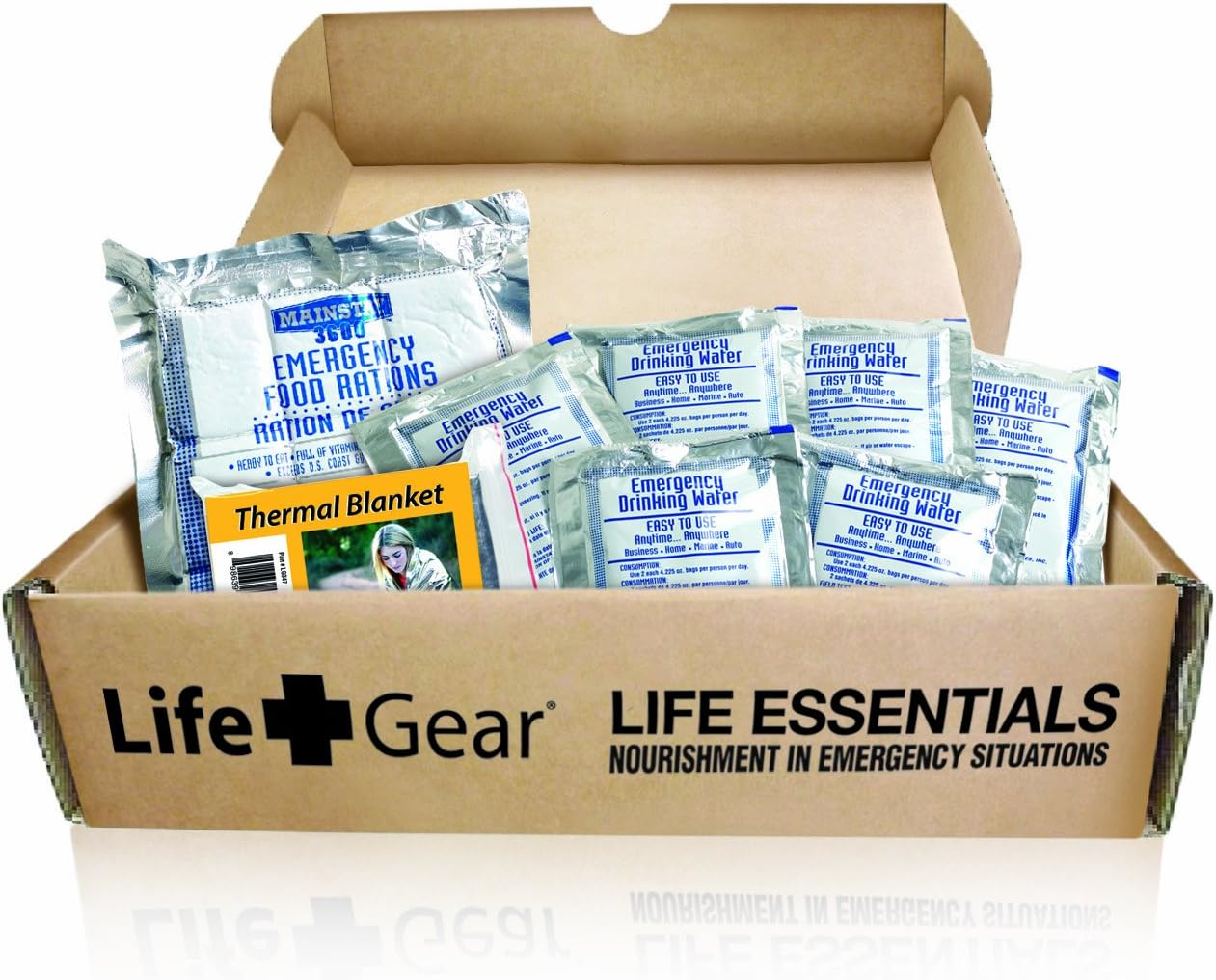
The Life Gear Emergency 3-Day Supply is the smallest and cheapest kit here. It's got 9 calorie-dense food bars, 3 days of water packets, and a thermal blanket, all in a single compact box. It’s best for anyone who wants a self-contained emergency supply in a trunk, go-bag, or desk drawer.
What emergency food do you get?
Life Gear takes a different approach from everything else here. Instead of rehydratable meals, it uses ready-to-eat calorie bars that need no water or prep at all.
- Prep method: Ready to eat; no water or cooking required
- Shelf life: 5 years
- Servings: 9 food bars at 400 calories each (3,600 total calories)
- Calories per day: Around 1,200 (designed as a survival minimum)
- Includes: U.S. Coast Guard-approved water packets and a thermal emergency blanket
- Packaging: Compact cardboard box, 3.2 lbs
- Price: Around $26
Life Gear kit pros and cons
The Life Gear emergency kit is the only option here that needs zero water, zero prep equipment, and no cooking. That makes it uniquely practical as a grab-and-go unit. But the 5-year shelf life means you're rotating it more often than anything else on this list.
Pros
- No water or stove needed; you eat the food bars straight from the packaging
- Includes both a water supply and a thermal blanket, so it's a pretty complete 3-day survival bundle in one box
- At around $26, it's the most affordable kit here by a long shot
- Compact enough to fit under a car seat or in a backpack outer pocket
Cons
- 1,200 calories per day is below the recommended 1,600 to 3,000 for adults
- Only one food type with no variety over three days
- 5-year shelf life is the shortest here; you'll want to check and rotate it annually
Should you buy it?
The Life Gear Emergency 3-Day Supply belongs in your car or go-bag, not your pantry. It's the only kit here that needs no water, no stove, and no prep, and at around $26 it's cheap enough to stash one in every vehicle. But 1,200 calories per day makes it a survival baseline, not a real food supply.
Buy it if:
- You want a self-contained kit for a car trunk, desk drawer, or go-bag, since it includes water packets and a thermal blanket
- You commute through areas where winter storms can strand you, and you want food that works at the side of the road
- You're adding a backup layer on top of a main supply like Mountain House or ReadyWise
Skip it if:
- You're buying your primary home food supply, because 1,200 calories per day falls below the FDA's 1,600 to 3,000 range for adults
- You want any variety, since you're eating the same food bar nine times over three days
- You don't want to rotate stock, because the 5-year shelf life needs an annual check
How we ranked these emergency food kits
We ranked these kits for one specific situation: a power outage. We combined verified consumer reviews, published taste test results, and manufacturer specs, then weighted everything against what our outage data says people actually deal with when the grid goes down.
Here's what mattered most, in order:
- Prep without electricity. This got the heaviest weight. A kit that needs a working stove fails the core test of a blackout. Just-add-water kits ranked above stovetop kits, and ready-to-eat bars got credit for needing no water at all.
- Outage-duration fit. PowerOutage.us tracks outages across 950 utilities in real time, and that data shaped our duration assumptions. The average U.S. customer lost power for around 11 hours in 2024, but hurricane-affected households waited days and sometimes weeks. We favored kits that scale from a 3-day baseline to a longer event.
- Consumer reviews and taste rankings. We leaned on aggregated buyer reviews and published blind taste tests. That's why Augason Farms holds the taste crown here and why we note Mountain House's flavor as middle-of-the-road rather than claiming we sampled it.
- Calories and protein per day. We compared each kit's daily numbers against the FDA's 1,600 to 3,000 calorie range for adults, with extra credit for kits that support the physical work outages tend to bring, like storm cleanup or moving supplies.
- Shelf life. A longer shelf life means you replace the kit less often and waste less food. Manufacturer claims ranged from 5 years to 30 years, and we treated third-party-verified claims like Mountain House's lab-tested guarantee as stronger evidence than a number on a label.
- Cost per meal. We calculated cost per meal or per serving from current prices so kits of different sizes could compete fairly, from $3.78 per meal at the low end to $13.83 per serving at the high end.
- Packaging and portability. Pouches that pack into a go-bag scored well for evacuation. Buckets scored well for shelter-in-place pest and moisture resistance. We noted where each kit's packaging works against it, like cardboard boxes in a damp garage.
What to look for in an emergency food kit for a blackout
The right emergency food kit for a power outage provides easy preparation, enough calories, and a long shelf life. Power outages take out electricity first, which means your electric stove and refrigerator go offline at the same time.
Freeze-dried vs. stovetop: Which type works without electricity?
Freeze-dried just-add-water kits are the more practical choice for power outage scenarios because they don't need a working stove.
Stovetop kits like Augason Farms need to simmer in a pot for 10 to 20 minutes. That's workable if you've got a camp stove and propane on hand, but it adds some complexity during an already stressful situation.
That said, a portable power station can run a small electric kettle, which gives freeze-dried meals a completely stove-free prep path during an outage. Most kettles draw 1,000 to 1,500 W, which is well within the output range of mid-size lithium battery stations.
How many calories do you need in a multi-day power outage?
The FDA's daily caloric guidance puts the adult range at 1,600 to 3,000 calories per day, depending on age, sex, and activity level. During a multi-day power outage, physical activity tends to go up. You're moving supplies, hauling ice, clearing storm damage, or maybe evacuating on foot. It makes sense to plan toward the higher end of that range if you expect any real physical exertion.
None of the kits here fully hit the upper end of that range on their own. Mountain House averages 1,706, ReadyWise averages 1,874, and Peak Refuel reaches 2,545. For a family dealing with an active storm event, it's worth supplementing with calorie-dense non-perishables like peanut butter, nuts, or crackers to cover the gap.
Does shelf life matter when buying for a one-week emergency?
Shelf life matters most as a purchase decision, not really as a week-of-the-outage concern. You buy a kit today because you want it to be safe and nutritious the next time you need it.
Mountain House's 30-year taste guarantee is the industry benchmark. The reason it works comes down to water removal.
- Freeze-drying research confirms that sublimation removes moisture to below the water activity level bacteria need to grow (typically 0.6 Aw or higher).
- Freeze-dried meals tend to sit at 0.3 Aw or below, which is a pretty wide safety margin.
- Peak Refuel's 10-year shelf life is the shortest freeze-dried option here. For a set-and-forget household supply, a longer shelf life means less replacement and less food waste over time.
All shelf life claims assume ideal storage: cool (55 to 70°F), dry, and dark. Garages and attics with seasonal temperature swings will reduce actual shelf life below what's printed on the label.
How long do power outages actually last?
Real-world outage data matters when you're figuring out how much food to stock. FEMA's 3-day baseline is a starting point. But it's just not the ceiling for a lot of U.S. households.
According to the EIA's 2024 electricity reliability data, the average U.S. electricity customer was without power for around 11 hours in 2024. That's nearly double the prior decade's average of 4 to 5 hours annually.
The national figure is heavily skewed by hurricane events: Hurricanes Beryl, Helene, and Milton accounted for roughly 80% of all outage hours that year. In South Carolina, customers averaged nearly 53 hours without power in 2024, the longest of any state. Our hurricane power outage guide covers region-specific prep for those scenarios.
During Hurricane Helene in September 2024, PowerOutage.us tracked 4.79 million customers without power at peak across 10 states. Western North Carolina customers in mountain counties waited more than 14 days for restoration, while Charlotte-area customers were back online in roughly 24 hours.
That urban-to-rural restoration gap is one of the most important variables in figuring out how much food you actually need. A 3-day kit covers the urban scenario. Rural households in storm-prone regions should really plan for at least a week.
Similarly, during Winter Storm Fern in January 2026, PowerOutage.us tracked more than 1,005,641 customers without power at peak across the Southeast, with some Tennessee areas going 6 or more days without restoration.
Winter outages add a food-prep challenge that summer storms don't: freezing temperatures make outdoor cooking difficult, and camp stoves with propane are less reliable when it's really cold out. Our winter storm power outage guide covers what cold weather adds to food and water prep.
Quick recap
To summarize, Mountain House is the best emergency food kit for most power outage scenarios because it needs no stove, stores for 30 years, and packs flat into a go-bag. Augason Farms wins on taste and value if you've got a camp stove. ReadyWise covers families best per dollar. Stock at least a 3-day supply per person, with 7 days as a more realistic buffer if you're in a storm-prone region.