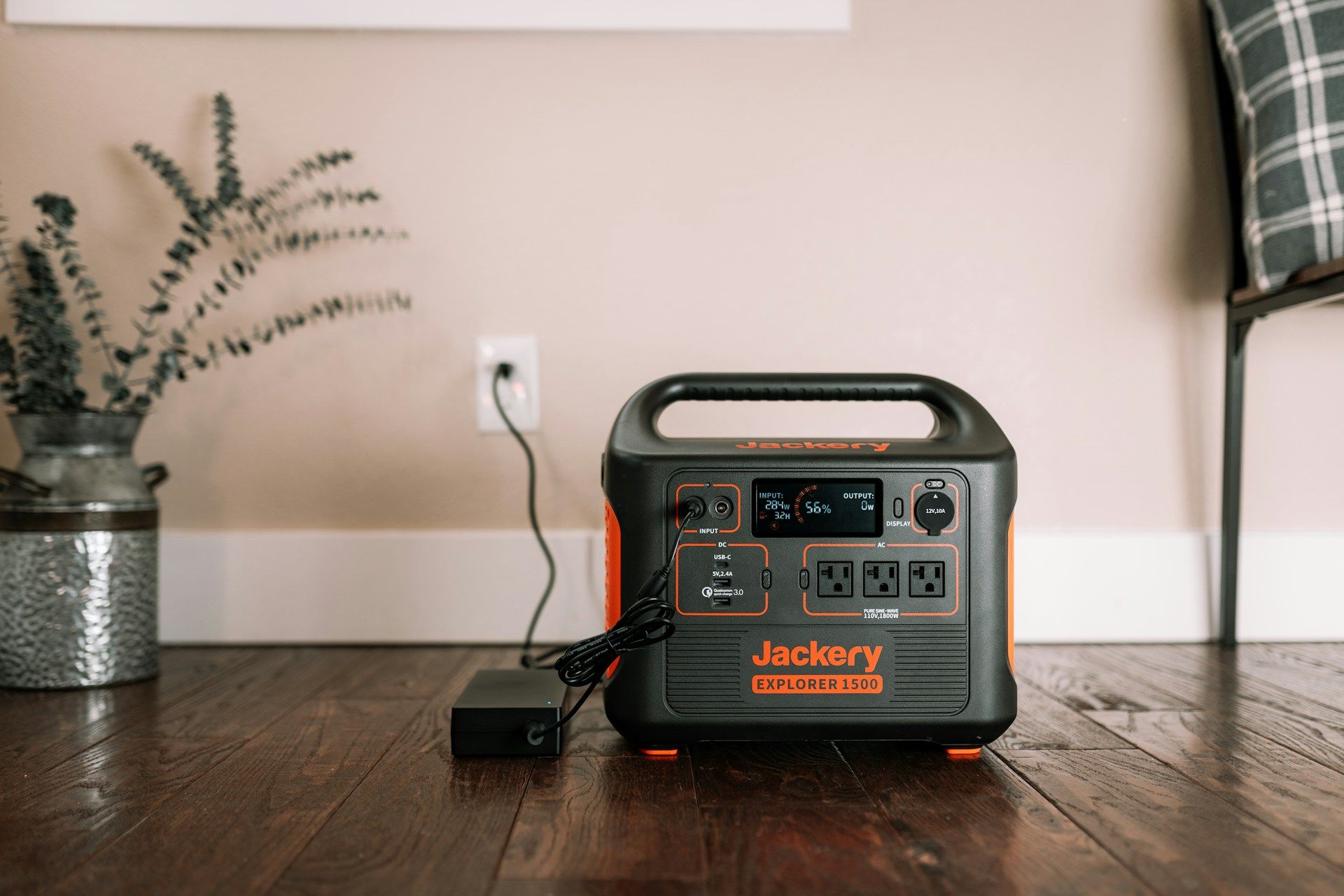


EcoFlow leads on recharge speed, Jackery leads on portability, and Bluetti delivers the most watt-hours per dollar in the mid-to-high range. This guide compares each brand's standout portable power station across charging speed, battery chemistry, capacity, and price.
PowerOutage.us monitors power outages across 950+ utilities serving over 200 million U.S. customers. That coverage informs the capacity guidance below, because a 4-hour suburban blackout and a 6-day ice storm outage like Winter Storm Fern demand very different amounts of stored energy from a power station or home backup.
EcoFlow vs. Jackery vs. Bluetti brand comparison
The three brands split the portable power station market into distinct roles: EcoFlow dominates AC recharge speed, Jackery leads on portability and simplicity, and Bluetti delivers the strongest watt-hours-per-dollar ratio at the mid-to-high price tier. Each of the three models below earns its spot in a specific use case.
EcoFlow DELTA Pro 3
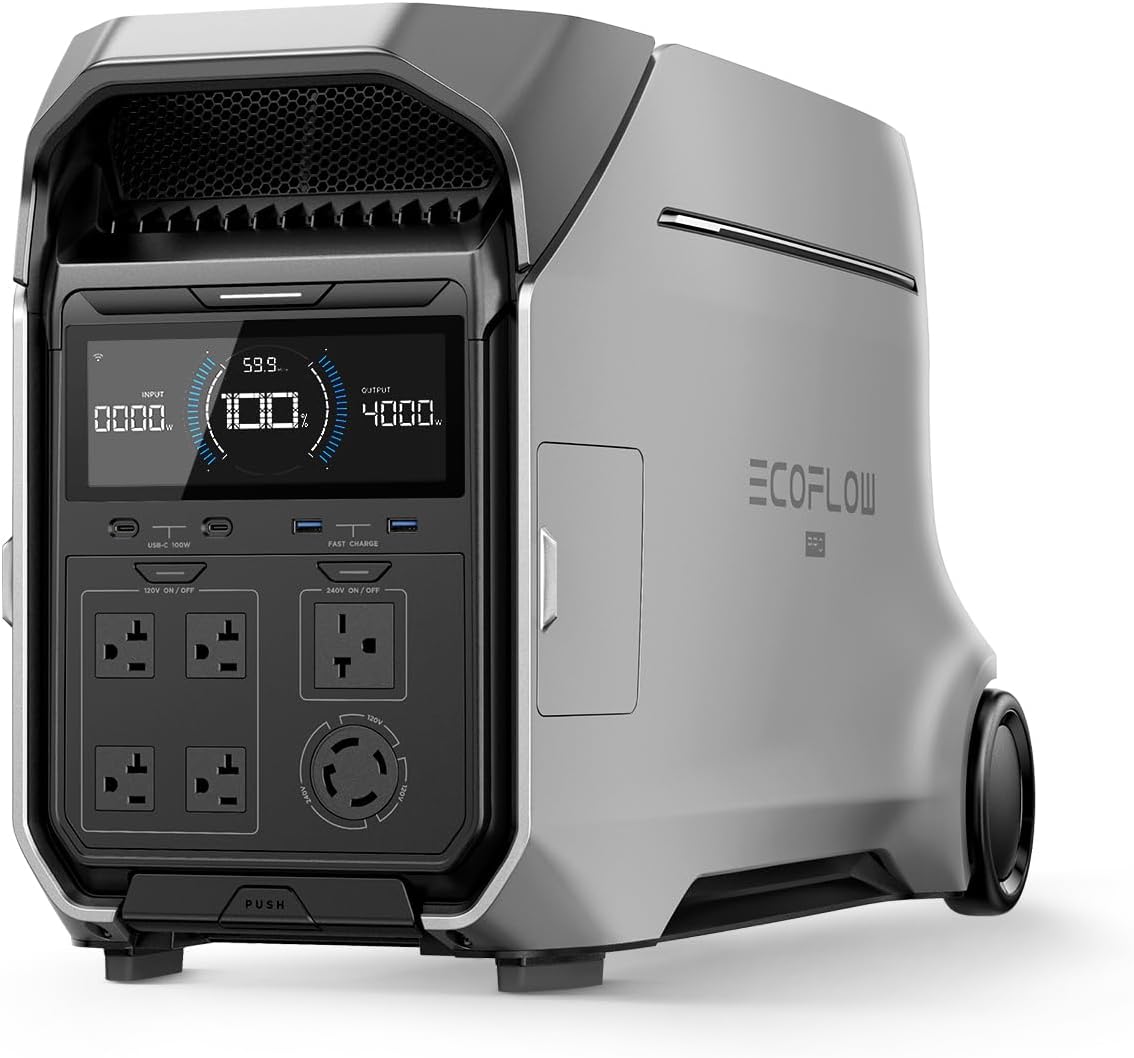
The EcoFlow DELTA Pro 3 suits homeowners who lose power during hurricanes or winter storms and need a battery station that recharges quickly between grid restoration cycles. Its 4,096 Wh LiFePO4 cell pack and 3,600 W AC output can run a refrigerator, router, and LED lighting simultaneously for over 24 hours per charge (estimated).
What are the EcoFlow DELTA Pro 3's features?
The EcoFlow DELTA Pro 3 leads its class on solar input capacity, accepting up to 1,600W from photovoltaic panels through its MPPT charge controller. Its X-Boost technology allows it to power 240 V appliances like window air conditioners and electric ranges, which is a huge plus for a power station.
- Capacity: 4,096 Wh LiFePO4, expandable to 12kWh with battery modules
- AC output: 3,600 W continuous, 240V compatible
- Solar input: Up to 1,600 W MPPT
- AC recharge: Roughly 2 hours under maximum AC charging settings.
- UPS transfer: 10 ms auto-switch for sensitive electronics
- App: EcoFlow app with scheduling and remote monitoring
- Smart Home Panel 2: Compatible for circuit-level home integration
- Warranty: 5 years
- Price range: $2,300 to $3,700
What are the pros and cons of the EcoFlow DELTA Pro 3?
The DELTA Pro 3 is great if you prioritize recharge speed above other things, but its weight and price make it a poor fit for camping or single-appliance backup.
Pros
- Fastest AC recharge in its capacity class
- Expandable to 12 kWh for multi-day whole-home backup
- 240 V output for heavy appliances
- Most advanced app ecosystem of the three brands
- 1,600 W solar input ceiling charges its battery in one sunny afternoon
Cons
- Heaviest model of the three featured here
- Highest price point ($2,300 to $3,700)
- Overkill for camping or single-device backup
- Fan noise increases under sustained high-watt loads
Jackery Explorer 1000 v2
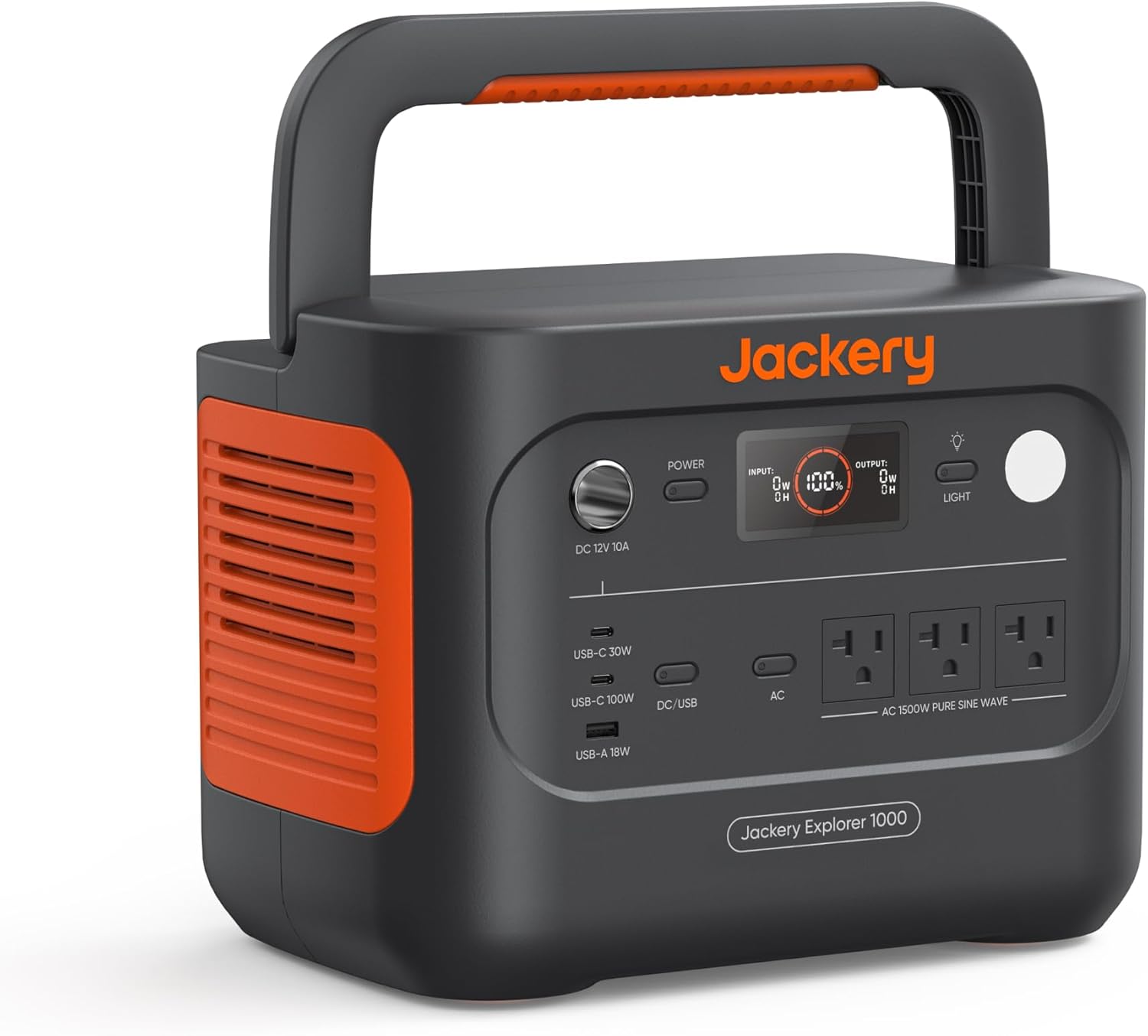
The Jackery Explorer 1000 v2 is great for campers and renters who need a power station light enough to carry to a campsite or keep in a car trunk without help. At 23.8 lbs with 1,070 Wh of LiFePO4 capacity and dual 100 W USB-C ports, it covers phones, laptops, routers, and fans without requiring a high-watt output.
What are the Jackery Explorer 1000 v2's features?
The Explorer 1000 v2's 4,000-plus charge cycle rating makes it a strong long-term investment for users who charge it monthly rather than daily. Its compatibility with the Jackery SolarSaga panel line means it integrates cleanly with an outdoor solar charging setup, though its solar input ceiling is lower than EcoFlow's or Bluetti's comparable options.
- Capacity: 1,070 Wh LiFePO4
- AC output: 1,500 W continuous
- Weight: 23.8 lbs
- USB-C: Dual 100 W ports
- Cycle rating: 4,000+ charge cycles
- Solar compatibility: Compatible with Jackery SolarSaga panels and many third-party solar panels through adapter-supported connections.
- Warranty: 3 years
- Price range: $400 to $500
What are the pros and cons of the Jackery Explorer 1000 v2?
The Explorer 1000 v2 wins on portability and simplicity, but buyers who expect multi-day refrigerator backup from it will find its 1,070 Wh capacity depleted well before a 14-hour outage ends.
Pros
- Lightest full-capacity LFP power station among the three brands
- 4,000-plus cycle rating for lasting long-term value
- Plug-and-play operation with no app required
- Lowest price point of the three featured models ($400 to $500)
- Strong outdoor ecosystem through Jackery SolarSaga panel compatibility
Cons
- 1,500 W output ceiling is lower than Bluetti or EcoFlow equivalents
- Slower AC recharge time than EcoFlow or Bluetti options
- Smaller solar input ceiling limits recovery during cloudy multi-day storms
- 3-year warranty is shorter than the 5-year coverage from EcoFlow and Bluetti
Bluetti Elite 200 V2

The Bluetti Elite 200 V2 suits apartment dwellers and homeowners preparing for multi-day outages who want maximum LiFePO4 capacity without flagship-tier pricing. Its 2,048 Wh battery, 2,400 W AC output with 4,800 W surge capability, and 45-minute recharge to 80% give it great overall value.
What are the Bluetti Elite 200 V2's features?
The Elite 200 V2's 10 ms UPS transfer switch stands out as it protects desktop computers, CPAP machines, and other sensitive electronics during the first seconds of a grid failure.
- Capacity: 2,048 Wh LiFePO4, expandable
- AC output: 2,400 W continuous (4,800W surge)
- AC recharge to 80%: Approximately 45 minutes
- UPS transfer: 10 ms auto-switch
- Output ports: 11 simultaneous connections
- App: Bluetooth and Wi-Fi via the Bluetti app
- Warranty: 5 years
- Price range: $1,200 to $1,600
What are the pros and cons of the Bluetti Elite 200 V2?
The Bluetti Elite 200 V2 delivers the best cost-per-watt-hour of the three models here, and its 45-minute recharge speed keeps it competitive with EcoFlow for buyers who prioritize value over maximum output wattage.
Pros
- Best watt-hours-per-dollar ratio at the mid-to-high price tier
- 45-minute recharge to 80% approaches EcoFlow speed at a lower price
- 11 ports support multiple simultaneous devices in a household
- 5-year warranty matches EcoFlow's coverage
Cons
- Heavier than the Jackery Explorer 1000 v2
- App experience is less refined than EcoFlow's ecosystem
- Higher upfront cost than Jackery options at comparable capacity
How to choose: Bluetti vs. EcoFlow vs. Jackery
To choose between these options, note how fast the battery recharges between grid cycles, how much capacity it holds, whether you need to carry it, and what you can spend.
Choose EcoFlow if:
- Fast recharge between cycling grid windows is the highest priority (see Hurricane Milton data below)
- You need 240 V support and smart home panel integration
- You plan to expand capacity over time with battery modules
- You want the most developed app control ecosystem
Choose Jackery if:
- Portability is the primary requirement (camping, vehicle storage, apartment carry)
- You want a plug-and-play setup without depending on an app
- Your outage risk is short (under 12 hours) and covers essentials only
- You want the lowest entry price in a full-capacity LFP station
Choose Bluetti if:
- You want maximum watt-hours per dollar at the mid-to-high tier
- You need 2,000 Wh or more for refrigerator backup
- Fast AC recharge matters but your budget is tighter than EcoFlow allows
- You want 5-year warranty coverage with expandable capacity
Warranty and support comparison:
| Brand | Standard warranty | Recharge speed (mid-range model) |
|---|---|---|
| EcoFlow DELTA Pro 3 | 5 years | Under 2 hours (X-Stream) |
| Bluetti Elite 200 V2 | 5 years | About 45 min to 80% |
| Jackery Explorer 1000 v2 | 3 years | 2 to 3 hours |
For buyers focused on running a refrigerator during a blackout, the 2,048 Wh capacity of the Bluetti Elite 200 V2 provides roughly 18 to 22 hours of refrigerator runtime based on a typical 90 W average draw.
The Jackery Explorer 1000 v2 provides roughly 10 hours at that same draw rate before reaching reserve. Buyers without rooftop solar may also want to review options for battery backup without solar panels.
Which power station charges fastest from solar panels during an outage?
The EcoFlow DELTA Pro 3 accepts up to 1,600 W of solar input through its onboard MPPT charge controller. Paired with four 400 W photovoltaic panels, it can theoretically recharge in roughly 3 to 4 hours under good solar conditions.
The Bluetti Elite 200 V2 supports a comparable MPPT input range, allowing faster solar recovery than its AC recharge time alone suggests.
The Jackery Explorer 1000 v2 works cleanly with Jackery SolarSaga 100 W and 200 W panels via its onboard MPPT controller. Its solar input ceiling is lower than EcoFlow's, which limits how quickly it recovers from a full discharge.
If you rely mainly on solar recharge rather than wall outlet charging, EcoFlow's higher ceiling creates a meaningful real-world advantage. For a wider look at matching panels to portable stations, the best solar portable generators guide covers panel pairing recommendations across multiple brands.
Is a power station enough for an outage?
Outage duration varies more than most buyers expect, and selecting too little capacity is the most common portable power station purchasing mistake. A 1,000 Wh station that handles a 6-hour suburban outage comfortably can leave a household powerless on the second day of a multi-day event.
During Hurricane Milton in October 2024, PowerOutage.us tracked 3.4 million Florida customers losing power. Many experienced cycling grid failures with restoration windows of only 30 minutes to 2 hours before repeat failures.
In those conditions, a station that recharges to 80% in 45 minutes (Bluetti Elite 200 V2) or under 70 minutes (EcoFlow DELTA Pro 3) can top off between cycles. A station requiring 2 to 3 hours of AC recharge time misses those brief windows entirely.
Winter Storm Fern in January 2026 left over 1 million customers without power, including 306,700 in Tennessee, with the hardest-hit areas going 6 or more days without restoration. Ice accumulation brought power line failures across a 2,000-mile impact zone stretching from New Mexico to New England.
In multi-day events like that, capacity matters more than recharge speed: the 2,048 Wh Bluetti Elite 200 V2 and 4,096 Wh EcoFlow DELTA Pro 3 outlast the 1,070 Wh Jackery Explorer 1000 v2 by a wide margin when no grid or generator recharge source is available.
For full guidance on assembling a backup power kit around any of these stations, the power outage emergency kit guide covers supporting equipment, including lighting, water, and communication devices.
Quick recap
To sum up, EcoFlow's DELTA Pro 3 wins on charging speed and expandability, Jackery's Explorer 1000 v2 wins on portability and price, and Bluetti's Elite 200 V2 wins on watt-hours per dollar and sustained home use. All three use LiFePO4 cells. Match your pick to your outage risk and how you will recharge.