

Your phone is your most critical device when the power goes out. It's what connects you to weather alerts, restoration updates, and emergency contacts. A solid storm prep plan includes at least one phone charging method you've set up before storm season.
PowerOutage.us tracks outages across over 950 utilities serving more than 200 million U.S. customers, and data refreshes every 10 minutes during live events. Free outage alerts (to your phone via email) notify you the moment power returns in your area so you know exactly when to plug back in. Let’s cover how to keep your phone glowing during an outage.
How to charge your phone during a power outage
Four methods work pretty reliably when the grid goes down: a portable power bank, a portable power station, a vehicle charger, and a solar panel paired with a battery. Each one covers a different outage length and budget. A power bank is the fastest and cheapest place to start. A portable power station handles the scenarios where a smaller bank runs out.
Power banks: Easiest way to keep your phone alive in a blackout
A portable power bank is one of the most practical things you can buy to keep your phone charged during a blackout. It requires no setup, no outlet, and no running vehicle. Models like the Anker MagGo Power Bank 10K and the INIU B5 20000 mAh PD Power Bank cover 2 to 5 full phone charges for under $40. These can just sit on a shelf fully charged until an outage hits.
Power banks charge phones through USB-A or USB-C ports and work with pretty much any modern smartphone. USB-C power delivery ports on models like the Anker 737 Power Bank PowerCore 26K output 65 W or more, which charges compatible iPhones and Android devices at speeds similar to wall adapters.
At a standard 5 W output through USB-A, the same bank still works, but it'll take 2 or more hours per charge cycle.
A few things to note:
- USB-C PD battery packs recharge modern iPhones and Android handsets much faster than older USB-A charging bricks, especially during long utility outages.
- High-capacity portable chargers can also power tablets, ultrabooks, handheld gaming consoles, LED lanterns, and other small USB-powered electronics.
- Compact external batteries fit easily into emergency kits, glove compartments, backpacks, or nightstands, so backup phone power stays accessible during a blackout.
How much capacity does a power bank need for an outage?
Most modern smartphones carry batteries somewhere between 3,500 mAh and 5,000 mAh. A 10,000 mAh power bank delivers roughly 6,500 to 7,000 mAh of usable charge after the 30 to 35 percent conversion loss that happens when lithium cells transfer energy through USB. So that covers 1 to 2 full charges of a high-capacity Android phone, or 2 to 3 full charges of a standard iPhone.
The U.S. Energy Information Administration reported that U.S. electricity customers averaged 11 hours without power in 2024, the highest figure in a decade. A 10,000 mAh bank handles that duration pretty comfortably for a single phone.
But for households with two or more smartphones, a 20,000 mAh bank covers everyone without needing a mid-outage recharge.
Portable power stations for longer or multi-device outages
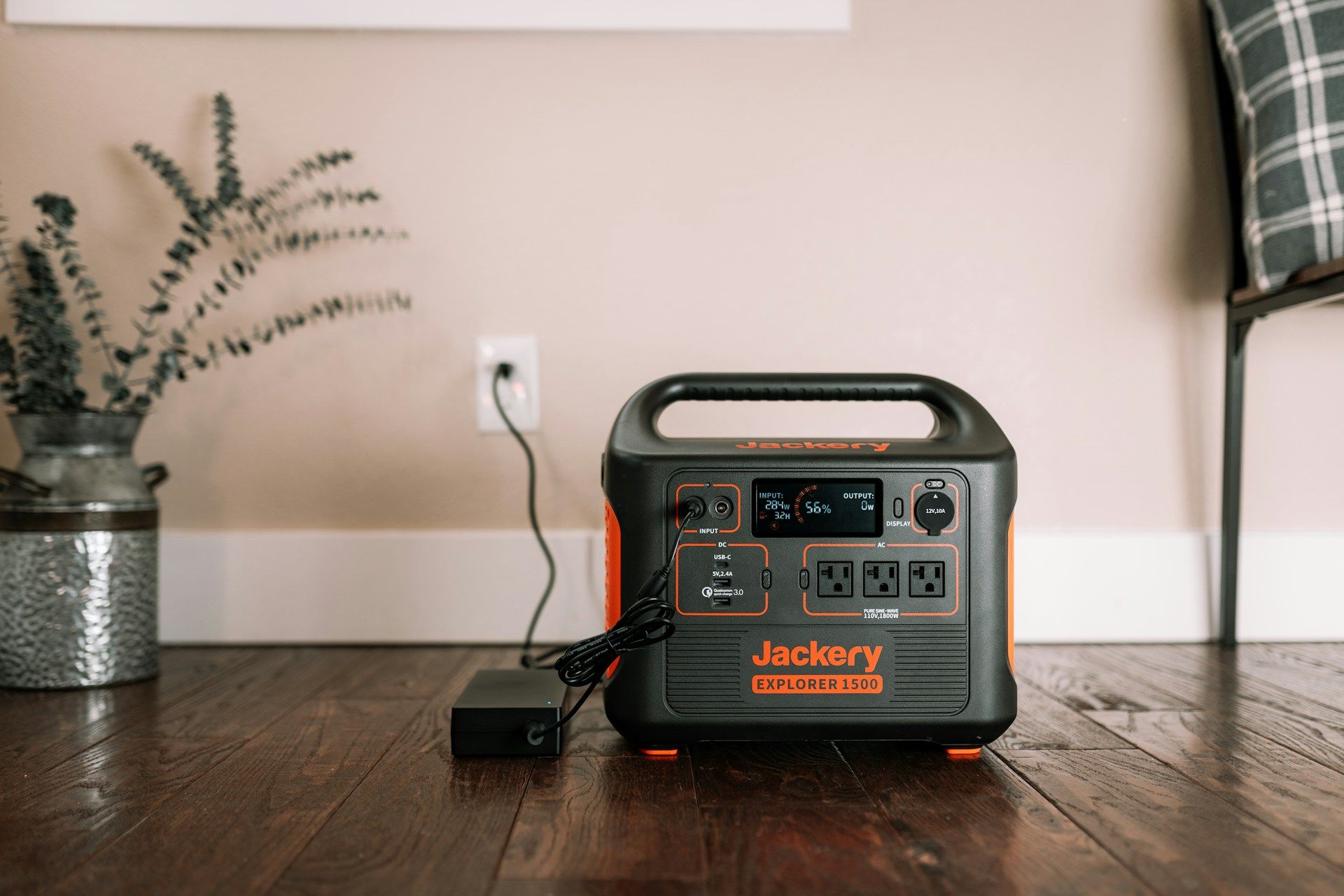
A portable power station stores a lot more energy than a power bank and powers multiple devices at once, including a laptop, Wi-Fi router, and several phones simultaneously.
For example, the EcoFlow RIVER 2 Pro holds 768 Wh, which is enough to charge a 5,000 mAh phone roughly 130 times before it runs out. The Jackery Explorer 1000 v2 holds 1,070 Wh and adds a 1,500 W AC outlet so you can use any standard wall charger instead of hunting for a USB port.
- Lithium iron phosphate battery chemistry lasts for thousands of charge cycles, making many portable battery stations more durable than smaller charging packs.
- Integrated AC outlets power standard wall chargers and household electronics during outages.
- Fast recharge systems on models from EcoFlow and Jackery can refill large battery reserves from a wall outlet in roughly 1 to 2 hours before severe weather arrives.
- Unlike gasoline generators, portable backup batteries run silently indoors with no exhaust fumes or fuel storage.
Portable power stations are the better call when an outage runs past 24 hours or when you need backup for a laptop, a medical device, and multiple phones all at once. For a broader look at options, see the home battery backup guide.
Charging your phone from your car during a blackout
A vehicle provides reliable phone charging during an outage as long as the engine's running. Most cars built after 2015 include USB-A ports in the center console that output 5 W to 12 W, which is enough to charge a phone slowly while the car idles. Dedicated USB-C car adapters plugged into the 12 V outlet deliver 18 W to 45 W and charge compatible phones faster.
The U.S. Department of Energy recommends keeping a car charger as part of your emergency kit and points out that any vehicle used for charging needs to stay outdoors in a ventilated location.
Running a car engine inside a garage, even with the door open, can let carbon monoxide accumulate pretty quickly. Idling's sufficient to charge a phone and burns roughly half a gallon of fuel per hour.
If the engine's off, a vehicle's 12 V battery can still get you one or two partial phone charges. But drawing from it repeatedly risks dropping voltage below what's needed to start the car. Restart the engine for 20 minutes after each engine-off charge session to recover the battery.
Can a solar panel charge your phone during a power outage?
A portable solar panel recharges a power bank or portable power station during the day, which gives you a renewable energy source during longer outages. A 100 W panel in direct sunlight produces 60 to 80 W of actual output after conversion losses, which is enough to replenish a 10,000 mAh power bank in 1 to 2 hours under good conditions.
However, solar doesn't reliably charge a phone directly without a battery buffer in the circuit. Plugging a phone into a panel without a bank or station between them causes charge interruptions every time a cloud passes or the panel angle shifts, and that can stress the phone's battery controller over time.
The best workflow is:
- Panel to power bank or power station
- Power station to phone
Does a power outage drain your phone battery faster?
During a power outage, a smartphone burns battery power faster than under normal conditions. The main cause is cellular signal searching. When towers lose power or get overloaded, phones cycle between networks and increase transmission power to maintain a connection, which burns far more energy than holding a stable home signal would.
Cold weather makes this worse. Lithium-ion cells lose 20 to 30 percent of their rated capacity at temperatures below 32 degrees Fahrenheit. So winter outages create a compounding effect where the battery's already weakened by cold before signal searching even starts.
Keeping a phone in a jacket pocket or a closed bag during a winter blackout preserves more usable charge than leaving it on a cold surface.
How to conserve phone battery when the power is out
Reducing battery drain matters just as much as having backup capacity. These steps make a real difference without requiring any extra hardware:
- Enable airplane mode when you don't need cellular data or calls. This eliminates signal searching and can extend battery life by 30 to 40 percent.
- Reduce screen brightness to the lowest comfortable level. The display is the single largest power draw on most smartphones.
- Close background apps. Navigation, social media, and streaming apps continue drawing power when minimized.
- Disable Wi-Fi, Bluetooth, and location services when they're not in use. Each radio adds a small but continuous drain.
- Keep calls brief and avoid video. Voice calls consume far less battery than video calls over a cellular connection.
If your phone provides alerts for a CPAP machine, oxygen monitor, or another medical device, review our medical device power outage checklist before storm season. Phones tied to health monitoring need more reliable backup planning than phones you're using just for communication.
What outages show about backing up device power
During Winter Storm Fern in January 2026, PowerOutage.us tracked more than 1,005,641 customers without power at the outage peak across the Southeast. In Nashville, where nearly half of all residents live in apartment buildings of 20 or more units, some neighborhoods went 6 or more days without restoration.
That kind of duration exhausts a 10,000 mAh power bank by day two. So a portable power station becomes the practical choice for any outage that stretches past the first evening.
In another example, our data shows Hurricane Milton in October 2024 cut power to 3.4 million Florida customers. Restoration windows were as short as 30 minutes before repeat failures.
A power station that recharges quickly during those brief windows captures more energy per window than units requiring 4 or more hours. For food and appliance backup context during extended events, see the best battery for refrigerator backup guide.
Quick recap
A 10,000 mAh power bank covers most single-phone outage scenarios at under $40. For longer or multi-device blackouts, a portable power station like the EcoFlow RIVER 2 Pro handles the full device load. Enabling airplane mode and reducing screen brightness cuts drain by 30 to 40 percent, which stretches whatever backup capacity you've got on hand.