

PowerOutage.us monitors more than 950 utilities covering 96% of U.S. electricity customers, so we know how long the grid actually stays down when basements flood during a storm. We ranked these systems on that data, runtime, and flow rate so you can buy the one that protects your basement the first time, instead of replacing a failed bargain unit after the water's already in. Here are the five best sump pump backups.
5 Best sump pump battery backup systems
These five systems cover the range of basement flood protection scenarios. That's everything from high water table homes that run their primary pump every few minutes to city water properties where a water-powered unit makes more sense than having another battery to deal with.
We looked at each one on GPH capacity at a 10-foot lift, battery runtime, installation complexity, and long-term reliability based on manufacturer specs and homeowner reports.
1. Basement Watchdog Big Dog BWD12-120C
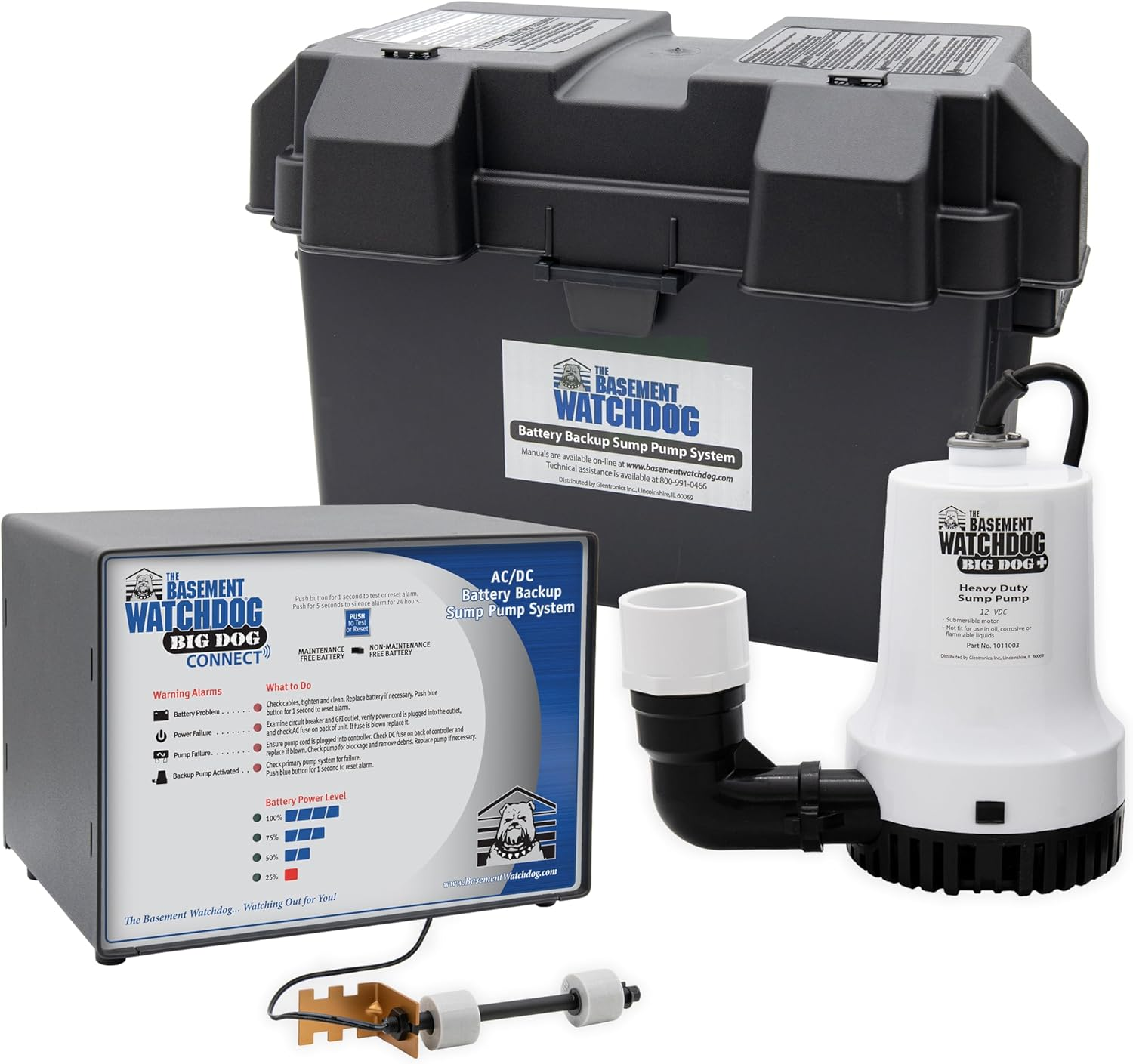
The Basement Watchdog Big Dog BWD12-120C is the best sump pump battery backup for most homeowners who want maximum runtime and a system they don't have to think about.
What do you get with this sump pump battery backup?
The Big Dog CONNECT packs a high-output pump and a smart 20-amp charging system into one unit. That gives it the best combination of performance and battery management in the standalone backup category.
- Flow rate: 2,200 GPH at 10 ft, 3,500 GPH at 0 ft
- Charger: 20-amp automatic multi-stage charger with battery health monitoring
- Battery type: Group 27 or Group 30 deep-cycle wet cell or AGM (sold separately, minimum 75 Ah)
- Runtime: Up to 50 hours intermittent at 75 Ah; longer with higher-capacity batteries
- Float switch: Microreed dual float switch, proven reliable for over 50 years
- Connectivity: WiFi-capable with optional module for remote alerts
- Discharge: 1 1/2-inch or 1 3/8-inch port
- Price range: $170 to $250 (pump and controller; battery sold separately)
Basement Watchdog Big Dog pros and cons
The Big Dog stands out from cheaper systems because the 20-amp charger maintains battery health over years of standby use, not just weeks.
Pros
- The 20-amp charger keeps a 75 Ah battery at full charge without overcharging it, which tends to extend battery life
- Handles moderate-to-high water table homes that cycle their primary pump several times per hour
- WiFi connectivity lets you monitor battery status and get alerts without physically checking the unit
- Compatible with any Group 27 or Group 30 battery, so you're not stuck with a proprietary replacement
Cons
- Battery is sold separately and adding a quality 75 Ah AGM battery brings the total system cost to $350 to $450
- The 20-amp charger requires 110 V AC power to maintain the battery, so if you lose power for an extended stretch, the battery depletes and doesn't recharge until the grid comes back
Should you buy the Basement Watchdog Big Dog BWD12-120C?
The Basement Watchdog Big Dog BWD12-120C is the right buy for most homeowners. It pairs the highest flow rate in this roundup with a 20-amp charger that keeps a 75 Ah battery healthy for years of standby duty. If you want one system that handles a high water table and don't want to think about battery maintenance, this is the pick.
Buy it if:
- You have a moderate-to-high water table and your primary pump cycles several times per hour
- You want the longest runtime in this roundup, up to 50 hours intermittent on a 75 Ah battery
- You want WiFi alerts so you can check battery status without walking to the basement
- You're fine using any Group 27 or Group 30 battery instead of a proprietary one
Skip it if:
- You're on a tight budget. A quality 75 Ah AGM battery brings the total system cost to $350 to $450, and the Liberty Pump 441 costs less overall.
- Your outages regularly run longer than the charger can recover between events. The 20-amp charger needs 110 V AC to maintain the battery and can't recharge it during an extended outage.
- You're on city water and would rather avoid a battery entirely, where the Basepump HB1000-PRO fits better
2. Zoeller Aquanot 508
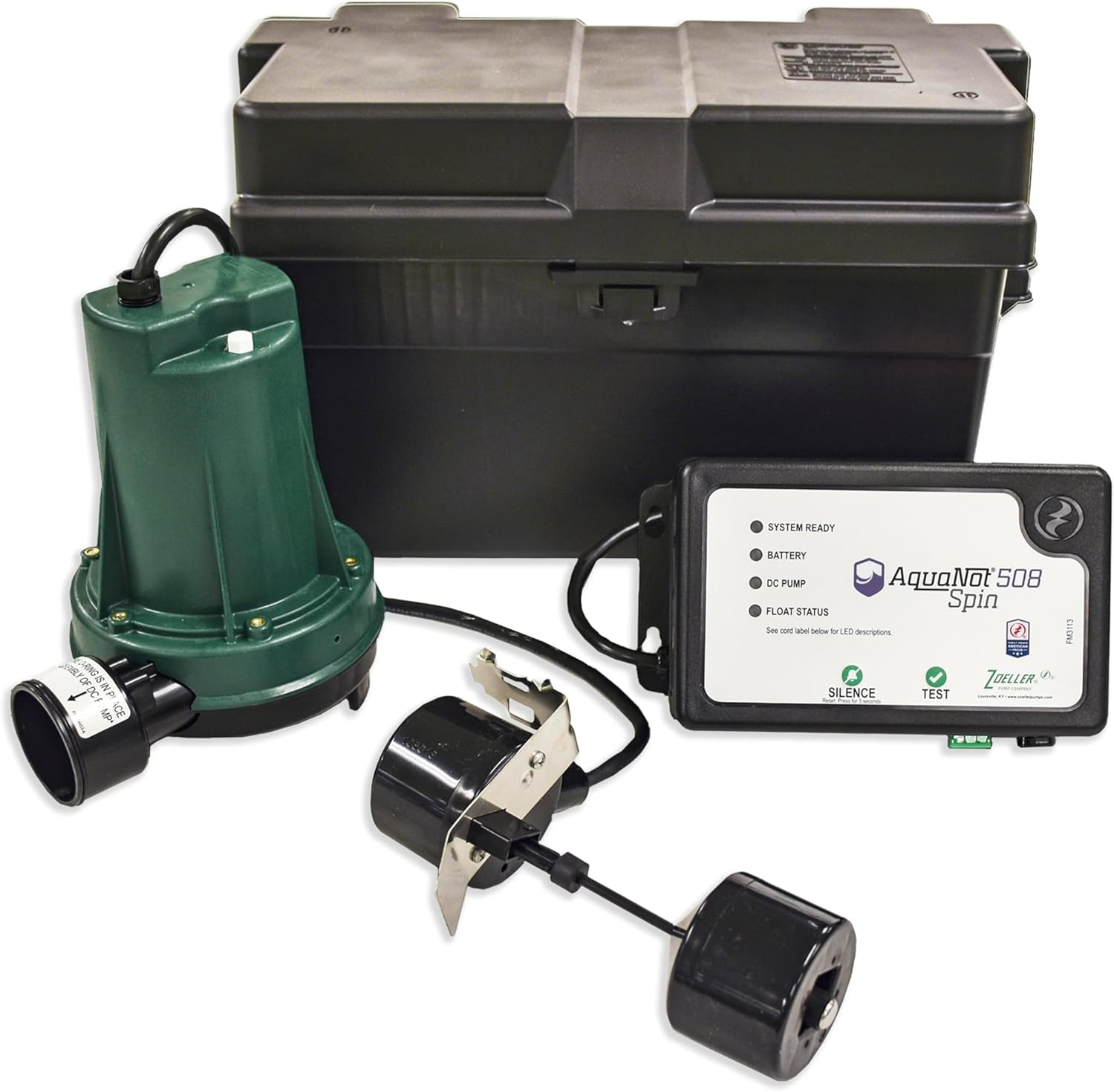
The Zoeller Aquanot 508 is the best sump pump battery backup for homes with a high water table or a primary pump that cycles pretty frequently.
What do you get with this sump pump battery backup?
The Aquanot 508 comes in two variants: the Spin and the Fit. Both share the same pump and Z Control smart controller platform. The Fit variant adds a WiFi-connected controller with two-way remote monitoring and diagnostics.
- Flow rate: 1,800 GPH at 10 ft, 2,340 GPH at 5 ft
- Battery charger: 7-amp automatic charging system with overcharge and burnout protection
- Battery type: Group 27, 29, or 31 deep-cycle (sold separately)
- Runtime: Up to 6 hours continuous, up to 48 hours at 10% duty cycle
- Controller: Z Control WiFi-enabled smart controller (Fit variant) with two-way remote monitoring and diagnostics
- Float switch: High/low dual-level activation
- Discharge: 1 1/2-inch port
- Price range: $300 to $420 (pump and controller; battery sold separately)
Zoeller Aquanot 508 pros and cons
The Aquanot 508 is the pick if you want a system your plumber already knows, but it costs more than the Basement Watchdog at similar performance specs.
Pros
- The Z Control smart controller gives you remote diagnostics beyond simple status alerts
- The 7-amp charger is gentler on battery chemistry than higher-amperage chargers, which tends to extend battery life in wet cell batteries over multiple charge-discharge cycles
- Accepts Group 27, 29, and 31 battery sizes, giving you flexibility to upgrade to a larger battery for more runtime without changing hardware
Cons
- The 7-amp charger is slower to recover a depleted battery than the Big Dog's 20-amp charger
- At $300 to $420 before battery, the Aquanot 508 is the second-most expensive standalone backup in this list
Should you buy the Zoeller Aquanot 508?
The Zoeller Aquanot 508 is worth the extra cost if you want a system installed and serviced by a licensed plumber. Zoeller's reputation among plumbers and the Aquanot's gentler 7-amp charger support long-term battery health better than a cheaper unit.
Buy it if:
- You want a system a local plumber already knows and can service
- You're upgrading batteries over time and want flexibility across Group 27, 29, or 31 sizes
- You want two-way remote diagnostics, not just status alerts, with the Fit variant's Z Control controller
Skip it if:
- You want the highest flow rate for the money, where the Basement Watchdog Big Dog moves more GPH at a lower price
- You need the fastest battery recovery between cycles, since the Aquanot's 7-amp charger is slower than the Big Dog's 20-amp charger
- Budget is the deciding factor, where the Liberty Pump 441 covers the same basic job for less
3. Liberty Pump 441
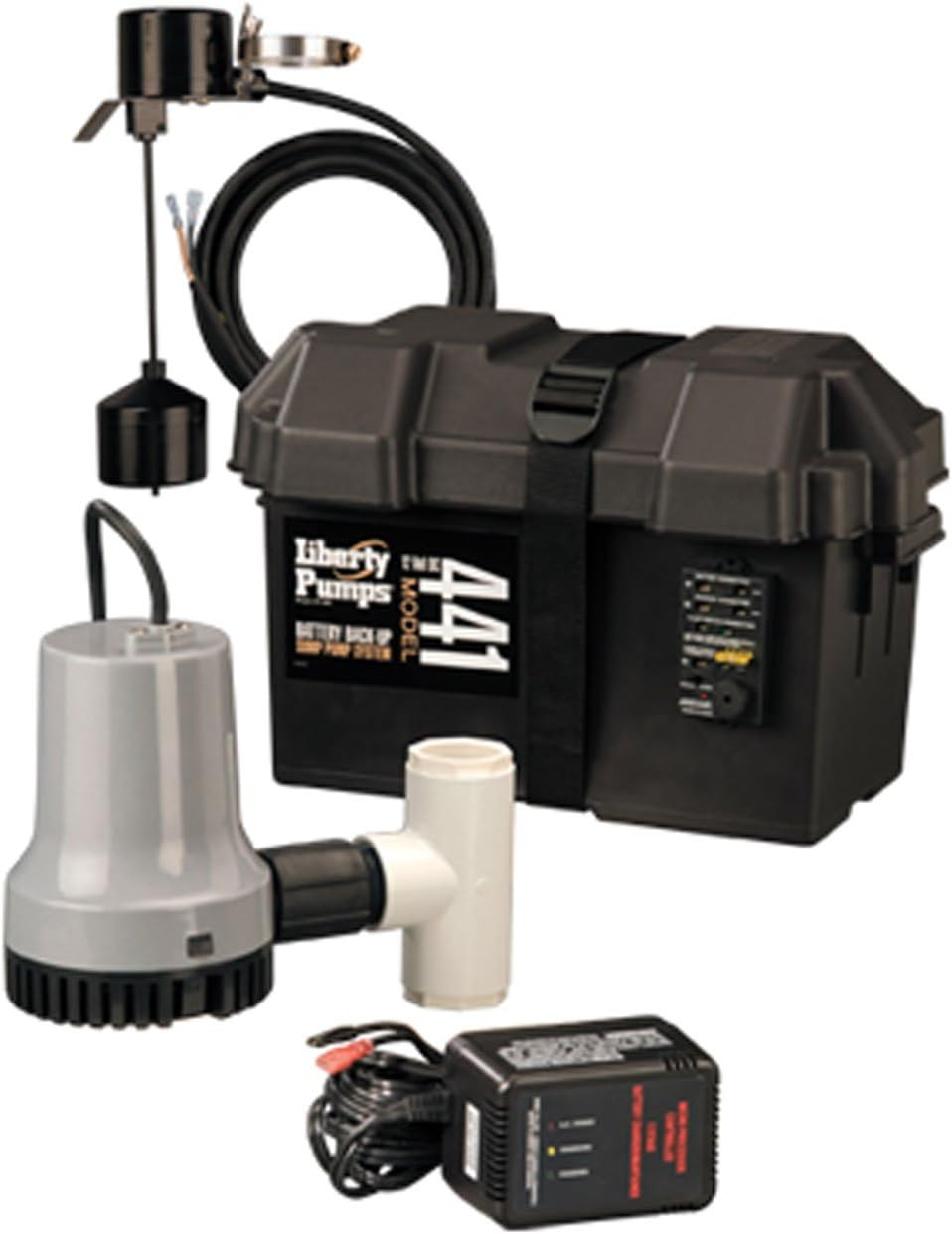
The Liberty Pump 441 is the best sump pump battery backup if you want solid protection without spending on a premium system.
What do you get with this sump pump battery backup?
The 441 is a straightforward battery backup sump pump system. It prioritizes reliability and ease of installation over advanced connectivity.
- Flow rate: 1,260 GPH at 10 ft
- Battery charger: 5-stage automatic charger that tests and maintains battery without self-discharge
- Battery type: Group 24 or Group 27 marine deep-cycle wet cell batteries (sold separately; GEL-type batteries are not compatible)
- Float switch: Vertical mercury-free float switch, reliable in narrow sump pits
- Alarm: Audible alarm and LED indicator activates during backup operation or charger fault
- Discharge: 1 1/2-inch port with check valve included
- Warranty: 3-year consumer warranty
- Price range: $180 to $260 (pump and controller; battery sold separately)
Liberty Pump 441 pros and cons
The 441's 5-stage charger is a pretty meaningful advantage over budget systems with single-stage chargers. It preserves battery life better over multiple charge-discharge cycles between storms.
Pros
- The 5-stage automatic charger tests battery health at each cycle
- The vertical float switch operates reliably in sump pits that are too narrow for tethered-style floats
- An audible alarm lets you know the backup is running even if you're not monitoring an app
- At $180 to $260 before battery, it's the most accessible price point among the three standalone battery backup systems in this list
Cons
- At 1,260 GPH at 10 ft, the 441 has the lowest flow rate of the standalone backup systems here
- The 441 doesn't support GEL-type batteries, which limits your replacement battery options at the 3-to-5-year swap
Should you buy the Liberty Pump 441?
The Liberty Pump 441 is the right buy if solid backup protection on a budget matters more than top-end flow rate. At $180 to $260, it's the most accessible price point in this roundup, and it still includes a 5-stage charger and an audible alarm.
Buy it if:
- You want the lowest-priced standalone battery backup in this roundup at $180 to $260 before battery
- Your sump pit is narrow and a tethered float switch tends to jam, since the 441's vertical float switch handles tight pits better
- You want an audible alarm and LED indicator that tells you the backup kicked in without checking an app
Skip it if:
- Your primary pump cycles frequently and needs more than 1,260 GPH at 10 ft, where the Basement Watchdog Big Dog or Zoeller Aquanot 508 move more water
- You expect to need GEL-type replacement batteries at the 3-to-5-year swap, since the 441 doesn't support them
- You want smart connectivity or remote alerts, which the 441 doesn't offer
4. Wayne BGSP50 Basement Guardian
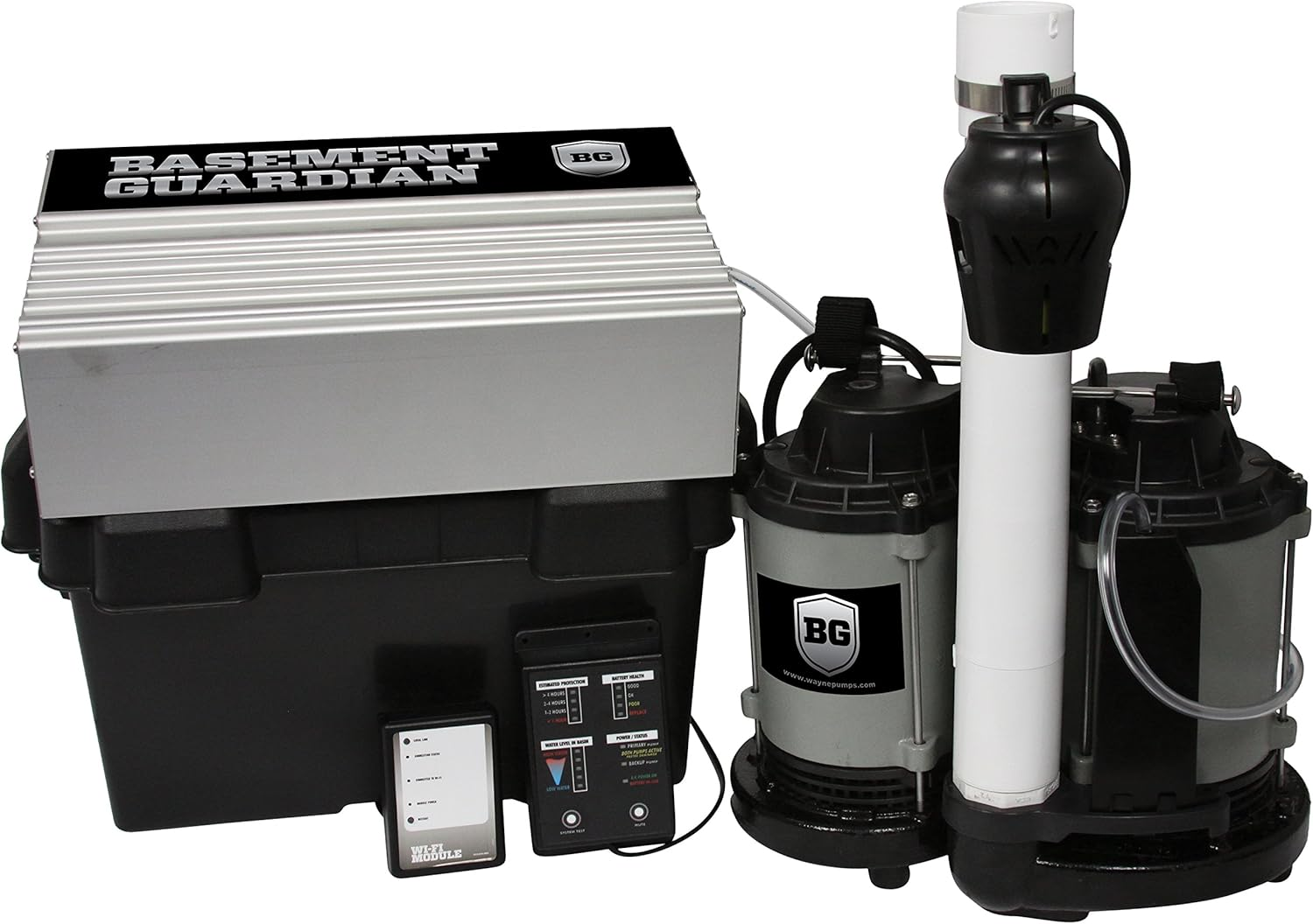
The Wayne BGSP50 Basement Guardian is the best battery backup if you want to replace your primary pump and add backup protection in a single installation.
What do you get with this sump pump battery backup?
The Basement Guardian replaces the primary pump and adds backup coverage simultaneously. That simplifies installation compared to adding a standalone backup alongside an existing primary pump.
- Primary pump flow rate: 3,840 GPH at 10 ft (5,100 GPH / 85 GPM maximum)
- Primary pump: 1/2 HP cast-iron AC submersible
- Backup pump: DC backup pump with redundant float switches
- Backup runtime: 6 hours continuous, removes up to 11,000 gallons per full battery charge
- Plumbing: Two pre-installed 1 1/2-inch check valves and a 1 1/2-inch discharge; fits 15-inch diameter or larger sump basins
- Connectivity: iOS and Android smart monitoring with Local Link technology that keeps transmitting pump data to the app even during a power outage; remote display shows pump activity, battery health, and water level
- Construction: Cast iron on both pump assemblies; 66 lb assembled weight
- Warranty: 5-year, assembled in the USA
- Customer rating: 3.6 out of 5 stars (46 ratings)
- Price range: $1,800 to $1,900 (battery sold separately; a compatible 75 Ah battery adds roughly $280)
Wayne BGSP50 pros and cons
The Basement Guardian's Local Link technology is the key differentiator among smart combo systems. It keeps a direct phone connection even when your home router loses power during an outage. The catch is that homeowner reviews are genuinely split on whether the electronics hold up.
Pros
- Local Link connectivity lets the unit send phone alerts even when your home router goes offline during a grid outage
- The 5-year warranty is the longest in this roundup, and the system is assembled in the USA
- Redundant float switches on the backup pump reduce the single-point failure risk that affects simpler tethered-float designs
- It comes pre-assembled with both check valves in place, and reviewers report a full primary-plus-backup setup in roughly 15 minutes of pump work given basic PVC skills, with a compact footprint that fits a 15-inch pit
Cons
- At $1,800 to $1,900 before a battery, the BGSP50 is by far the most expensive system in this roundup
- Homeowner reports include controller and microprocessor failures within months, plus intermittent controller-connection faults that knock the monitoring app offline Reviewers report the battery is effectively proprietary for monitoring purposes
Should you buy the Wayne BGSP50 Basement Guardian?
The Wayne BGSP50 Basement Guardian is the right buy if you need to replace an aging primary pump and want backup protection built in from the start, and you're willing to pay a premium for the longest warranty and outage-proof Local Link monitoring. Just go in clear-eyed: at $1,800 to $1,900 before a battery and a 3.6-star rating shaped by controller-reliability and app complaints, it asks for more money and more trust than anything else here.
Buy it if:
- Your primary pump is due for replacement and you want to add backup protection in the same installation
- You want the longest warranty in this roundup at 5 years, on a system assembled in the USA
- You want phone alerts that keep working even when your home router loses power, through Local Link connectivity, and you'll run Wayne's own battery to keep the monitoring accurate
Skip it if:
- Your existing primary pump still works fine and you just need a standalone backup, where the Basement Watchdog Big Dog or Liberty Pump 441 cost a small fraction as much
- The $1,800-plus price before a battery is more than your budget allows, where the Liberty Pump 441 covers the basics for a fraction of the price
- The mixed reliability record and reported controller failures give you pause, since a backup pump is the one device you can't afford to have fail during an outage
- You're on city water and want to avoid batteries entirely, where the Basepump HB1000-PRO fits better
5. Basepump HB1000-PRO
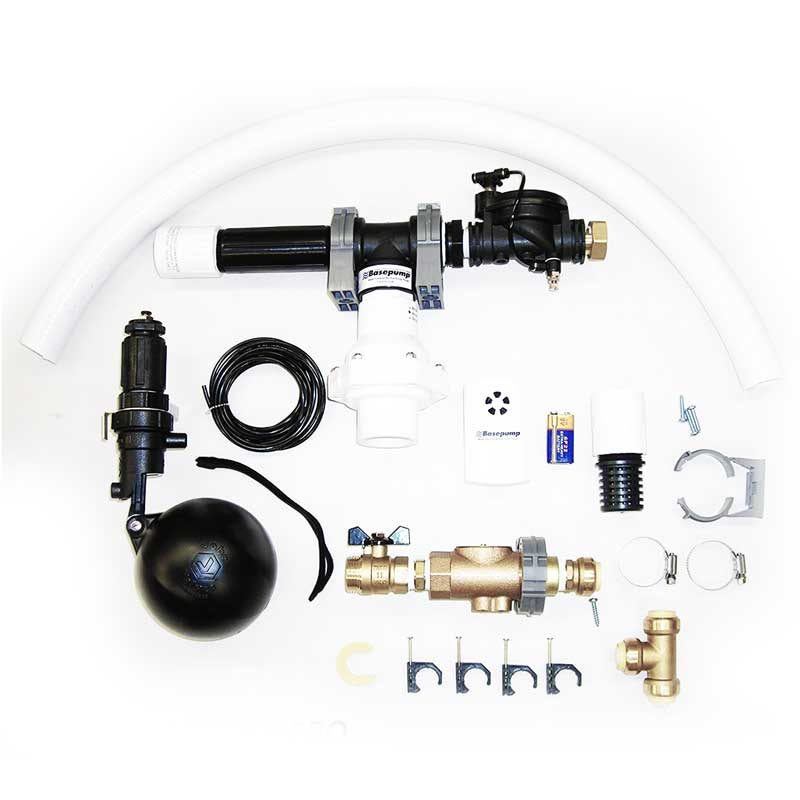
The Basepump HB1000-PRO is the best sump pump backup for homeowners on municipal water who want unlimited runtime without a battery to maintain or replace.
What do you get with this sump pump battery backup?
The HB1000-PRO mounts above the sump pit rather than inside it. That reduces contamination risk compared to in-sump water-powered units and often satisfies local plumbing codes with a simpler atmospheric vacuum breaker rather than a full reduced-pressure zone valve.
- Flow rate: Up to 1,400 GPH at 10 ft at 90 PSI city water pressure
- Water usage: 1 gallon of municipal water per 2 gallons of sump water removed
- Minimum water pressure required: 40 PSI; maximum 90 PSI
- Backflow prevention: Built-in brass backflow preventer (included in PRO version)
- Mounting: Above-sump design reduces contamination risk and simplifies code compliance
- Activation: Automatic float switch activation when the primary pump fails, or water rises
- Maintenance: No battery to replace, no charger to test
- Price range: $200 to $400
Basepump HB1000-PRO pros and cons
The HB1000-PRO's unlimited runtime is its defining advantage. But it actively consumes municipal water while running, and some jurisdictions prohibit it outright or require annual inspections.
Pros
- No battery means no replacement cycle, no charging system to fail, and no runtime limit as long as city water pressure holds during the outage
- The above-sump mounting design lowers contamination risk and simplifies backflow code compliance in a lot of jurisdictions compared to in-sump units that require a reduced-pressure zone valve
- At $200 to $400, it has a low cost of ownership over a 10-year period, once you factor out battery replacement costs from the other systems
Cons
- Not compatible with well water systems. During a power outage, your well pump also stops working, so the HB1000-PRO has no water supply and provides no protection.
- Some municipalities prohibit water-powered backup pumps outright or require annual testing of the backflow preventer by a licensed plumber.
Should you buy the Basepump HB1000-PRO?
The Basepump HB1000-PRO is the right buy for homeowners on municipal water who want unlimited runtime and no battery to maintain. It runs as long as city water pressure holds and costs $200 to $300 with no replacement battery to budget for.
Buy it if:
- You're on municipal water with at least 40 PSI pressure and want unlimited backup runtime
- You don't want to buy, maintain, or replace a battery on a 3-to-5-year cycle
- You want the lowest total cost of ownership over 10 years among the systems in this roundup
Skip it if:
- You're on well water, since your well pump also loses power in an outage and the HB1000-PRO would have no water supply
- Your municipality prohibits water-powered backup pumps or requires annual backflow inspections you'd rather avoid
- Your area has frequent prolonged outages where city water pressure could drop, where the Basement Watchdog Big Dog or Zoeller Aquanot 508 provide more reliable protection
How we ranked these sump pump battery backups
We ranked these systems for one specific situation: a power outage that puts your basement at risk. We combined manufacturer specs, homeowner reports, and published performance data, then weighted everything against what our outage data says people actually deal with when the grid goes down.
Here's what mattered most, in order:
- Works without grid power. This got the heaviest weight. Every system here runs on a deep-cycle marine battery or municipal water pressure, so none of them depend on the grid to activate when the primary pump loses power.
- Outage-duration fit. PowerOutage.us tracks outages across 950 utilities in real time, and that data shaped our duration assumptions. Average U.S. outage duration reached 662 minutes per customer in 2024, but hurricane-affected households like those after Helene waited 53 hours or more, and some areas went 14 or more days without restoration. We favored systems whose runtime figures scale toward that longer end, and we noted where a system's runtime covers only the first day of a multi-day event.
- GPH capacity at a 10-foot lift. We compared each backup pump's flow rate at a 10-foot lift against typical primary pump ratings, since a backup that can't match the primary pump's GPH falls behind during heavy inflow.
- Battery runtime and charger quality. For battery-powered systems, we weighed charger amperage, charge stages, and compatible battery groups, since these determine how long a system protects your basement and how well it maintains battery health between storms.
- Homeowner reports and manufacturer specs. We leaned on aggregated homeowner reviews and manufacturer-published specs. That's why we note things like the Zoeller Aquanot's reputation among plumbers or the Liberty Pump 441's narrow-pit float switch as reported strengths rather than claims we verified ourselves.
- Installation complexity. Standalone backups, combo systems, and water-powered units all install differently. We factored in whether a system requires replacing the primary pump, professional plumbing, or municipal water access.
- Cost, including the battery. We compared price ranges for the pump and controller, then noted where a battery purchase adds significantly to the total, like the $350 to $450 total for the Basement Watchdog Big Dog once a quality 75 Ah AGM battery is included.
- Warranty and long-term reliability. Longer warranties and proven track records, like the Basement Watchdog's microreed float switch rated for over 50 years or the Wayne BGSP50's 5-year warranty, counted in a system's favor.
Can storms knock out power long enough to flood your basement?
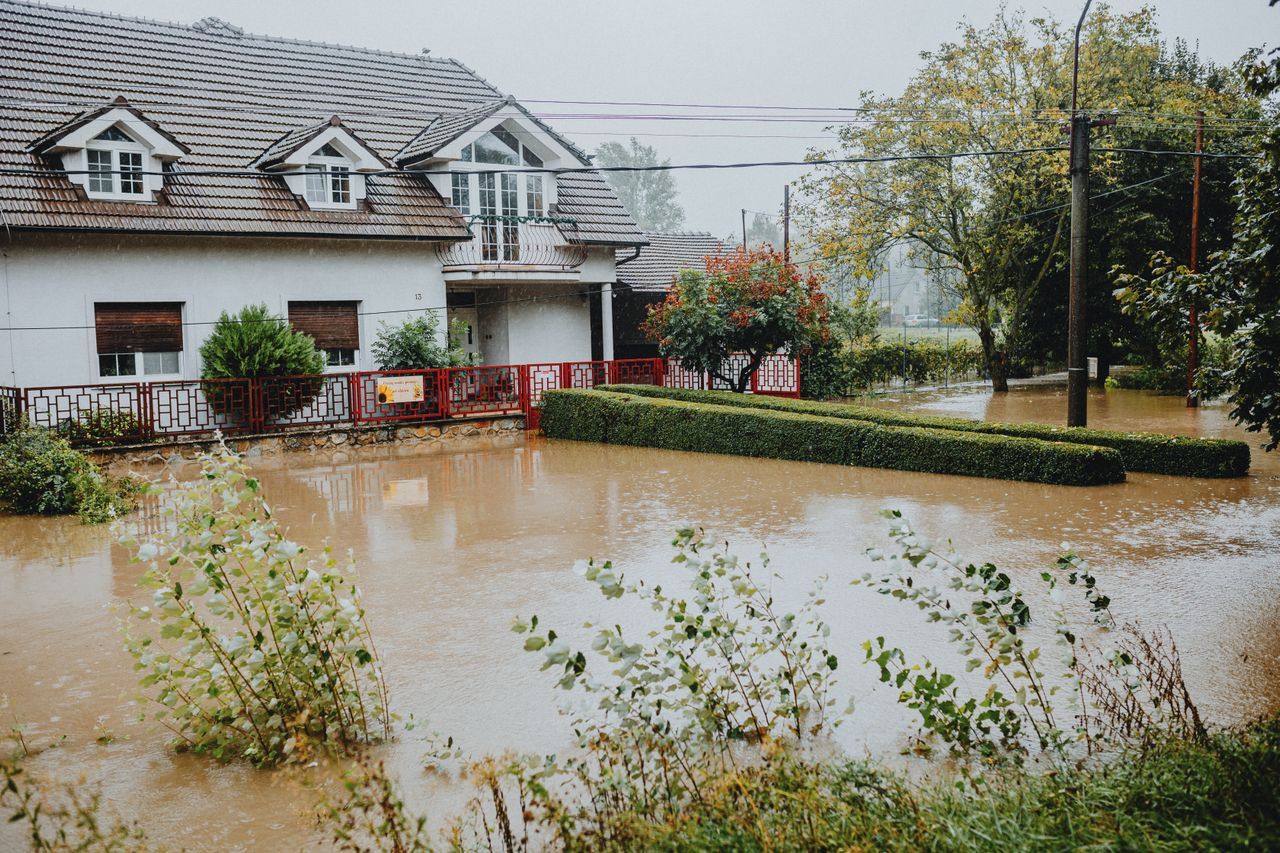
Multi-day power outages during major storms are common enough that a sump pump battery backup sized for only a few hours of runtime can run out of power.
For example, when Hurricane Helene made landfall in September 2024, PowerOutage.us tracked 4.79 million customers without power across the Southeast. Western North Carolina went 14 or more days without restoration in the hardest-hit mountain counties.
In those areas, a backup battery sized for 12 to 24 hours of runtime provided no real protection after day one of an event that lasted two weeks.
Winter Storm Fern in January 2026 left more than 1,005,641 customers without power at its peak. Some areas in Tennessee and Mississippi went 6 or more days without electricity. In this storm, ice brought down trees onto power lines across a 2,000-mile area, and utility crews worked through subzero conditions to restore service.
For homeowners in those areas with active water tables, a battery sized for a 12-hour outage covered one day of a six-day event. Read our severe thunderstorm guide for storm-specific preparation steps.
Does a generator work as a sump pump backup alternative?
A portable generator can power a sump pump during a grid outage, but someone has to be home to start it, and it doesn't protect against primary pump mechanical failures.
A typical 1/2 HP sump pump draws about 9 amps at 120 V, or roughly 1,080 W under load. Any portable generator rated above 1,500 W can handle that load no problem. But a whole-home standby generator activates automatically within seconds of a grid failure and is pretty much the most complete solution for homes where outages occur regularly.
However, a generator doesn't solve the primary pump failure scenario. If your primary pump's motor burns out or its float switch fails while the grid is up, no generator helps.
A dedicated battery backup sump pump activates on both conditions: power outage and primary pump failure. Homeowners in high-risk areas often run both. They use a generator for extended outage coverage and a battery backup as an automatic fail-safe for the first hours of any event.
Quick recap
Wrapping up, the Basement Watchdog Big Dog BWD12-120C is the best sump pump battery backup for most homes, with the highest runtime and the most proven field record. The Wayne BGSP50 replaces your primary pump and adds backup in one install. And if you have city water, you can consider the Basepump HB1000-PRO for unlimited runtime with no battery to maintain.