


Older adults have to deal with certain dangers during a power outage that most younger people don't. Heat, cold, medication storage, powered medical devices, and limited mobility all become problems when the lights go out. Senior citizen power outage preparation requires a doable plan before the storm.
PowerOutage.us tracks outages across 950+ utilities serving more than 200 million customers. During Hurricane Ida in 2021, we tracked over 1 million customers still without power the morning after landfall, with Louisiana bearing the heaviest impact. Many of those customers were elderly adults living alone or in assisted care facilities. During Hurricane Ian in 2022, over 2.78 million customers lost power at peak across Florida, with some coastal communities waiting weeks for full restoration. Events like these show why elderly power outage storm prep isn't optional.
Why do elderly adults have higher risks during outages?
Seniors experience power outages differently because of physical and medical factors that compound quickly in the dark. About 22% of those ages 65-74 and 55% of those who are 75 and older have disabling hearing loss, according to the National Institutes of Health. That means emergency alerts like from a radio or even a neighbor knocking can go unheard.
Vision impairment adds another layer. Navigating a home in the dark is difficult with reduced depth perception or peripheral vision. A sudden power blackout multiplies the risk of falling in every room of the house.
Medical device dependency is another urgent concern. Oxygen concentrators, CPAP machines, home dialysis units, and electric wheelchairs all require power to function and can stop when the grid fails if they don’t have backup batteries or power. If you need supplemental oxygen, for example, you don’t have hours to figure out a backup plan. You need to already know what to do. See our medical device power outage checklist for device-specific backup guidance.
Senior citizen power outage preparation plan
Senior citizen power outage preparation starts with knowing your personal risks and planning support through utility assistance and your personal network.
Assess personal risk first
Start by writing down every condition or device that would become a problem within 24 hours of losing power. Depending on your situation, this could include:
- Prescription medications that require refrigeration (like insulin)
- Powered mobility equipment (electric wheelchair, stair lift, hospital bed)
- Medical devices that run on electricity (CPAP, oxygen concentrator, nebulizer)
- Hearing aids that need USB or battery charging
- Vision limitations that make navigating in the dark dangerous
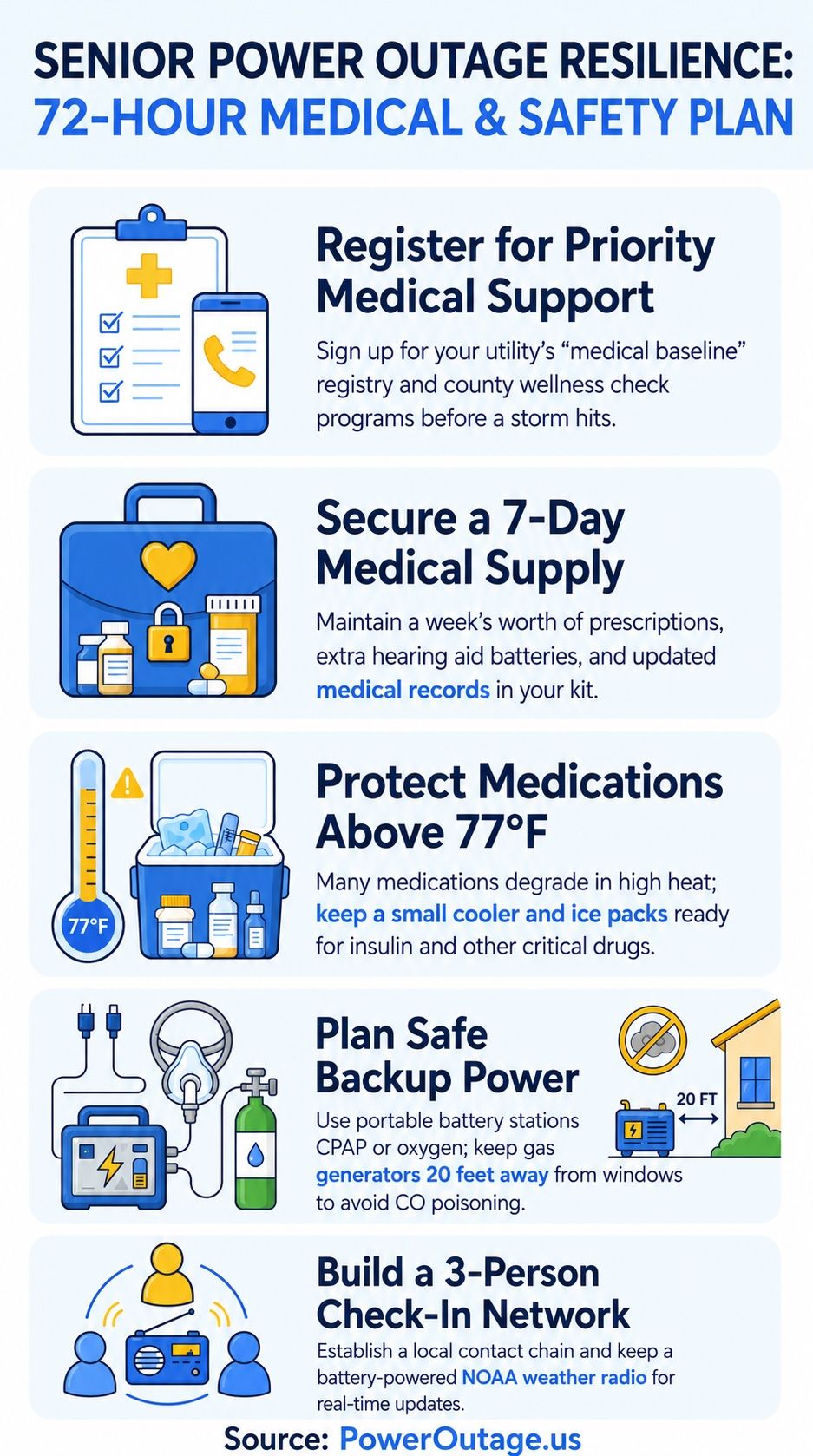
Next, make a specific backup plan for each item. For example, insulin kept at room temperature above 77°F begins to degrade, so even a short outage in summer creates a risk. A portable cooler with ice packs buys time, while a generator or even a home battery backup provides more.
Let your utility company know
Many utility companies maintain a medical baseline or life support registry. Customers who register as medically dependent can receive advance warning of planned outages and may receive priority restoration during emergencies. Contact your utility directly to ask about enrollment. The FEMA Ready.gov resource for older adults also recommends this for anyone relying on powered medical equipment.
Build a communication and check-in plan
Create a list of at least three people (neighbors, family members, friends) who will check in if power goes out for more than a few hours, since elderly adults living alone are especially vulnerable during extended outages. Decide in advance how you'll reach each other if cell service becomes spotty. We recommend having walkie-talkies for local communication backup.
Share this list with local emergency management. Many counties offer voluntary wellness check registries for elderly and disabled residents. Search your county's emergency management website or call 211 to find out what's available in your area.
Create a 72-hour senior emergency kit
Preparing for 72 hours without power means covering food, water, medications, communication, and warmth before the outage happens. For elderly adults, the standard kit needs a few extra items.
Main supplies:
- One gallon of water per person per day (minimum 3-day supply)
- Non-perishable food that doesn't require cooking or refrigeration
- Flashlights and extra batteries
- Battery-powered or hand-crank radio for emergency alerts
- Manual can opener
- Warm blankets and extra clothing
Senior-specific additions:
- A 7-day supply of all prescription medications (ask your doctor or pharmacist about an emergency supply; some states allow early refills during declared disasters)
- Ice packs and a small cooler for temperature-sensitive medications like insulin
- Extra batteries for hearing aids and assistive devices
- A portable phone charger (power bank) for medical alert devices and phones
- Large-print or Braille labels on emergency items
- Written copies of medical records, insurance cards, and medication lists
- Manual wheelchair, cane, or walker as backups to powered mobility devices
Store everything in a wheeled container that you can grab and put it near an exit you'd use to evacuate.
The FEMA emergency kit checklist provides a standard baseline. Build on it with the senior-specific items above. Our power outage emergency kit guide also includes additional detail on supply selection and storage.
Watch the temperature
Medications stored in cars or garages face temperature extremes that can degrade them within hours. Heat above 77°F and cold below freezing both affect common medications like insulin, nitroglycerin, and some antibiotics. A temperature log strip, available cheaply at most pharmacies, can tell you if a medication supply was exposed to harmful temperatures during an outage.
Backup power options for elderly adults
A generator or battery backup unit can be the difference between a manageable outage and a medical emergency for elderly adults who rely on powered devices. The right choice depends on which devices need power and for how long.
Portable generators
Portable generators can run medical equipment and household appliances, but they must never be used indoors or in attached garages. Carbon monoxide from a generator kills within minutes in an enclosed space. The CDC's carbon monoxide safety guidance is clear: keep home generators at least 20 feet from any window, door, or vent.
Battery backup systems
Battery backup systems range from portable power banks to whole-home installed units. For CPAP machines and smaller oxygen concentrators, a high-capacity power station can provide overnight runtime. Larger systems can power an entire medical setup for 12 to 48 hours.
Medical battery backups
Home health equipment providers sometimes provide medical battery backups. If you rent or lease a CPAP or oxygen concentrator, call your equipment supplier and ask whether they provide emergency battery support. Options include uninterruptible power supplies, which have a smaller capacity but are designed to switch over in only a few milliseconds.
The right backup depends on which devices you have and your budget. Keep in mind that one storm can cause outages of very different durations in a region. During Hurricane Helene, for example, rural customers in western North Carolina waited over two weeks for restoration. In urban areas during the same storm, power returned within a day or two. Knowing your area's typical pattern helps you size your backup correctly. Use PowerOutage.us to check current and historical outage data for your county.
Outage events show why senior preparation matters
When Winter Storm Fern hit in January 2026, our PowerOutage.us platform tracked over 1 million customers losing power at once. This included 306,700 customers in Tennessee. Parts of northern Mississippi were dark for two weeks as trees kept falling on power lines.
Elderly residents in those affected areas who hadn't prepared faced the full weight of that outage. Cold snaps during winter ice storms push indoor temperatures down quickly in poorly insulated homes. For older adults, hypothermia is a real risk in this situation.
During Hurricane Helene, which knocked out power to 4.79 million customers across the Southeast, we also tracked restoration taking 14+ days in some rural areas. Do you have what you need to last through a two-week outage? Many people don’t.
Nursing home power outage protocols
Nursing homes and assisted living facilities in most states are legally required to have emergency preparedness plans that address power failures. After Hurricane Irma in 2017, a Florida nursing home power outage caused the deaths of multiple residents. That event prompted the Centers for Medicare and Medicaid Services (CMS) to strengthen emergency preparedness requirements for facilities receiving Medicare and Medicaid funding.
Under current CMS rules, nursing homes must maintain a generator and fuel supply capable of running heating, cooling, and essential medical equipment. They also need documented plans for evacuation, staff responsibilities, and coordination with local emergency management.
As a family member or caregiver, you can ask the facility directly:
- What is the backup power plan if grid power fails for more than 24 hours?
- Does the facility have a generator? What does it power?
- How does the facility communicate with families during an emergency?
- Is the facility registered with local emergency management?
If you have a loved one in a memory care unit or skilled nursing facility, ask for a copy of the emergency preparedness plan. Facilities are required to share it. If the plan is vague or the staff can't answer basic questions, that's worth escalating to your state's long-term care ombudsman (a third-party who resolves disputes). The National Long-Term Care Ombudsman Resource Center can help you locate your state's ombudsman.
Seasonal safety during outages for the elderly
Temperature extremes during outages can be more risky to elderly adults.
Summer
During a heat-related outage, move to the coolest part of the home. If indoor temperatures rise above 90°F, relocate to an air-conditioned public space like a library, community center, or cooling shelter. The CDC's heat emergency guidance identifies adults over 65 as the highest-risk group for heat-related illness. Check on elderly neighbors who live alone. Heat exhaustion and heat stroke can develop quickly and may not be recognized as emergencies.
Winter
In cold-weather outages, keep sleeping areas insulated. Layering blankets to retain body heat effectively. Wool and synthetic materials hold warmth better than cotton when wet. If a wood stove or fireplace is available, use it with proper ventilation. Never use a gas stove or oven for heat. Carbon monoxide poisoning from improvised heating is a leading cause of outage-related death.
Coordinating care during an extended outage
For elderly adults who receive regular caregiver visits (home health aides, visiting nurses, or family members) an extended outage disrupts the entire care schedule. Caregivers have to deal with road closures, fuel shortages, or their own power failures at home.
Identify a backup caregiver who lives closer and can step in if the primary caregiver can't reach you. Keep a printed list of critical care instructions that any backup caregiver could follow without needing to call for guidance. These instructions should cover medication schedules, mobility assistance needs, dietary requirements, and other important care points.
Area Agencies on Aging (AAA) coordinate services for elderly adults in every state. During declared disasters, many AAAs provide emergency coordination and can help connect isolated seniors with transportation, meals, and wellness checks. Find your local AAA through the Eldercare Locator, operated by the U.S. Administration on Aging.
Staying informed during an outage
Staying informed when the grid goes down is especially important for seniors and their caregivers. Power outages move fast. A storm that looked like it would miss your area can shift within hours, so keep these tips in mind.
- Battery-powered or hand-crank weather radio: The NOAA Weather Radio network broadcasts emergency alerts continuously. A battery-powered receiver keeps you connected without relying on cell service or Wi-Fi.
- Text alerts from your county: Most counties offer opt-in emergency alerts by text message. Sign up before the storm.
- PowerOutage.us outage map: Our real-time outage map updates every 10 minutes and covers 94%+ of the U.S. power grid. Bookmark it on your phone for live outage data during events.
- FEMA app: The FEMA app provides real-time alerts, shelter locations, and disaster assistance information for your area.
Quick recap
Elderly adults face life-threatening risks when a power outage cuts heat, refrigeration, and medical devices. Manage the event by making a 72-hour emergency kit, planning a backup power source, and making a caregiver check-in plan. Use PowerOutage.us to monitor outages in your area in real time.