



A solid power outage communication plan means your family knows exactly how to reach each other before cell towers get jammed and the internet goes dark. Cell phones can die and towers can run out of backup power in an extended storm blackout, so preparation is important.
PowerOutage.us tracks 950+ utilities serving over 200 million customers across the U.S., monitoring every major outage event since 2016. When Winter Storm Fern struck in January 2026, our platform showed some Tennessee households went over 6 days without electricity. A plan keeps your family safe during events like that.
Why a family communication plan matters during a power outage
Cell networks can fail during major outages because too many people try to call at once. Local circuits overload fast. That risk is exactly why every household needs a power outage communication plan, beyond just a general emergency checklist.
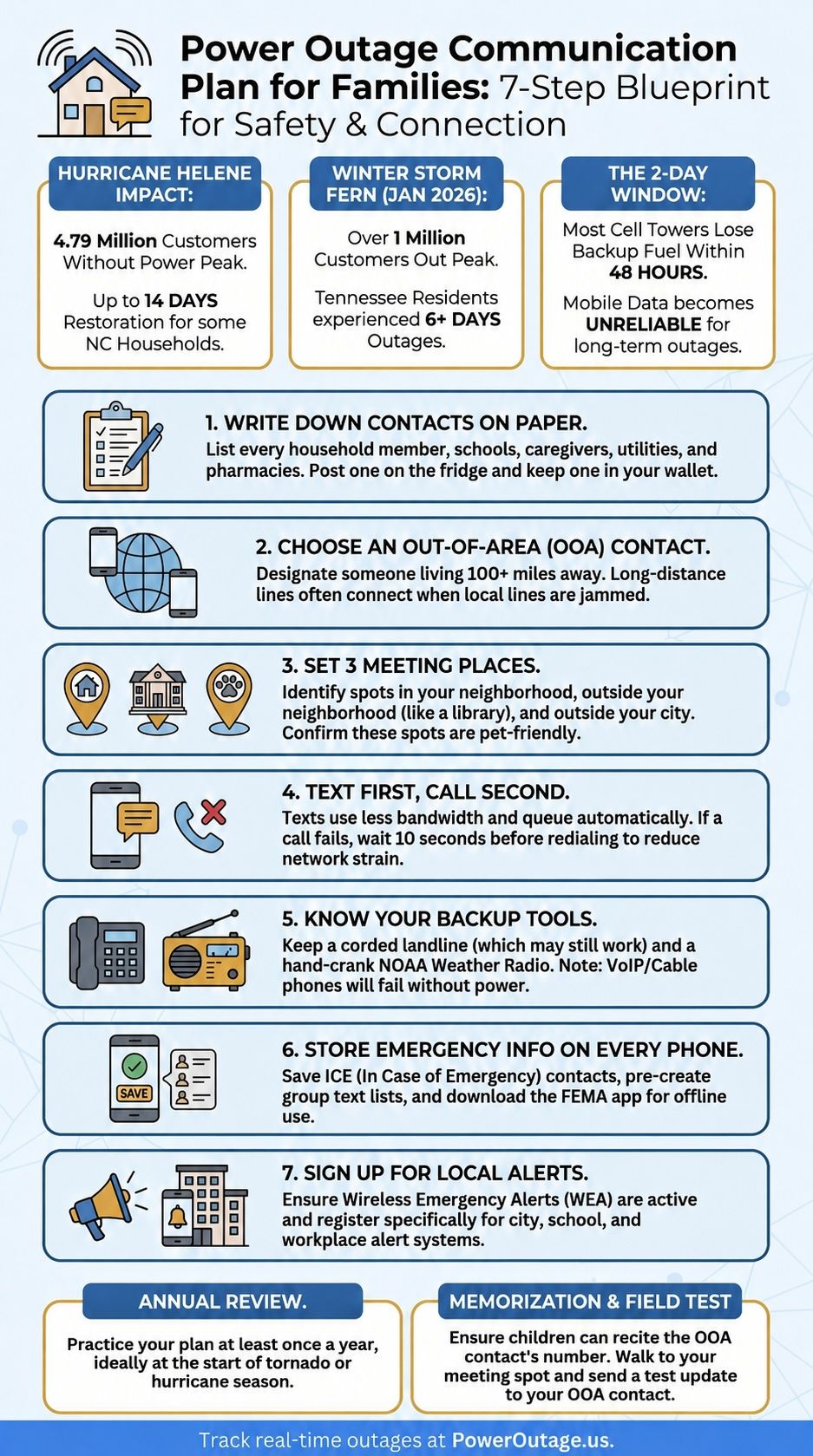
During Hurricane Helene, for example, our platform recorded 4.79 million customers without power at the storm’s peak across the Southeast. Millions of people reached for their phones at the same time in this situation.
A power outage communication plan gives each person clear instructions on who to contact, where to go, and what to do if direct communication fails.
Plan ahead because a written plan works when digital tools don’t. Families who prepare a blackout communication plan before an outage starts can reconnect faster and avoid wasting battery life on failed calls.
Step 1: Collect contact information on paper
Paper is the foundation of any power outage communication plan. Your phone will die after some time (whether you have a backup power bank or not). A written list works regardless of whether you get power back in two hours or two weeks.
Your paper contact list should include:
- Full names and phone numbers for every household member
- Your child's school, daycare, or caregiver phone numbers
- An out-of-area contact (more on this below)
- Emergency services like the local police non-emergency line, plus fire department and hospital numbers
- Utility company outage reporting number
- Insurance company contact
- Medical providers, pharmacies, and any service providers for household members with disabilities
Keep this list in a wallet, backpack, or purse. Post a copy on your refrigerator. You can find a wallet-sized template at Ready.gov to fill out online and print. You can include the contact list within a power outage emergency kit so everything your family needs is in one place when an outage happens.
Children who don't carry phones need to memorize at least two numbers: a parent's cell and the out-of-area contact. Most adults can’t recite important phone numbers from memory, which is why writing them down matters so much.
Step 2: Choose an out-of-area contact for outage communication
An out-of-area contact is one person outside your city or region who acts as a central relay point for your family. This works because local phone circuits overload during disasters, but long-distance calls often still connect.
When local lines are jammed and your family members can't reach each other directly, each person calls the out-of-area contact instead. That person collects status updates and passes them along. It is a simple system that removes the bottleneck of everyone trying to reach the same local number.
Your out-of-area contact should:
- Live at least 100 miles away from your area
- Know they have this role before any emergency occurs
- Have the names, phone numbers, and relevant medical information for your entire household
- Know your family's meeting places in case communication remains down
According to communication guidance from the American Red Cross, long-distance calls often work when local calls can’t get through.
Step 3: Set up meeting places
Every power outage communication plan needs physical meeting locations that are reliable If phones are dead and cell service is down.
Plan for three scenarios:
- In your neighborhood: A specific spot near your home where family members meet if you need to leave quickly. A mailbox, a neighbor's driveway, a large tree at the corner. Specific and familiar.
- Outside your neighborhood: A library, community center, or house of worship that your family can reach if home is not accessible. Confirm this location is open during emergencies and accessible for any household members with mobility needs.
- Outside your town or city: A relative's or friend's home at least one town away. This is important if a disaster causes evacuation orders or when the home isn’t reachable at all. Make sure every family member knows the address and at least one way to get there without GPS.
Don’t forget about your animals. If you have pets, find out which meeting places are pet-friendly in advance. Scrambling to find an animal-friendly shelter during an outage wastes time your family doesn't have.
Step 4: Prioritize text over calls
During a major outage, when cell towers are overloaded, a text will often get through when a call will not. This is because text messages require far less bandwidth than phone calls. Texts queue and send automatically once capacity frees up, while calls either work or drop.
The FCC advises keeping calls brief during emergencies, waiting at least 10 seconds before redialing failed calls, and defaulting to texts for non-urgent communication. Calling back very quickly can make the network more congested.
Practical texting habits for outages:
- Keep messages short
- Designate one household member to send group updates so messages don't get duplicated
- Create a group contact list on every phone now, before any emergency
- Make sure every family member, including older children and teens, knows how to send a text
If a household member is deaf or hard of hearing, the FCC recommends having relay service options available, including TTY devices or Video Relay Service (VRS) through mobile, and knowing how to connect via landline relay as a backup.
Step 5: Know your backup communication tools
Besides cell phones, battery-powered and analog options are important communication tools in an extended outage.
- Corded landline phones work during many outages because traditional copper phone lines carry their own low-voltage power. That said, cordless phones don’t work without electricity.
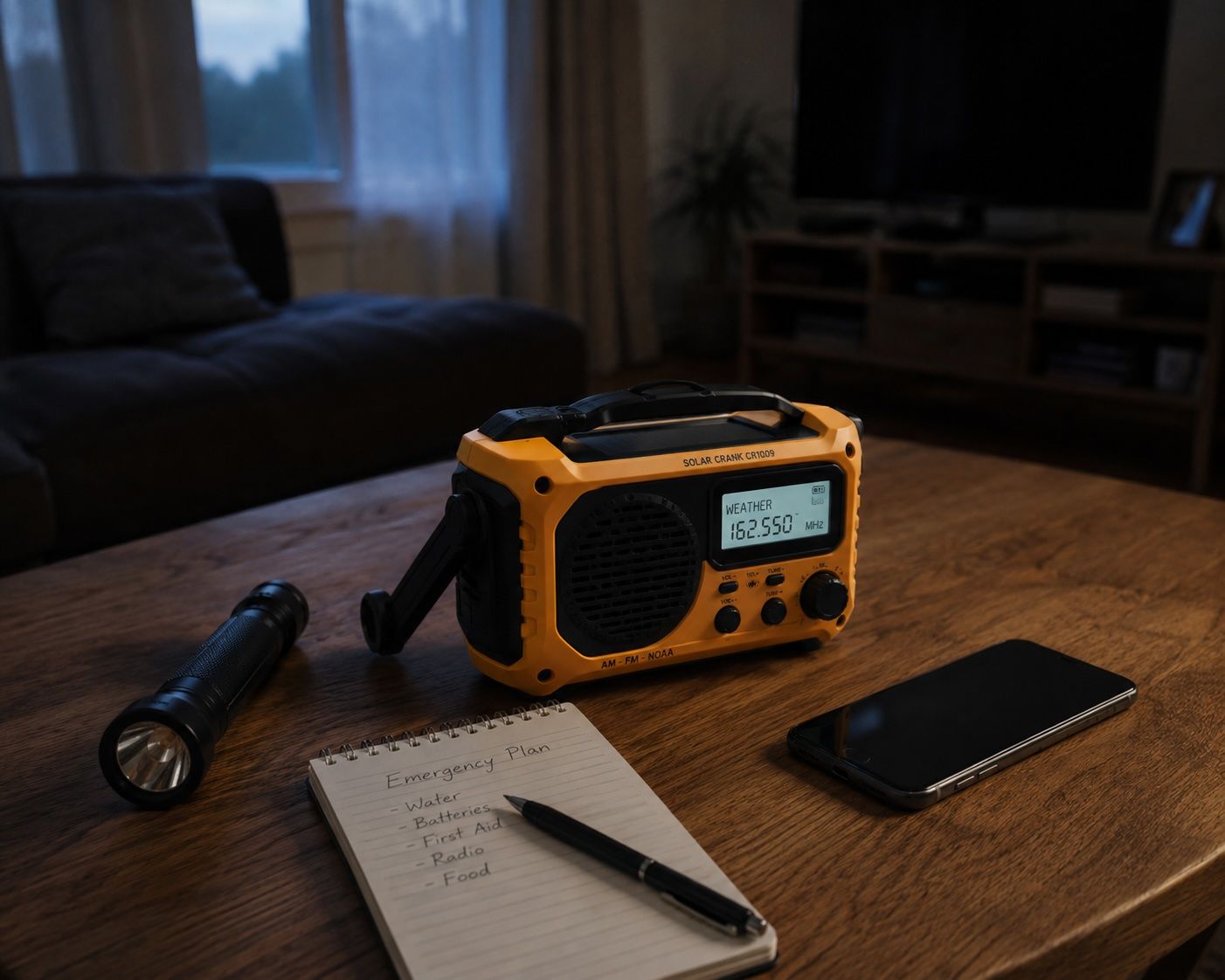
- Battery-powered or hand-crank radios let you receive emergency broadcasts when the internet and TV are down. A NOAA Weather Radio is worth keeping charged and accessible.
- Pay phones, where still available, run on separate circuits and may work when cell networks are saturated.
- Car chargers let you charge a cell phone using your vehicle's battery. If you’re charging a phone in a garage or enclosed space, make sure the car is not running to avoid carbon monoxide exposure.
The FCC and FEMA both recommend keeping a prepaid phone card on hand if your household relies entirely on cell service and does not have a landline. In areas with no signal, prepaid cards used on a landline or payphone can still work.
Also, VoIP phone service, which routes calls over the internet, doesn’t work during a power outage unless you have a backup battery for your modem and router. Many households have quietly shifted to VoIP without realizing that this changes how their phone behaves when the grid goes down. If your provider is Comcast, Spectrum, or a similar cable/fiber company, your home phone almost certainly runs on VoIP. Ask your provider whether they include a battery backup unit and how long it lasts.
Consider backup power for devices
Plan out your backup power options to keep some communication devices going in an outage. For example, a generator can keep a corded phone base, battery charger, or modem running during extended outages when other backup power runs out. If you can afford it, installing a home battery backup can also help keep devices running while you have capacity.
Step 6: Store contact information on mobile devices the right way
Every phone in your household should have an "in case of emergency" contact. Emergency responders and hospital staff are trained to look for emergency contact names when a person can’t communicate.
- Enter all household member numbers into every phone, not just your own
- Create a group text list with everyone you'd need to reach in an emergency
- Store your utility company's outage number
- Download the FEMA app, which provides emergency alerts, shelter locations, and disaster checklists offline
Let your emergency contact know of any medical conditions or medications. This is especially important for household members with diabetes, heart conditions, mobility limitations, or those who rely on electrically powered medical devices. Make sure you have a medical device checklist to know how to provide backup power to devices in an outage.
Step 7: Sign up for local alerts and warnings
Sign up for emergency alerts to get information before the outage gets worse and before your local news website updates. Wireless Emergency Alerts (WEA) are sent automatically to most cell phones by government agencies, but local alerts require you to sign up separately.
Check your county or city emergency management website to register. Many systems send alerts via text, email, or automated call. Schools and workplaces often run separate alert systems as well. Sign up for each one that applies to your household.
Outage examples that strained communications
The PowerOutage.us platform has tracked every major outage event since 2016. Communication failures follow predictable patterns across events.
During Winter Storm Fern in January 2026, our platform tracked over one million customers losing power at one time, with northern Mississippi customers going without power for two weeks. Ice-laden trees crashed onto lines faster than crews could repair them.
Cell towers ran on backup generators, but many lost power within a couple of days once generator fuel ran out. Families in Nashville metro areas experienced some of the longest restoration waits because urban density creates more complex repair sequencing.
Hurricane Helene produced even more extreme communication stress, with 4.79 million customers losing power at its peak and over 7.4 million customers affected across Florida, South Carolina, Georgia, and North Carolina. Some households in western North Carolina went 14 days without power. In areas like that, any family communication plan that depends entirely on cell service fails by day two. Written contact lists, designated meeting places, and an out-of-area contact are what actually reconnect families when outages stretch into weeks.
Check PowerOutage.us during any active event to see real-time data on your area's outage status.
Practice your plan at least once a year
Don’t forget to actually practice your communication plan to transform it from a plain document to a real-life plan.
Run a simple drill with your household:
- Have each member send a text to the out-of-area contact
- Walk or drive to your neighborhood meeting spot so everyone knows exactly where it is
- Confirm that every household member can recite or find the out-of-area contact number without looking at their phone
- Review the written contact list together and update any numbers that have changed
Review and practice your plan at least once a year, or any time household members or contact information changes. Another good reason to practice is the start of storm season in your region. For much of the U.S., that means spring for tornado season and early fall for hurricane season, but winter ice storms like Fern have shown that outages can happen anywhere, in any month.
After each practice, talk about what worked, then djust accordingly. The goal is to be comfortable following the process under stress.
Quick recap
When power goes out, cell networks jam fast. Build a written family communication plan before it happens: collect paper contact lists, designate an out-of-area relay contact, pick meeting spots, default to texting, and keep backup tools like corded phones and battery radios ready. Use PowerOutage.us to track outages in real time and know whether your family's area is affected before you make the call to activate your communication plan.