





For a power outage, you want an emergency radio that pairs automatic NOAA weather alerts with a few different charging methods, including a hand crank. We cover five tested models here, ranging from 850 mAh to 4,000 mAh in battery capacity, plus a buyer's guide for figuring out which one fits your outage risk.
PowerOutage.us monitors 950-plus utilities covering more than 200 million U.S. customers, with data refreshing every 10 minutes during live events. Our storm preparedness resources use that outage data to help you prepare for the events most likely to affect your area.
5 best emergency radios for power outages
To find the best emergency radios for power outages, we evaluated models on four things. Automatic NOAA weather alert capability versus manual tune weather band, hand crank efficiency measured in minutes of radio time per minute of cranking, battery capacity in milliampere hours (mAh), and how easy the controls are to use under stress. We only considered radios available in the U.S. market with verified third party testing data.
1. Midland ER310
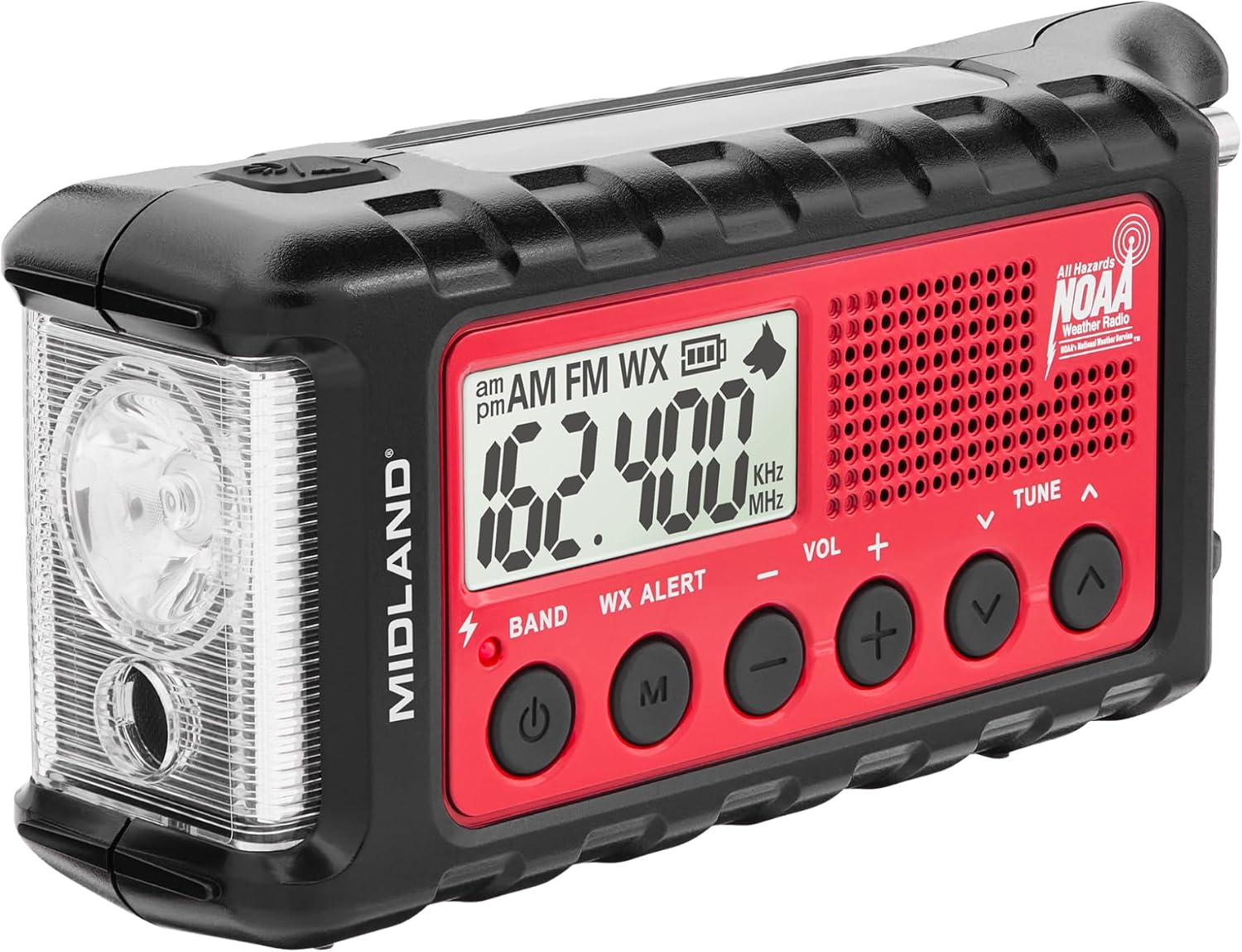
The Midland ER310 is the best emergency radio for power outages. It's got automatic NOAA weather alerts, good ergonomics, and four independent power sources in one unit.
What do you get with this emergency radio?
The ER310 combines weather alert capability with the widest range of charging options you'll find in a portable emergency radio.
- NOAA weather alert: Automatic; activates without manual tuning via a dedicated Alert button
- Battery: 2,600 mAh rechargeable lithium ion
- Hand crank output: 26 minutes of radio time from 1 minute of cranking
- Solar panel: Charges fully after 1 hour in direct sunlight; reaches one third charge after 6 hours
- Battery backup: 6 AA batteries (the only model in this list with a disposable battery fallback)
- Flashlight: 3 modes: standard, bright, and flashing SOS
- USB output: Charges external devices from the internal battery
- Display: Large backlit LCD screen
- Price range: $75 to $90
Here's the thing about the Midland ER310. It's a weather alert radio, not just a weather band radio. A weather alert radio receives emergency broadcasts automatically and sounds an alarm without you having to have it on and tuned in ahead of time. A weather band radio needs manual tuning before it can receive any NOAA alert.
Midland ER310 pros and cons
The ER310 is the most versatile option in this list because its four charging methods and auto alert capability cover every scenario, from a brief thunderstorm outage to a multi week hurricane aftermath.
Pros
- Automatic NOAA weather alerts don't require any manual setup during an emergency
- Four independent power sources (rechargeable battery, hand crank, solar, and 6 AA batteries)
- 26 minutes of radio time per minute of cranking is pretty strong performance relative to the battery size
Cons
- At $75 to $90, the ER310 costs more than weather band alternatives with comparable battery capacity
- The solar panel charges slowly in indirect or partly cloudy conditions. You're getting well under one third charge after 6 hours outdoors on an overcast day.
Should you buy the Midland ER310?
The Midland ER310 is the right buy for most households because it pairs automatic NOAA weather alerts with four independent charging methods and a 2,600 mAh battery in one unit. If you want one emergency radio that covers every outage scenario without a learning curve, this is the pick to start with.
Buy it if:
- You want automatic NOAA alerts that work overnight without you tuning anything
- You want maximum charging redundancy, since the ER310 is the only model here with a disposable AA battery fallback alongside crank, solar, and rechargeable power
- You're building a single go bag or household radio and don't want to compare charging tradeoffs later
Skip it if:
- $75 to $90 is more than you want to spend, where the FosPower Model A1 or RunningSnail MD-090P cost less
- Phone charging capacity matters more than auto alerts, where the RunningSnail MD-090P's 4,000 mAh battery does more
- You want a smaller, lighter version with the same alert capability, where the Midland ER40 slips into a pocket or go bag better
2. Sangean MMR-88
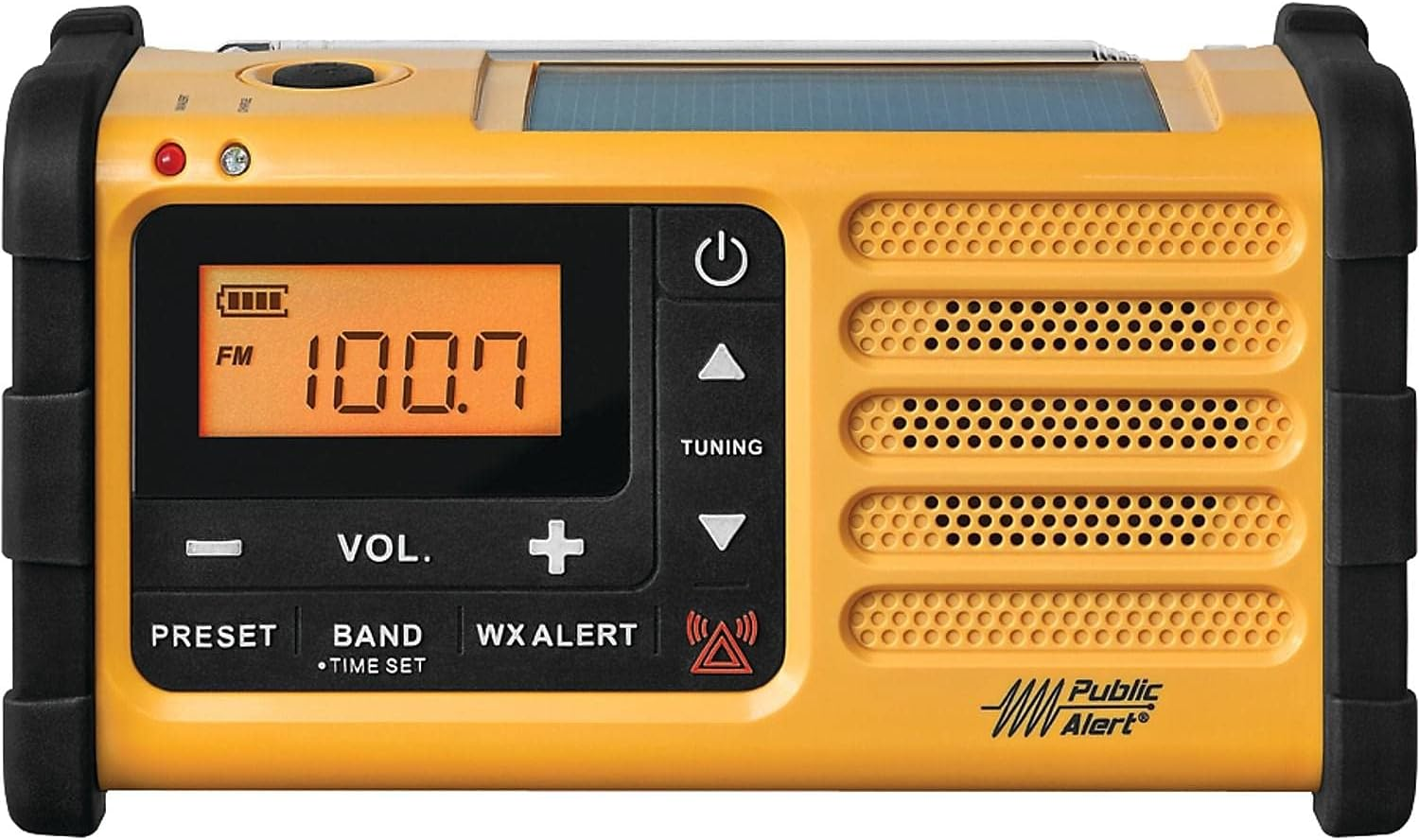
The Sangean MMR-88 delivers the strongest radio reception of any hand crank emergency radio tested, including in basements and parking structures.
What do you get with this emergency radio?
The MMR-88 prioritizes reception quality, build durability, and control clarity over raw battery size.
- NOAA weather alert: Automatic
- Battery: 850 mAh LFP (lithium iron phosphate), replaceable
- Hand crank output: 32 minutes of radio time from 1 minute of cranking
- Solar panel: Reaches half capacity after 6 hours of sunlight
- Display: Orange backlit screen
- Controls: Large side buttons with clear symbols and text labels
- Extras: AM/FM/WB bands, radio station presets, automatic power off after 90 minutes
- Price range: $68 to $85
The extendable antenna on the MMR-88 does most of the work for its reception advantage. According to independent testing, it's the only hand crank emergency radio that delivered a clear signal at 15 to 20 meters underground without connecting to external aids.
Sangean MMR-88 pros and cons
The MMR-88 is the right choice when reception reliability and durability matter more than maximum battery or phone charging capacity.
Pros
- Strongest underground and in structure reception of any model tested, including in deep parking structures
- Rubber end caps on all four corners absorb drops onto hard floors better than plain plastic housings
- Radio station presets let you access a stored NOAA station instantly during an emergency, no scanning needed
Cons
- The 850 mAh battery is the smallest capacity in this list. If you want to charge a phone from it, it drains quickly.
- Solar charging is slow. Six hours of sunlight gets you to about half charge under decent conditions.
Should you buy the Sangean MMR-88?
The Sangean MMR-88 is the right buy if reception and durability matter most to you. It's the only hand crank radio tested that holds a clear signal 15 to 20 meters underground. For basements, parking structures, and storm shelters, that reception advantage outweighs its smaller battery.
Buy it if:
- You need a radio that works in a basement, storm shelter, or parking structure where other models lose signal
- You want a rugged build, since the rubber corner bumpers and large labeled buttons hold up to drops and cold or wet hands
- Quick access to a stored NOAA station matters to you, since presets skip the scanning step
Skip it if:
- You want to charge a phone from the radio, where the 850 mAh battery is the smallest of the five and the RunningSnail MD-090P's 4,000 mAh battery does the job
- You're on a tight budget, where the FosPower Model A1 or RunningSnail MD-090P cost less
- You want the most charging methods in one unit, where the Midland ER310's four power sources beat the MMR-88's crank and solar combination
3. RunningSnail MD-090P
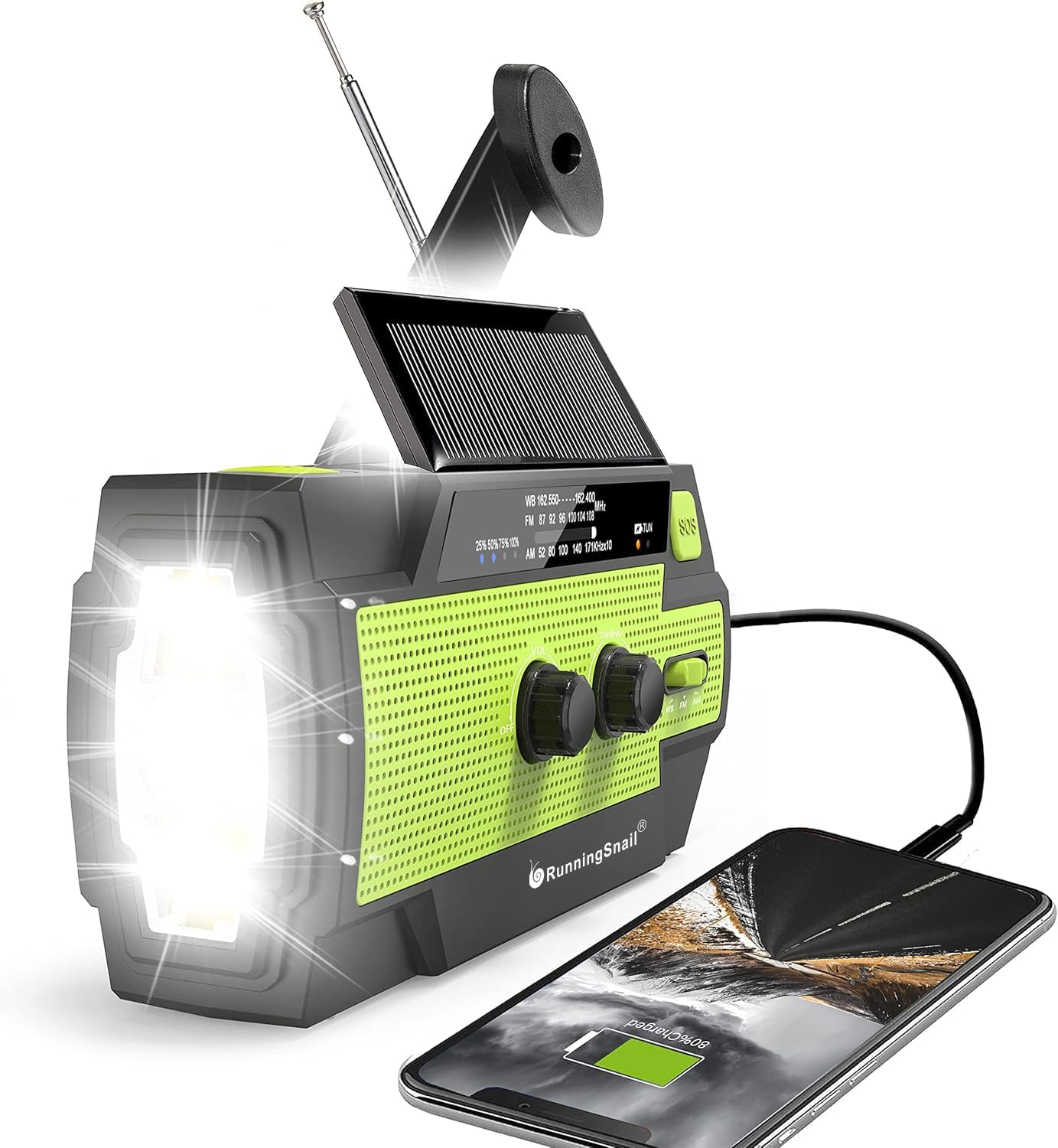
The RunningSnail MD-090P has the largest battery of any hand crank emergency radio tested, at 4,000 mAh. That's more than four times the Sangean MMR-88 and roughly 50% more than the Midland ER310.
What do you get with this emergency radio?
The MD-090P is built around battery capacity and USB phone charging output above everything else.
- NOAA reception: Weather band (manual tune required; no automatic alert)
- Battery: 4,000 mAh LFP, replaceable
- Charging methods: Hand crank, solar panel, USB input
- USB output: Charges external devices, including smartphones
- Bands: AM, FM, and NOAA weather stations
- Price range: $25 to $35
So the RunningSnail MD-090P is a weather band radio, not a weather alert radio. It picks up NOAA broadcast stations just fine, but it won't sound an automatic alarm when an emergency alert transmits. If you keep the radio on during severe weather, that's a pretty minor limitation. But if you need overnight alerts, you'd want the Midland ER310 or Midland ER40 instead.
RunningSnail MD-090P pros and cons
The MD-090P is the right call when phone charging capacity and multi day battery runtime matter more than automatic alert capability.
Pros
- 4,000 mAh battery can bring a depleted smartphone to about 80% charge while still powering the radio
- Lowest price of the five models at $25 to $35
- Replaceable LFP battery keeps the unit going strong after years of charge cycling
- Covers all three bands: AM, FM, and NOAA weather stations
Cons
- No automatic NOAA weather alert. The radio needs to be on and tuned to a NOAA station to receive emergency broadcasts.
- Manual tuning takes more steps than digital tuned competitors, which slows things down when you're stressed
Should you buy the RunningSnail MD-090P?
The RunningSnail MD-090P is the right buy if phone charging and multi day runtime matter more to you than automatic alerts. Its 4,000 mAh battery is the largest in this list and its $25 to $35 price is the lowest. For a vehicle kit or a second radio, that combination is hard to beat.
Buy it if:
- You want to keep a phone charged through a multi day outage, since the 4,000 mAh battery can bring a depleted phone to about 80% charge
- You're on a tight budget or want a backup radio for a vehicle or go bag, since this is the lowest priced of the five at $25 to $35
- You don't mind manually tuning to a NOAA station and keeping the radio on during severe weather
Skip it if:
- You need overnight automatic alerts, where the Midland ER310 or Midland ER40 sound an alarm without you tuning anything
- You want digital tuning instead of manual dial adjustment, where the Midland ER310 is faster under stress
- Reception in basements or structures is your priority, where the Sangean MMR-88 performs best
4. FosPower Model A1
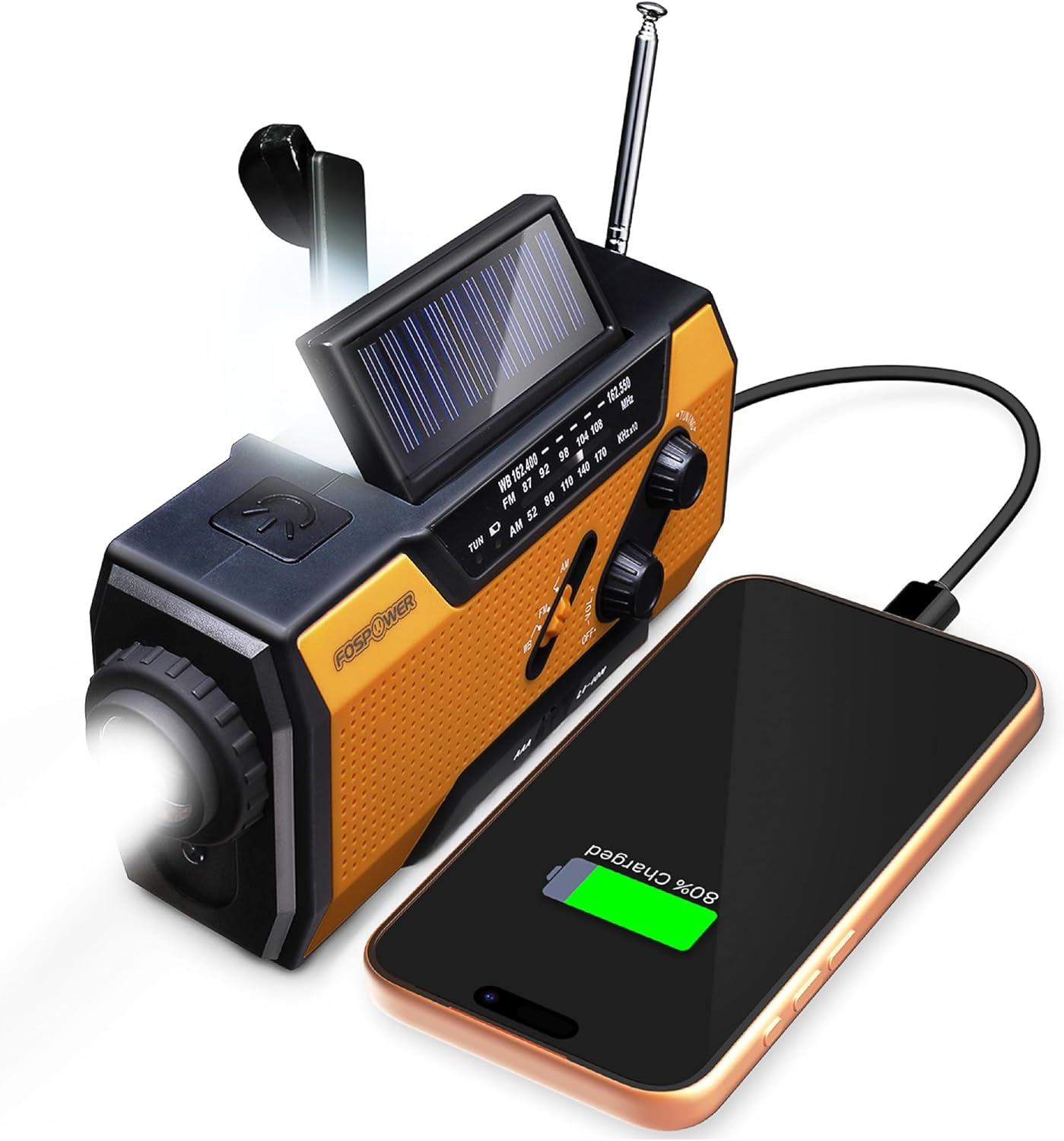
The FosPower Model A1 is the simplest emergency radio in this list. It's got manual analog tuner knobs, no digital menu system, and four independent charging methods.
What do you get with this emergency radio?
The Model A1 uses analog controls throughout, which gets rid of any menu navigation confusion during an emergency.
- NOAA reception: Weather band (manual tune; no automatic alert)
- Battery: Internal rechargeable battery with AA battery backup support
- Hand crank output: 32 minutes of radio time from 1 minute of cranking
- Charging methods: Hand crank, solar panel, USB input, AA batteries
- Controls: Physical analog frequency tuner knob, physical volume dial
- Flashlight: LED
- Price range: $25 to $40
Manual tuner knobs are a pretty practical advantage in high stress situations. Digital radios make you remember button sequences and menu paths. The FosPower Model A1's frequency knob turns, and the dial moves. Some emergency management professionals still recommend analog tuned receivers for household preparedness kits.
FosPower Model A1 pros and cons
The Model A1 is the best value if your household wants a reliable backup radio without digital menus or any kind of learning curve.
Pros
- Four charging methods give you solid redundancy: crank, solar, USB, and AA batteries
- 32 minutes from one minute of cranking matches the top performers in this list
- Physical dial controls work fine with wet or gloved hands
Cons
- No automatic NOAA weather alert. You have to manually tune to a NOAA frequency to receive emergency broadcasts.
- Analog tuning is less precise than digital. Finding the exact NOAA station takes a few extra seconds of dial adjustment.
Should you buy the FosPower Model A1?
The FosPower Model A1 is the right buy if your household wants a no learning curve backup radio. Its analog controls and four charging methods cover the basics for $25 to $40 with nothing to figure out under stress.
Buy it if:
- You want a radio any household member can operate without instructions, since the analog dials need no menu navigation
- You want charging redundancy on a budget, since crank, solar, USB, and AA batteries are all covered for $25 to $40
- Wet or gloved hands are a concern, since physical dials work better than touch controls in those conditions
Skip it if:
- You want automatic NOAA alerts, where the Midland ER310 or ER40 sound an alarm without manual tuning
- You want the largest possible battery for phone charging, where the RunningSnail MD-090P's 4,000 mAh battery does more
- Reception in basements or structures is your priority, where the Sangean MMR-88 performs best
5. Midland ER40
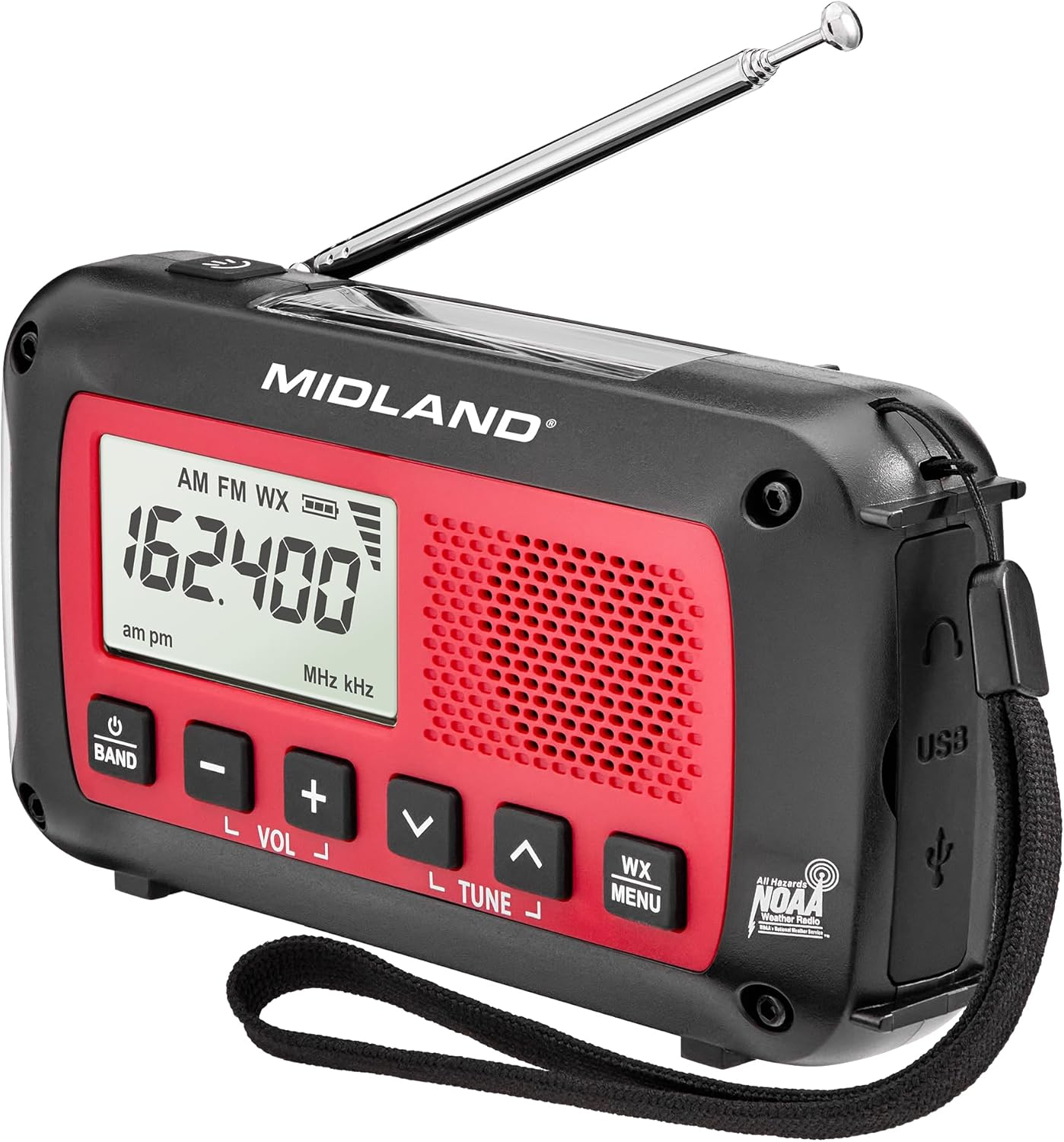
The Midland ER40 is a slimmer, cheaper alternative to the Midland ER310 that keeps the most important feature: automatic NOAA weather alerts.
What do you get with this emergency radio?
The ER40 delivers the ER310's core alert capability in a smaller, simpler unit.
- NOAA weather alert: Automatic; alerts in standby mode, no SAME county filtering
- Battery: 2,600 mAh rechargeable lithium ion, replaceable 18650 cell
- Charging methods: Hand crank, solar panel, micro USB
- USB output: Charges phones and small devices from the internal battery
- Flashlight: Low, high, and flashing SOS, with brightness adjustment to conserve battery
- Bands: AM, FM, and NOAA weather
- Size: 6.8 by 2 by 4.3 inches
- Extras: Wrist lanyard and micro USB charging cable included
- Price range: $55 to $60
The ER40 drops two things the ER310 has: the 6 AA battery fallback and the dog whistle. For most users, neither loss is a big deal.
Midland ER40 pros and cons
The ER40 gives you auto alert capability at $55 to $60, making it the best compact option for a go bag or a secondary household kit.
Pros
- Pros: Automatic NOAA weather alerts without manual tuning, the same standby alert capability as the ER310
- Owners report clear AM, FM, and weather band reception. One reviewer picks up a NOAA station 20 miles away without extending the antenna.
- The 18650 lithium ion battery is replaceable, so you can swap in a fresh cell instead of retiring the radio
Cons
- No AA battery fallback. If the internal battery depletes and neither the crank nor solar is available, the radio stops.
- One reviewer notes the alert tone sounds without opening the broadcast channel, so you still have to tune to the station to hear the alert details Charges over micro USB rather than USB-C, so it may need its own cable in a kit full of USB-C devices
Should you buy the Midland ER40?
The Midland ER40 is the right buy for a go bag or secondary radio. It carries the ER310's automatic NOAA alerts and a 2,600 mAh battery in a slimmer chassis for $55 to $60.
Buy it if:
- You want automatic NOAA alerts in a compact unit that slips into a pocket or go bag
- You want the ER310's alert capability for less money and don't need the 6 AA battery fallback or dog whistle
- A replaceable battery matters to you, since the ER40's 18650 cell can be swapped when it wears out
Skip it if:
- You want the AA battery fallback for long outages with no sun and no cranking, where the Midland ER310 covers that scenario
- You're on a tight budget, where the FosPower Model A1 or RunningSnail MD-090P cost less
- Phone charging capacity is your priority, where the RunningSnail MD-090P's 4,000 mAh battery does more
How we ranked these emergency radios
We ranked these radios for one specific situation: a power outage. We combined verified consumer reviews, published third party test results, and manufacturer specs, then weighted everything against what PowerOutage.us outage data says people actually deal with when the grid goes down.
Here's what mattered most, in order:
- Works without electricity. This got the heaviest weight. A radio's value during a power outage comes down to whether it stays usable when wall power disappears, so automatic NOAA alert capability and the number of independent charging methods (hand crank, solar, USB, AA batteries) carried the most weight.
- Outage duration fit. PowerOutage.us tracks outages across 950-plus utilities in real time, and that data shaped our duration assumptions. The average U.S. customer lost power for around 11 hours in 2024, but hurricane affected households like those in South Carolina waited nearly 53 hours, and some North Carolina communities went 14 or more days without restoration. We favored radios that scale from a short overnight outage to a multi day event.
- Consumer reviews and published tests. We leaned on independent testing data and aggregated buyer reviews. That's why the Sangean MMR-88 holds the reception crown here, and why we attribute its underground signal performance to independent testing rather than claiming we tried it ourselves.
- Hand crank efficiency and battery capacity. We compared minutes of radio time per minute of cranking (26 to 32 minutes across the models that publish it) and battery capacity (850 mAh to 4,000 mAh), since both determine how long a radio keeps working without wall power.
- Ease of use under stress. Automatic alert buttons, analog dials, and labeled controls all score better here than menu driven digital interfaces, since a radio that's hard to operate in a panic doesn't help during an emergency.
- Cost. Price ranges run from $25 at the low end to $90 at the high end, and we weighed value against what each radio actually delivers for that price.
How to choose a NOAA weather radio for a power outage
Choosing the right emergency radio for a power outage comes down to one decision: whether you need automatic alert capability or whether a manual tune weather band receiver is enough.
Do you need automatic alerts, or is a weather band radio enough?
A weather alert radio is the right choice if you want emergency broadcasts to wake you up automatically. It activates the moment the National Weather Service transmits an alert for your area, even when the radio's in standby mode. A weather band radio can receive the same NOAA broadcasts, but only if it's already on and tuned to the correct frequency when the alert transmits.
The National Weather Service operates NOAA Weather Radio All Hazards as a continuous 24 hour broadcast network covering all 50 states. It covers weather emergencies, natural disasters, technological hazards like chemical releases, and national emergencies. For a power outage during a hurricane or severe thunderstorm, an auto alert radio gives you a safety layer a weather band radio can't. It wakes you up and sounds an alarm.
FEMA's Ready.gov lists both a battery powered radio and a NOAA Weather Radio with tone alert as separate items in the basic emergency supply kit. It draws a clear line between general AM/FM use and auto alert capability, so those are treated as two different needs.
Is hand crank charging enough to rely on, or do you need solar and USB too?
A hand crank alone covers short, occasional use. One minute of cranking produces 26 to 32 minutes of radio listening time on the radios in this list that publish crank output figures. That's enough for a quick situation update during the first minutes of a power outage, but not enough to run the radio continuously through a multi hour event.
The practical approach is to crank for one or two minutes each hour to maintain the battery level rather than starting from zero and trying to crank to full charge. Ten minutes of sustained cranking on most models gets you roughly one hour of combined radio and flashlight operation. Keep the radio's internal battery charged from wall power between outages so the crank serves as a top up, not the primary energy source.
What battery capacity matters for a multi-day power outage?
Battery capacity in emergency radios ranges from 850 mAh to 4,000 mAh across the five models in this list. For radio only use, even 850 mAh delivers more than a day of intermittent listening. The capacity difference starts to matter when you're using the radio to charge a phone.
EIA data shows U.S. customers averaged 11 hours without power in 2024, with Hurricanes Beryl, Helene, and Milton accounting for 80% of those outage hours. South Carolina customers averaged nearly 53 hours without power that year. For multi day outage scenarios in hurricane prone states, a radio with 2,600 mAh or higher and a USB-A charging output is a reasonable minimum.
Which extra features are worth paying for?
Beyond NOAA capability and battery capacity, a few more features are worth checking before you buy:
- SAME county filtering: Specific Area Message Encoding lets you program the radio with your county's FIPS code. The radio then alerts only for events affecting your specific county, cutting down on false alarms from distant events. Midland's product comparison data shows none of the hand crank models in this list include SAME; it's a feature of dedicated desktop weather alert radios like Midland's WR series. You can find your county FIPS code at weather.gov.
- USB device charging output: A radio with a USB-A output port can charge a phone or small device from its internal battery. This is different from USB input charging, which charges the radio from an external source.
- Flashlight modes: All five models include an LED flashlight, and it's worth having a light with at least two brightness settings.
If you're building a full power outage emergency kit, an emergency radio covers the communications layer. Pair it with a portable power station for device charging and a dedicated LED lantern for room level lighting.
How long of an outage should your emergency radio cover?
Power outage duration in the U.S. varies sharply by state, storm type, and local infrastructure, so the radio that fits a quick thunderstorm outage isn't necessarily the one that gets you through a hurricane. The national average doesn't tell the full story. EIA data from 2024 shows U.S. electricity customers averaged 11 hours without power that year, nearly double the decade average before 2024.
Hurricane outages drove most of that increase. Hurricane Helene left 4.79 million customers without power across 10 states according to PowerOutage.us tracking data, with western North Carolina mountain communities going 14 or more days without restoration. South Carolina customers averaged nearly 53 hours without power in 2024, the highest state average in the country.
Winter storms produce similar durations in different regions. During Winter Storm Fern in January 2026, PowerOutage.us tracked over 1,005,641 customers at peak impact, with hardest hit areas in Tennessee going six or more days without restoration. Ice accumulation snapped transmission lines across a 2,000-mile corridor from New Mexico to New England.
Quick recap
To recap, the Midland ER310 is the best emergency radio for power outages. It combines automatic NOAA weather alerts, four charging methods, and a 2,600 mAh battery in one unit. The Sangean MMR-88 leads in reception and durability. The RunningSnail MD-090P offers the largest battery at the lowest price if you mainly want phone charging capacity during extended outages.